Question: Item 1 In the case below, the original source material is given along with a sample of student work. Determine the type of plagiarism by
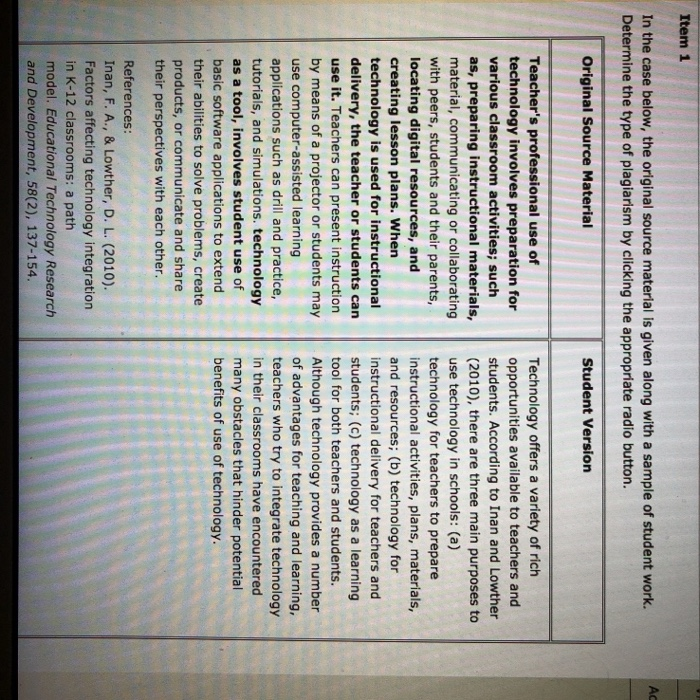
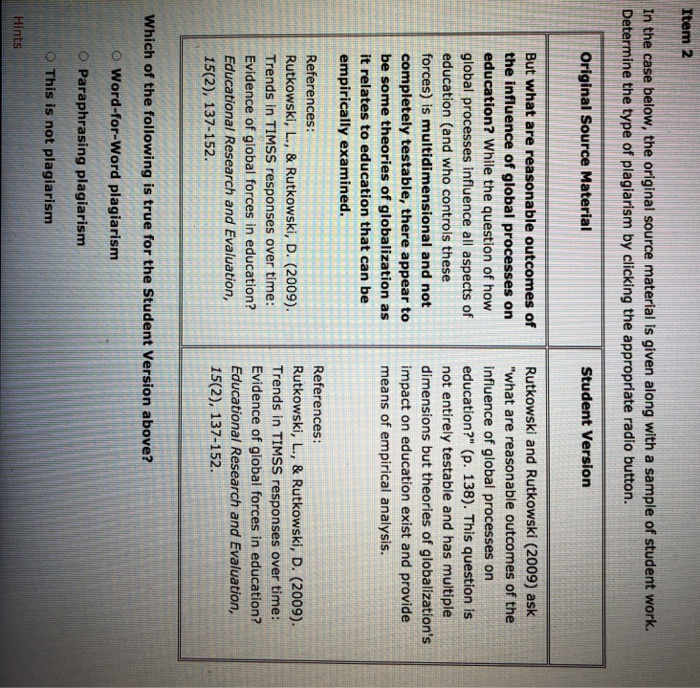
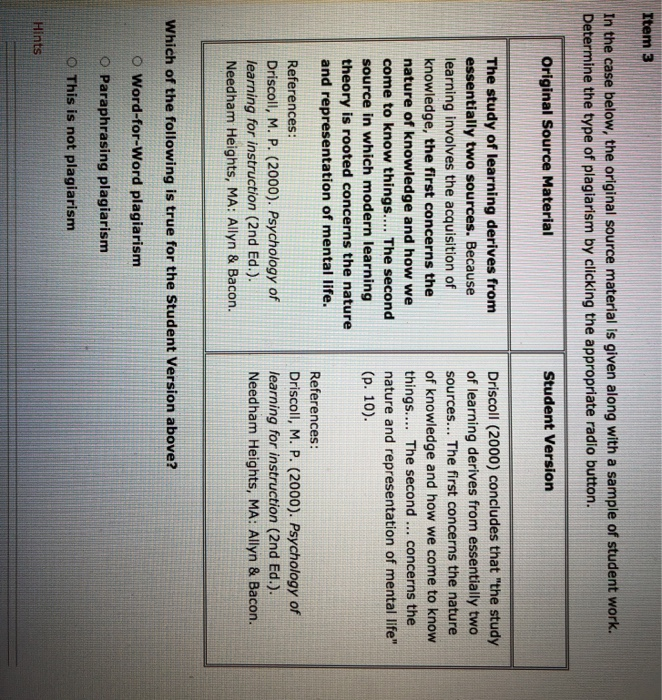
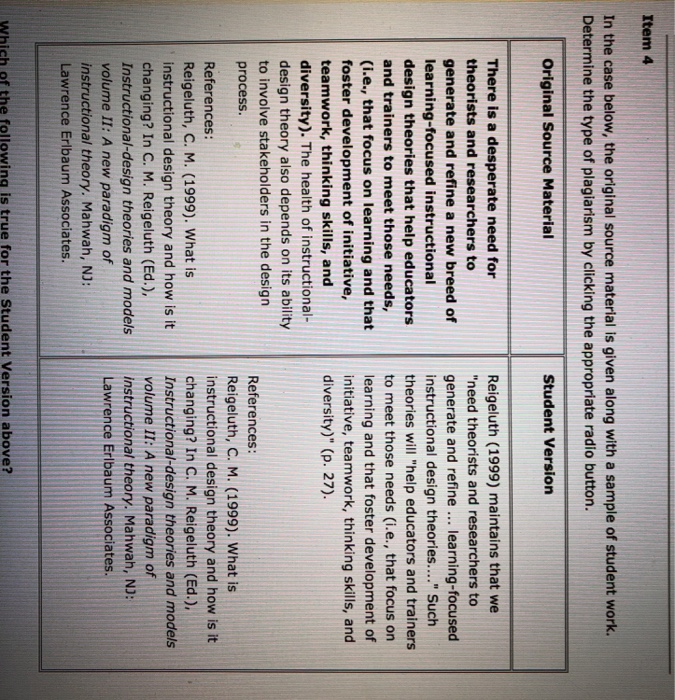
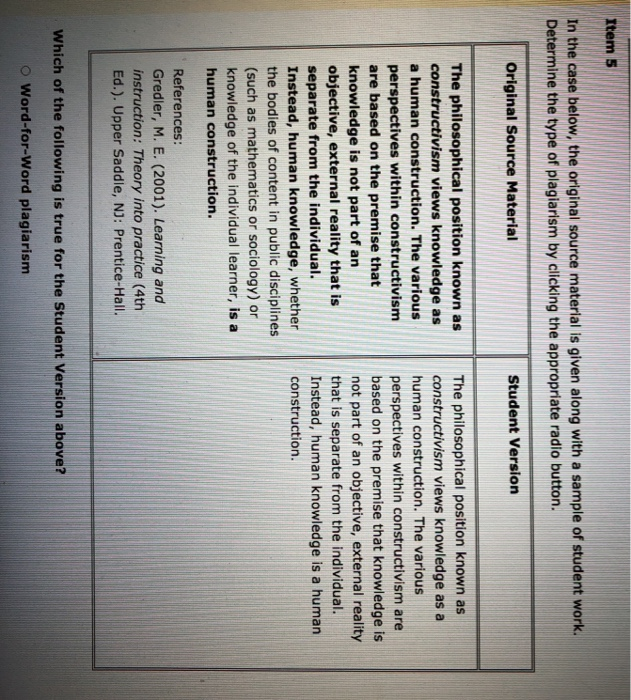
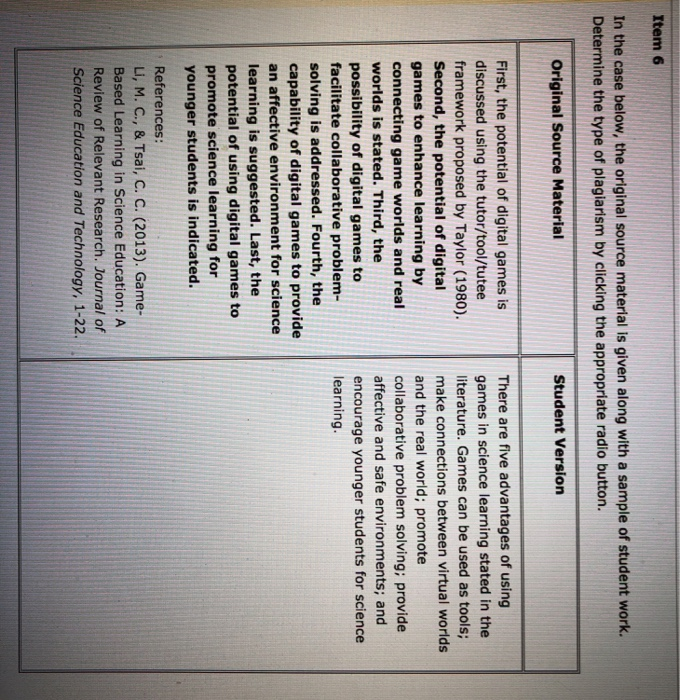
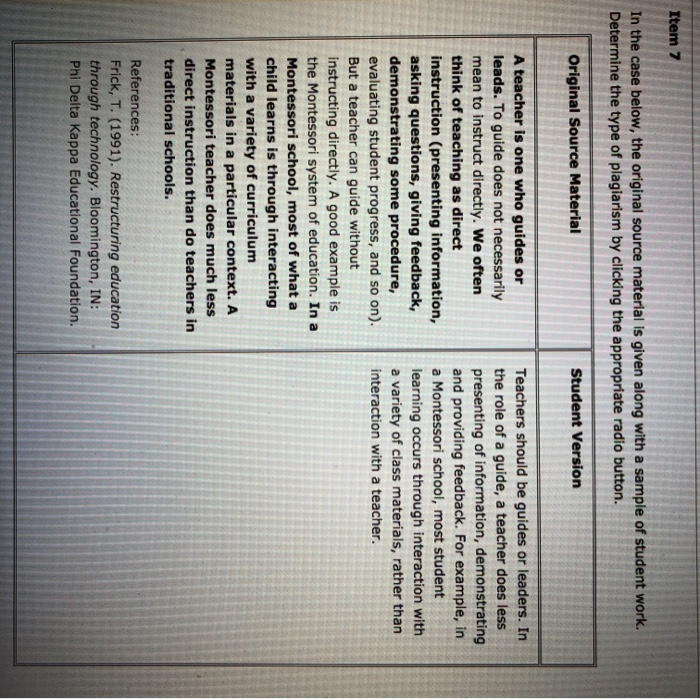
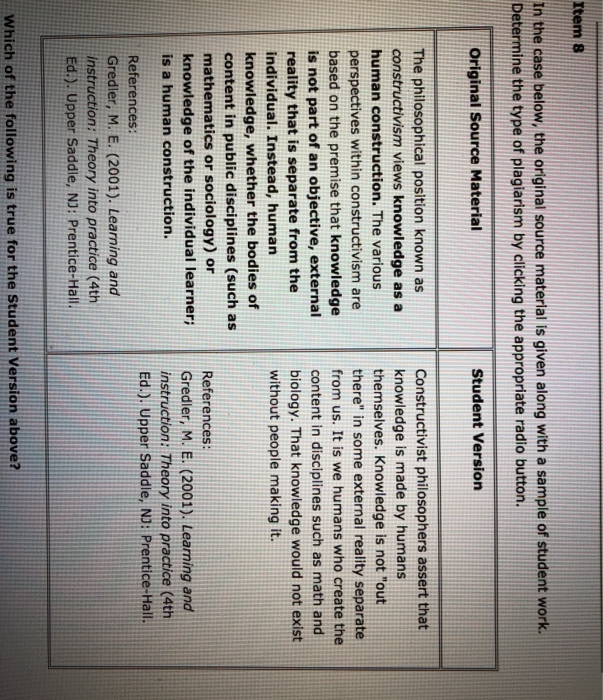
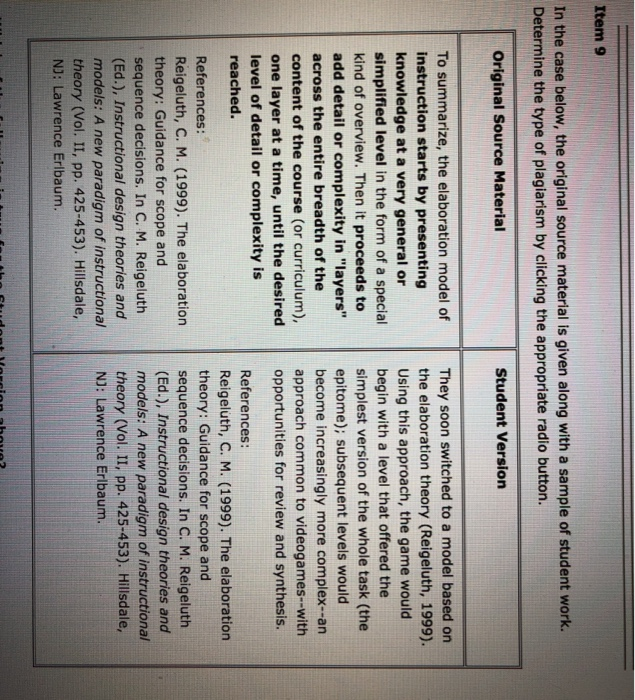
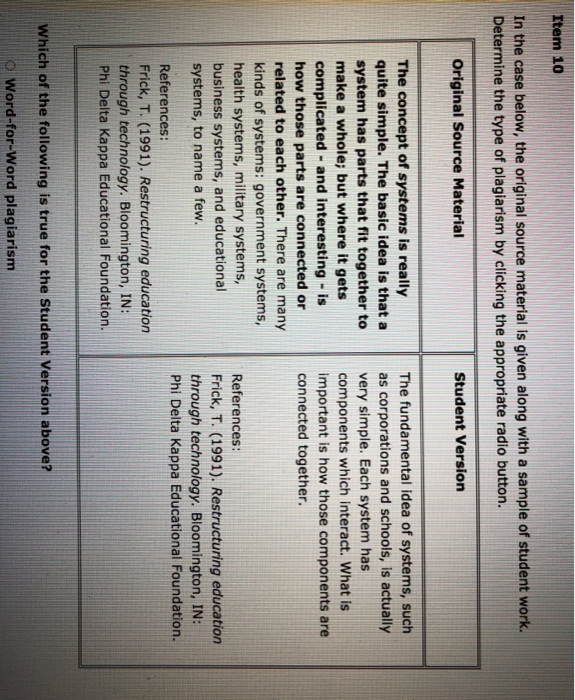
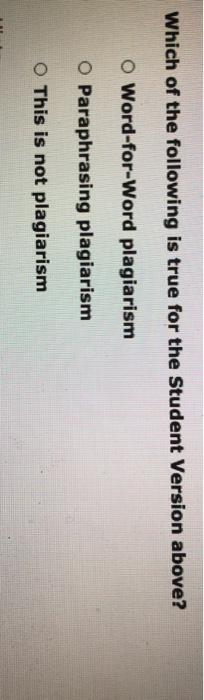
Item 1 In the case below, the original source material is given along with a sample of student work. Determine the type of plagiarism by clicking the appropriate radio button. Original Source Material Student Version Teacher's professional use of technology involves preparation for various classroom activities, such as, preparing instructional materials, material, communicating or collaborating with peers, students and their parents, locating digital resources, and creating lesson plans. When technology is used for instructional delivery, the teacher or students can use it. Teachers can present instruction by means of a projector or students may use computer-assisted learning applications such as drill and practice, tutorials, and simulations, technology as a tool, involves student use of basic software applications to extend their abilities to solve problems, create products, or communicate and share their perspectives with each other. Technology offers a variety of rich opportunities available to teachers and students. According to Inan and Lowther (2010), there are three main purposes to use technology in schools: (a) technology for teachers to prepare instructional activities, plans, materials, and resources; (b) technology for instructional delivery for teachers and students; (c) technology as a learning tool for both teachers and students. Although technology provides a number of advantages for teaching and learning, teachers who try to integrate technology in their classrooms have encountered many obstacles that hinder potential benefits of use of technology. References: Inan, F. A., & Lowther, D. L. (2010). Factors affecting technology integration in K-12 classrooms: a path model. Educational Technology Research and Development, 58(2), 137-154. Item 2 In the case below, the original source material is given along with a sample of student work. Determine the type of plagiarism by clicking the appropriate radio button. Original Source Material Student Version But what are reasonable outcomes of the influence of global processes on education? While the question of how global processes influence all aspects of education (and who controls these forces) is multidimensional and not completely testable, there appear to be some theories of globalization as it relates to education that can be empirically examined. Rutkowski and Rutkowski (2009) ask "what are reasonable outcomes of the influence of global processes on education?" (p. 138). This question is not entirely testable and has multiple dimensions but theories of globalization's impact on education exist and provide means of empirical analysis. References: Rutkowski, L., & Rutkowski, D. (2009). Trends in TIMSS responses over time: Evidence of global forces in education? Educational Research and Evaluation, 15(2), 137-152. References: Rutkowski, L., & Rutkowski, D. (2009) Trends in TIMSS responses over time: Evidence of global forces in education? Educational Research and Evaluation, 15(2), 137-152. Which of the following is true for the Student Version above? O Word-for-Word plagiarism O Paraphrasing plagiarism O This is not plagiarism Hints Item 3 In the case below, the original source material is given along with a sample of student work. Determine the type of plagiarism by clicking the appropriate radio button. Original Source Material Student Version The study of learning derives from essentially two sources. Because learning involves the acquisition of knowledge, the first concerns the nature of knowledge and how we come to know things.... The second source in which modern learning theory is rooted concerns the nature and representation of mental life. Driscoll (2000) concludes that "the study of learning derives from essentially two sources... The first concerns the nature of knowledge and how we come to know things.... The second ... concerns the nature and representation of mental life" (p. 10). References: Driscoll, M. P. (2000). Psychology of learning for instruction (2nd Ed.). Needham Heights, MA: Allyn & Bacon. References: Driscoll, M. P. (2000). Psychology of learning for instruction (2nd Ed.). Needham Heights, MA: Allyn & Bacon. Which of the following is true for the Student Version above? O Word-for-Word plagiarism O Paraphrasing plagiarism O This is not plagiarism Hints Item 4 In the case below, the original source material is given along with a sample of student work. Determine the type of plagiarism by clicking the appropriate radio button. Original Source Material Student Version There is a desperate need for theorists and researchers to generate and refine a new breed of learning-focused instructional design theories that help educators and trainers to meet those needs, (i.e., that focus on learning and that foster development of initiative, teamwork, thinking skills, and diversity). The health of instructional- design theory also depends on its ability to involve stakeholders in the design process. Reigeluth (1999) maintains that we "need theorists and researchers to generate and refine ... learning-focused instructional design theories...." Such theories will "help educators and trainers to meet those needs (i.e., that focus on learning and that foster development of initiative, teamwork, thinking skills, and diversity)" (p. 27). References: Reigeluth, C. M. (1999). What is instructional design theory and how is it changing? In C. M. Reigeluth (Ed.), Instructional-design theories and models volume II: A new paradigm of instructional theory. Mahwah, NJ: Lawrence Erlbaum Associates. References: Reigeluth, C. M. (1999). What is instructional design theory and how is it changing? In C. M. Reigeluth (Ed.), Instructional-design theories and models volume II: A new paradigm of instructional theory. Mahwah, NJ: Lawrence Erlbaum Associates. of the following is true for the Student Version above? Item 5 In the case below, the original source material is given along with a sample of student work. Determine the type of plagiarism by clicking the appropriate radio button. Original Source Material Student Version The philosophical position known as constructivism views knowledge as a human construction. The various perspectives within constructivism are based on the premise that knowledge is not part of an objective, external reality that is separate from the individual. Instead, human knowledge, whether the bodies of content in public disciplines (such as mathematics or sociology) or knowledge of the individual learner, is a human construction. The philosophical position known as constructivism views knowledge as a human construction. The various perspectives within constructivism are based on the premise that knowledge is not part of an objective, external reality that is separate from the individual. Instead, human knowledge is a human construction. References: Gredler, M. E. (2001). Learning and instruction: Theory into practice (4th Ed.). Upper Saddle, NJ: Prentice-Hall. Which of the following is true for the Student Version above? O Word-for-Word plagiarism Item 6 In the case below, the original source material is given along with a sample of student work. Determine the type of plagiarism by clicking the appropriate radio button. Original Source Material Student Version First, the potential of digital games is discussed using the tutor/tool/tutee framework proposed by Taylor (1980). Second, the potential of digital games to enhance learning by connecting game worlds and real worlds is stated. Third, the possibility of digital games to facilitate collaborative problem- solving is addressed. Fourth, the capability of digital games to provide an affective environment for science learning is suggested. Last, the potential of using digital games to promote science learning for younger students is indicated. There are five advantages of using games in science learning stated in the literature. Games can be used as tools; make connections between virtual worlds and the real world; promote collaborative problem solving; provide affective and safe environments; and encourage younger students for science learning. References: L, M, C., & Tsai, C. C. (2013). Game- Based Learning in Science Education: A Review of Relevant Research. Journal of Science Education and Technology, 1-22. Item 7 In the case below, the original source material is given along with a sample of student work. Determine the type of plagiarism by clicking the appropriate radio button. Original Source Material Student Version Teachers should be guides or leaders. In the role of a guide, a teacher does less presenting of information, demonstrating and providing feedback. For example, in a Montessori school, most student learning occurs through interaction with a variety of class materials, rather than interaction with a teacher. A teacher is one who guides or leads. To guide does not necessarily mean to instruct directly. We often think of teaching as direct instruction (presenting information, asking questions, giving feedback, demonstrating some procedure, evaluating student progress, and so on). But a teacher can guide without instructing directly. A good example is the Montessori system of education. In a Montessori school, most of what a child learns is through interacting with a variety of curriculum materials in a particular context. A Montessori teacher does much less direct instruction than do teachers in traditional schools. References: Frick, T. (1991). Restructuring education through technology. Bloomington, IN: Phi Delta Kappa Educational Foundation, Item 8 In the case below, the original source material is given along with a sample of student work. Determine the type of plagiarism by clicking the appropriate radio button. Original Source Material Student Version The philosophical position known as constructivism views knowledge as a human construction. The various perspectives within constructivism are based on the premise that knowledge is not part of an objective, external reality that is separate from the individual. Instead, human knowledge, whether the bodies of content in public disciplines (such as mathematics or sociology) or knowledge of the individual learner; is a human construction. Constructivist philosophers assert that knowledge is made by humans themselves. Knowledge is not "out there" in some external reality separate from us. It is we humans who create the content in disciplines such as math and biology. That knowledge would not exist without people making it. References: Gredler, M. E. (2001). Learning and instruction: Theory into practice (4th Ed.). Upper Saddle, NJ: Prentice-Hall. References: Gredler, M. E. (2001). Learning and instruction: Theory into practice (4th Ed.). Upper Saddle, NJ: Prentice-Hall. Which of the following is true for the Student Version above? Item 9 In the case below, the original source material is given along with a sample of student work. Determine the type of plagiarism by clicking the appropriate radio button. Original Source Material Student Version To summarize, the elaboration model of instruction starts by presenting knowledge at a very general or simplified level in the form of a special kind of overview. Then it proceeds to add detail or complexity in "layers" across the entire breadth of the content of the course (or curriculum), one layer at a time, until the desired level of detail or complexity is reached. They soon switched to a model based on the elaboration theory (Reigeluth, 1999). Using this approach, the game would begin with a level that offered the simplest version of the whole task (the epitome); subsequent levels would become increasingly more complex--an approach common to videogames--with opportunities for review and synthesis. References: Reigeluth, C. M. (1999). The elaboration theory: Guidance for scope and sequence decisions. In C. M. Reigeluth (Ed.), Instructional design theories and models: A new paradigm of instructional theory (Vol. II, pp. 425-453). Hillsdale, NJ: Lawrence Erlbaum. References: Reigeluth, C. M. (1999). The elaboration theory: Guidance for scope and sequence decisions. In C. M. Reigeluth (Ed.), Instructional design theories and models: A new paradigm of instructional theory (Vol. II, pp. 425-453). Hillsdale, NJ: Lawrence Erlbaum. Item 10 In the case below, the original source material is given along with a sample of student work. Determine the type of plagiarism by clicking the appropriate radio button. Original Source Material Student Version The concept of systems is really quite simple. The basic idea is that a system has parts that fit together to make a whole; but where it gets complicated - and interesting - is how those parts are connected or related to each other. There are many kinds of systems: government systems, health systems, military systems, business systems, and educational systems, to name a few. The fundamental idea of systems, such as corporations and schools, is actually very simple. Each system has components which interact. What is important is how those components are connected together. References: Frick, T. (1991). Restructuring education through technology. Bloomington, IN: Phi Delta Kappa Educational Foundation. References: Frick, T. (1991). Restructuring education through technology. Bloomington, IN: Phi Delta Kappa Educational Foundation. Which of the following is true for the Student Version above? o Word-for-Word plagiarism Which of the following is true for the Student Version above? O Word-for-Word plagiarism O Paraphrasing plagiarism O This is not plagiarism









 Study Help