Question: Item 1 In the case below, the original source material is given along with a sample of student work. Determine the type of plagiarism by
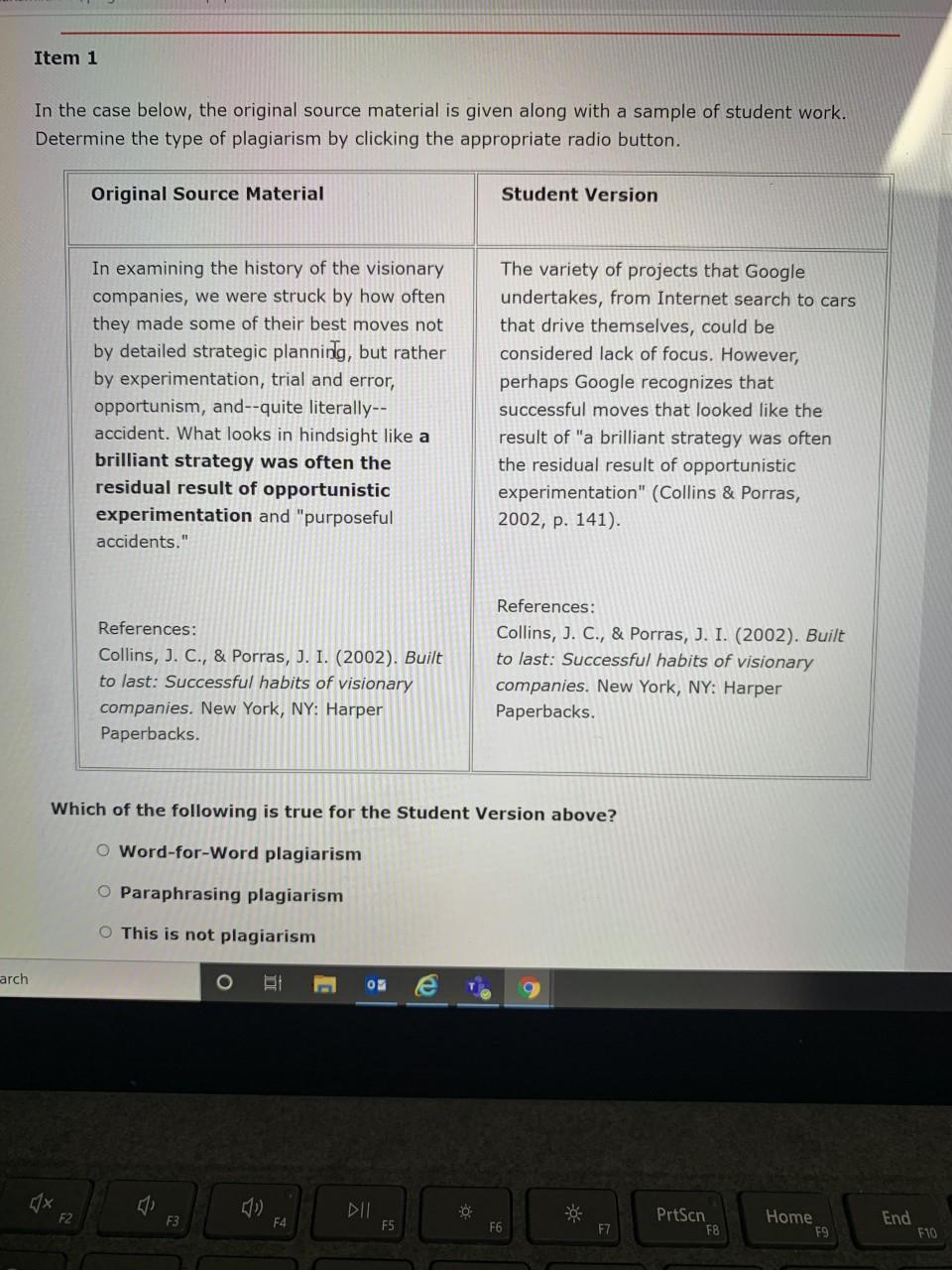
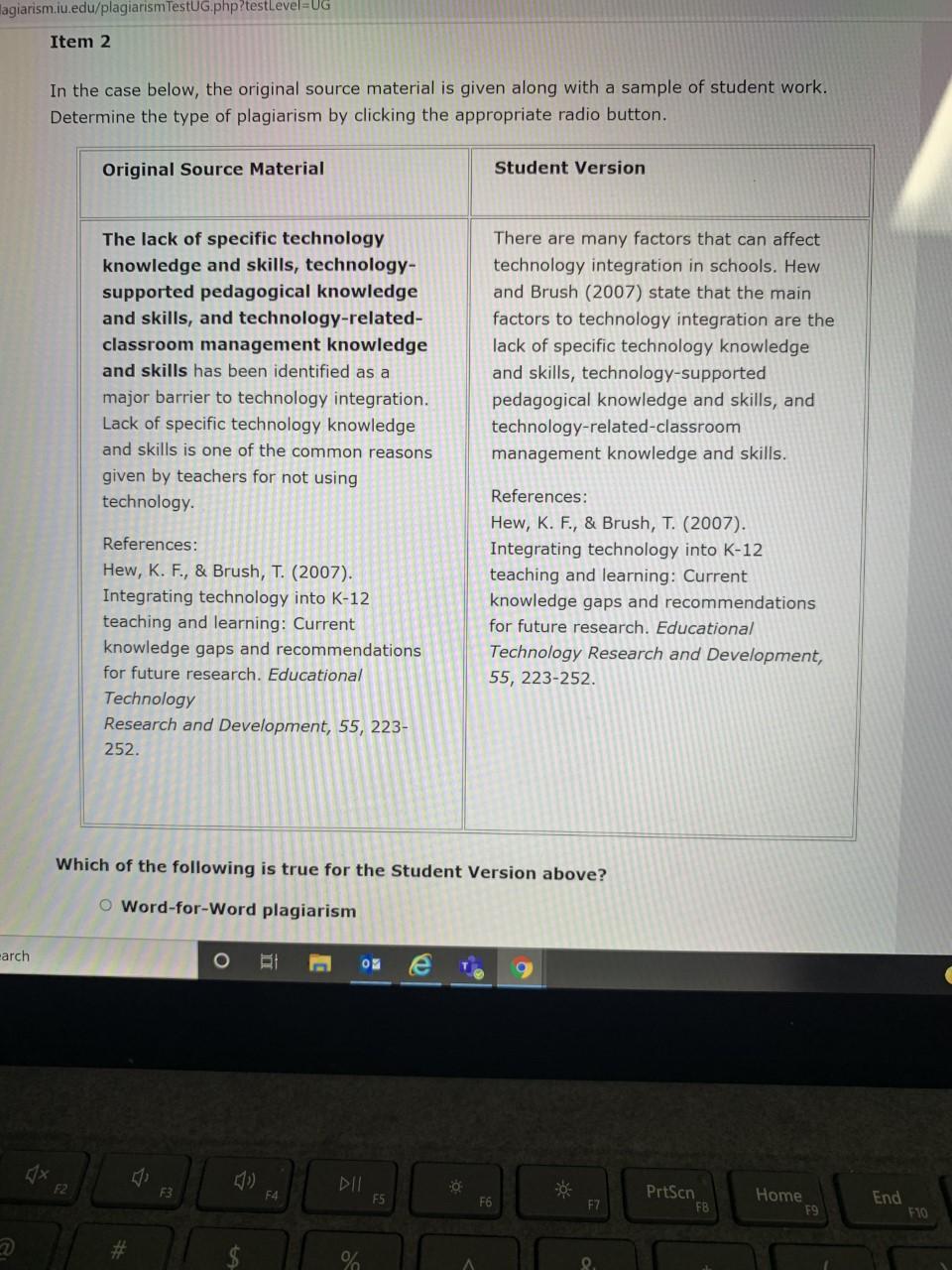
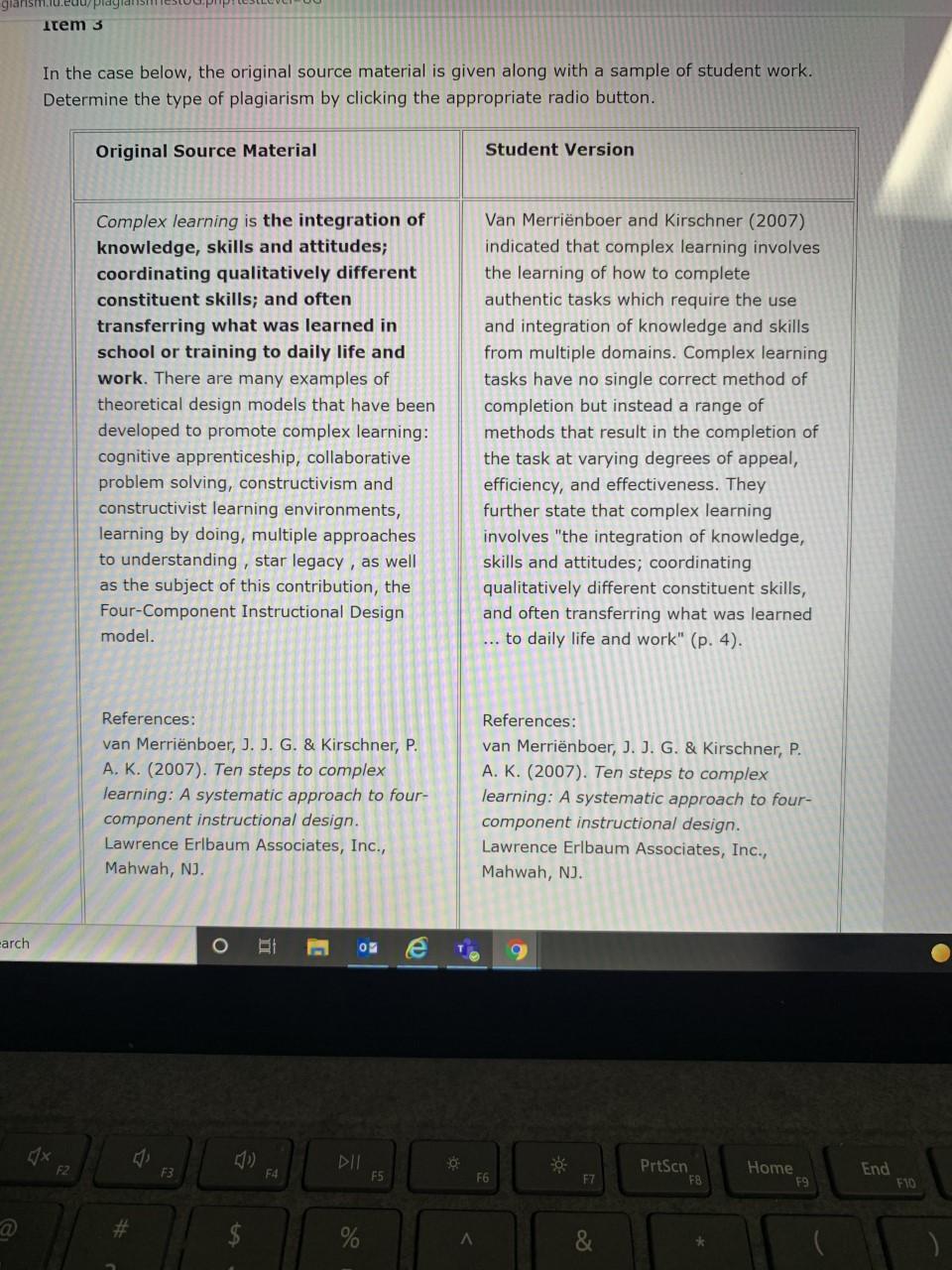
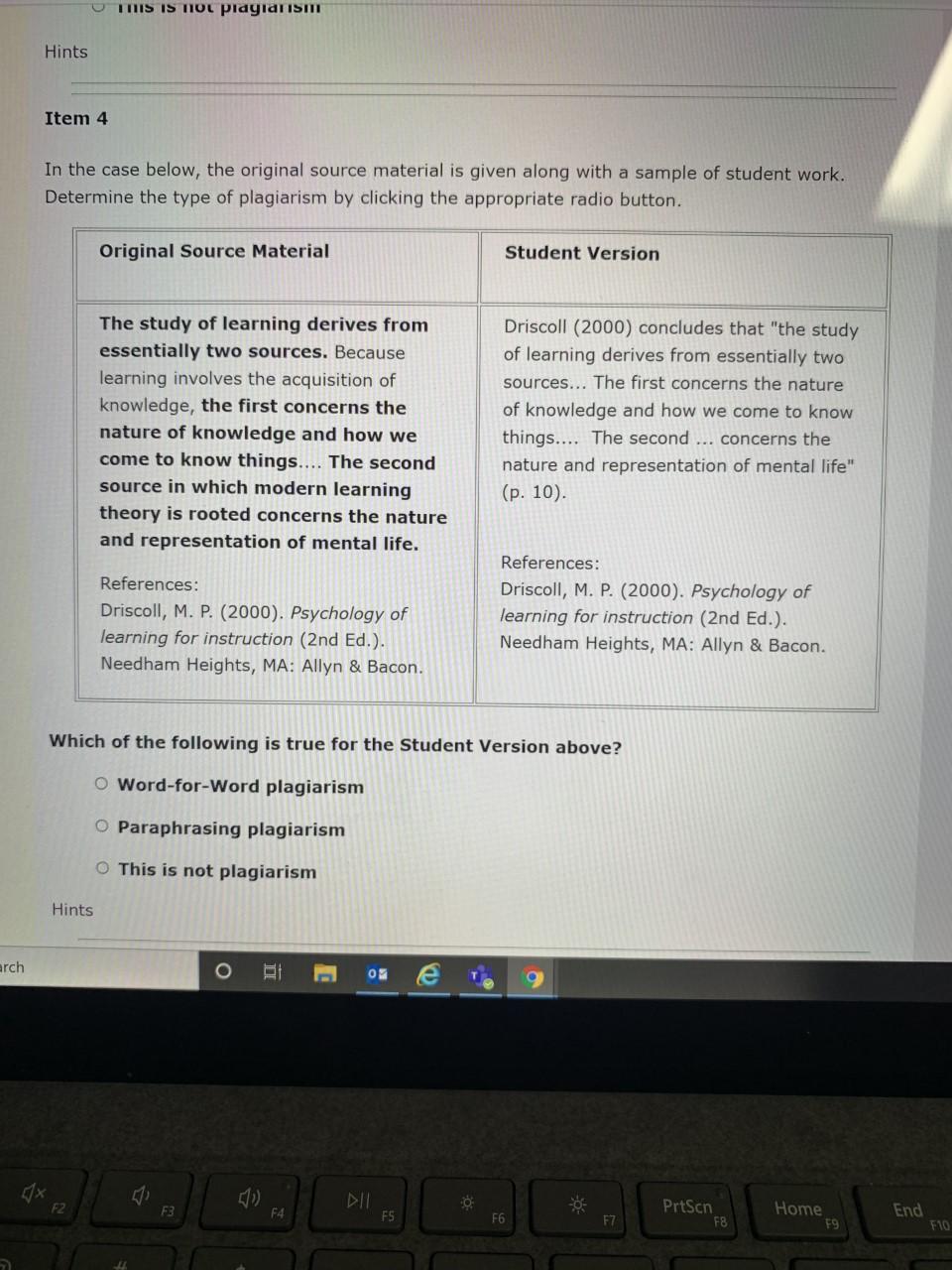
Item 1 In the case below, the original source material is given along with a sample of student work. Determine the type of plagiarism by clicking the appropriate radio button. Original Source Material Student Version In examining the history of the visionary companies, we were struck by how often they made some of their best moves not by detailed strategic planning, but rather by experimentation, trial and error, opportunism, and--quite literally-- accident. What looks in hindsight like a brilliant strategy was often the residual result of opportunistic experimentation and "purposeful accidents." The variety of projects that Google undertakes, from Internet search to cars that drive themselves, could be considered lack of focus. However, perhaps Google recognizes that successful moves that looked like the result of "a brilliant strategy was often the residual result of opportunistic experimentation" (Collins & Porras, 2002, p. 141). References: Collins, J. C., & Porras, J. I. (2002). Built to last: Successful habits of visionary companies. New York, NY: Harper Paperbacks. References: Collins, J. C., & Porras, J. I. (2002). Built to last: Successful habits of visionary companies. New York, NY: Harper Paperbacks. Which of the following is true for the Student Version above? O Word-for-Word plagiarism O Paraphrasing plagiarism This is not plagiarism arch 03 e x DIL F2 0 F3 F4 PrtScn F8 F5 End F6 Home F9 F7 F10 lagiarism.iu.edu/plagiarism TestUG.php?testlevel=UG Item 2 In the case below, the original source material is given along with a sample of student work. Determine the type of plagiarism by clicking the appropriate radio button. Original Source Material Student Version The lack of specific technology knowledge and skills, technology- supported pedagogical knowledge and skills, and technology-related- classroom management knowledge and skills has been identified as a major barrier to technology integration. Lack of specific technology knowledge and skills is one of the common reasons given by teachers for not using technology. There are many factors that can affect technology integration in schools. Hew and Brush (2007) state that the main factors to technology integration are the lack of specific technology knowledge and skills, technology-supported pedagogical knowledge and skills, and technology-related-classroom management knowledge and skills. References: Hew, K. F., & Brush, T. (2007). Integrating technology into K-12 teaching and learning: Current knowledge gaps and recommendations for future research. Educational Technology Research and Development, 55, 223- 252. References: Hew, K. F., & Brush, T. (2007). Integrating technology into K-12 teaching and learning: Current knowledge gaps and recommendations for future research. Educational Technology Research and Development, 55, 223-252. Which of the following is true for the Student Version above? O Word-for-Word plagiarism arch 07 e F2 F3 DI 0 F4 F5 F6 PrtScn FB Home F9 End F7 F10 % A 8. Item 3 In the case below, the original source material is given along with a sample of student work. Determine the type of plagiarism by clicking the appropriate radio button. Original Source Material Student Version Complex learning is the integration of knowledge, skills and attitudes; coordinating qualitatively different constituent skills; and often transferring what was learned in school or training to daily life and work. There are many examples of theoretical design models that have been developed to promote complex learning: cognitive apprenticeship, collaborative problem solving, constructivism and constructivist learning environments, learning by doing, multiple approaches to understanding, star legacy, as well as the subject of this contribution, the Four-Component Instructional Design model. Van Merrinboer and Kirschner (2007) indicated that complex learning involves the learning of how to complete authentic tasks which require the use and integration of knowledge and skills from multiple domains. Complex learning tasks have no single correct method of completion but instead a range of methods that result in the completion of the task at varying degrees of appeal, efficiency, and effectiveness. They further state that complex learning involves "the integration of knowledge, skills and attitudes; coordinating qualitatively different constituent skills, and often transferring what was learned ... to daily life and work" (p. 4). References: van Merrienboer, J. J. G. & Kirschner, P. A. K. (2007). Ten steps to complex learning: A systematic approach to four- component instructional design. Lawrence Erlbaum Associates, Inc., Mahwah, NJ. References: van Merrinboer, J. J. G. & Kirschner, P. A. K. (2007). Ten steps to complex learning: A systematic approach to four- component instructional design. Lawrence Erlbaum Associates, Inc., Mahwah, NJ. arch 07 e As DIL F2 - - F3 F4 PrtScn F8 F5 End Home 19 F6 F7 F10 @ $ A & U THIS IS HOL plagiarism Hints Item 4 In the case below, the original source material is given along with a sample of student work. Determine the type of plagiarism by clicking the appropriate radio button. Original Source Material Student Version The study of learning derives from essentially two sources. Because learning involves the acquisition of knowledge, the first concerns the nature of knowledge and how we come to know things.... The second source in which modern learning theory is rooted concerns the nature and representation of mental life. Driscoll (2000) concludes that "the study of learning derives from essentially two sources... The first concerns the nature of knowledge and how we come to know things.... The second ... concerns the nature and representation of mental life" (p. 10). References: Driscoll, M. P. (2000). Psychology of learning for instruction (2nd Ed.). Needham Heights, MA: Allyn & Bacon. References: Driscoll, M. P. (2000). Psychology of learning for instruction (2nd Ed.). Needham Heights, MA: Allyn & Bacon. Which of the following is true for the Student Version above? O Word-for-Word plagiarism O Paraphrasing plagiarism This is not plagiarism Hints arch o . E 07 * 7 DIL F2 0 F3 Prtsen F4 FS Home F9 End F6 F7 F8 FA









 Study Help