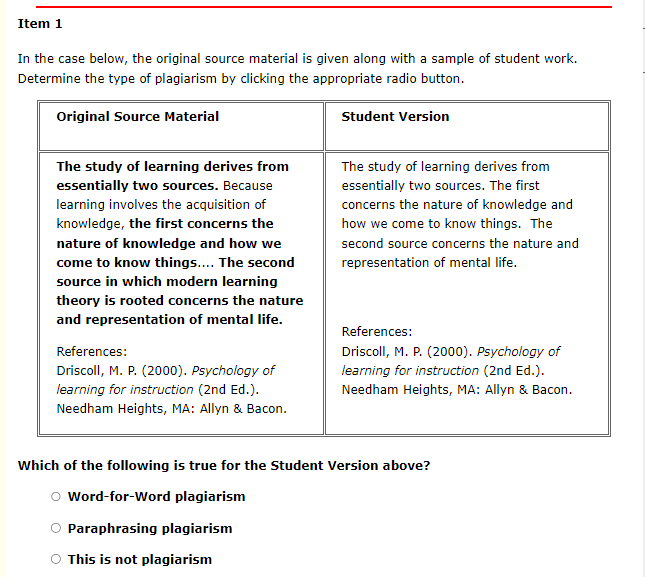
Question: Item 1 In the case below, the original source material is given along with a sample of student work. Determine the type of plagiarism by
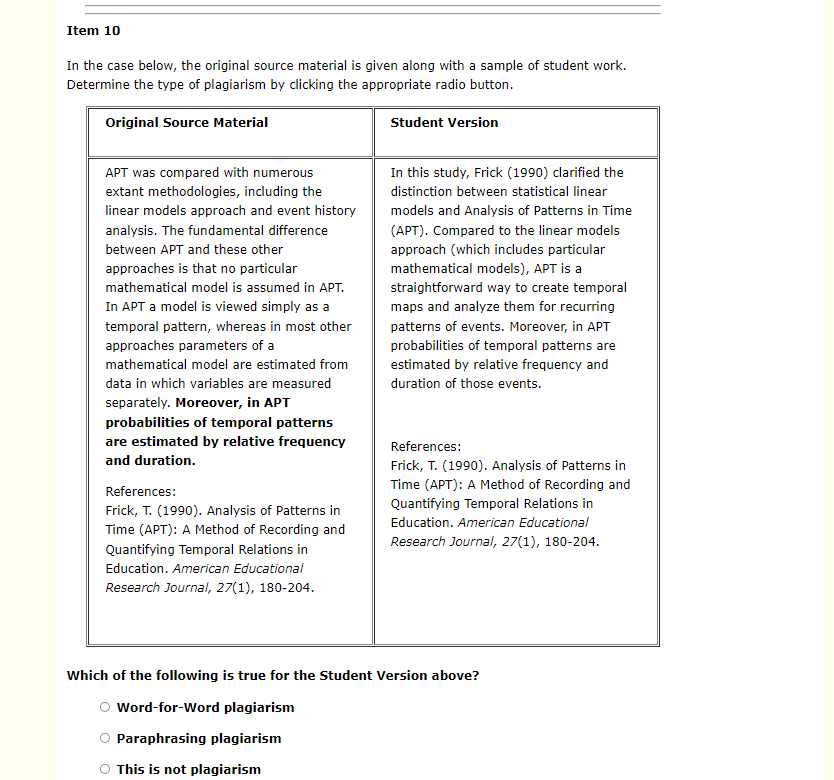
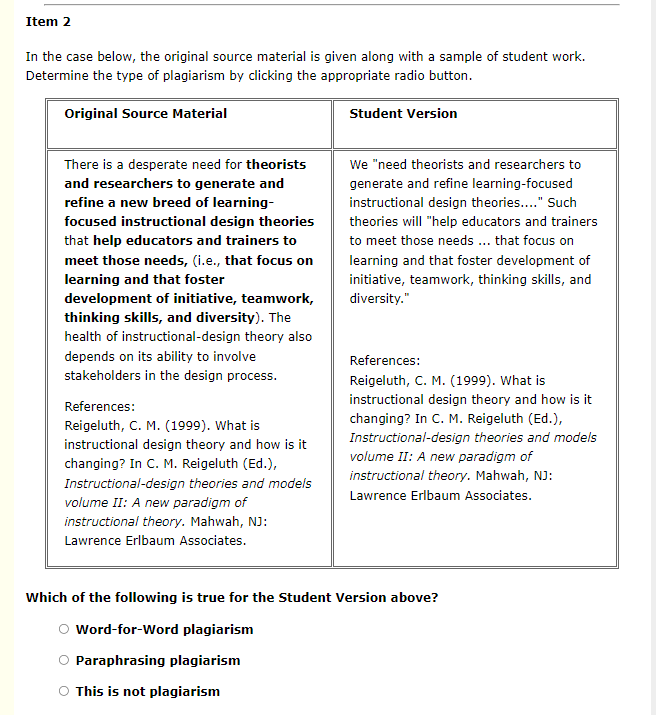
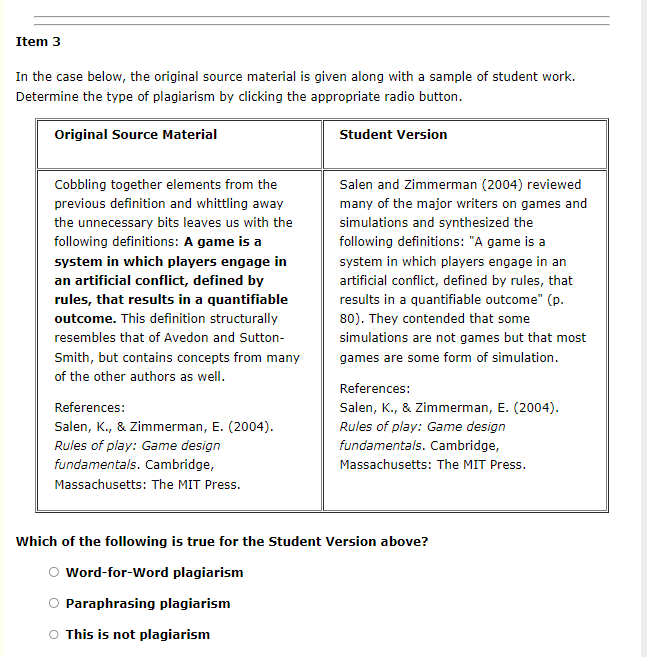
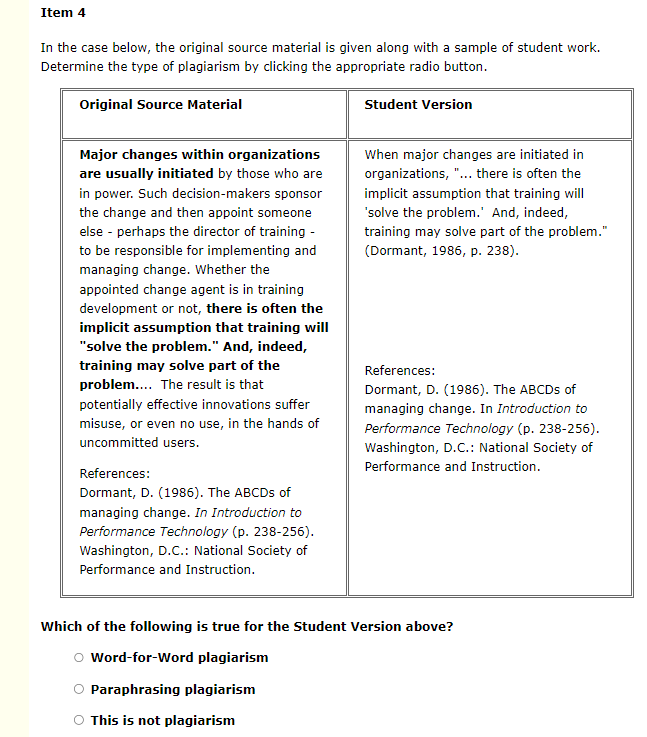
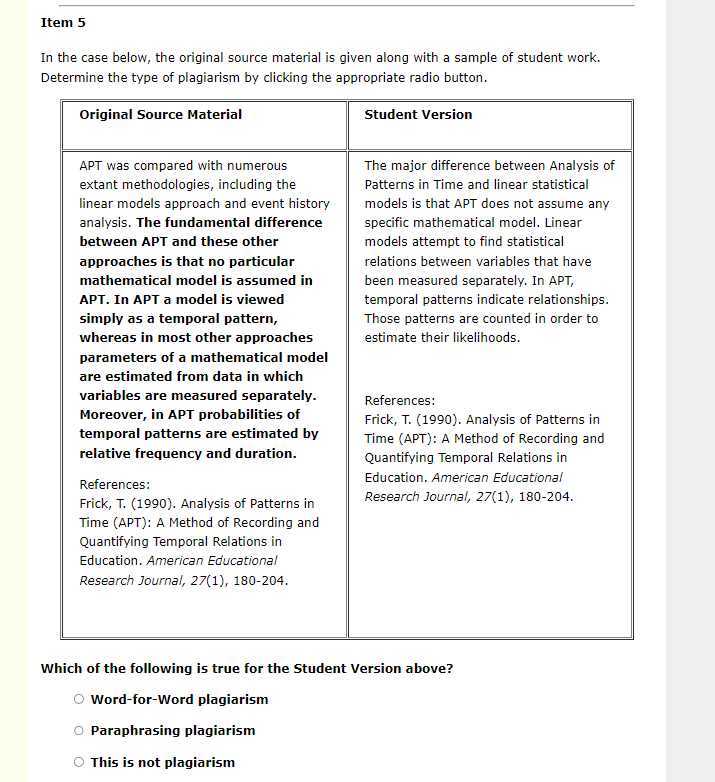
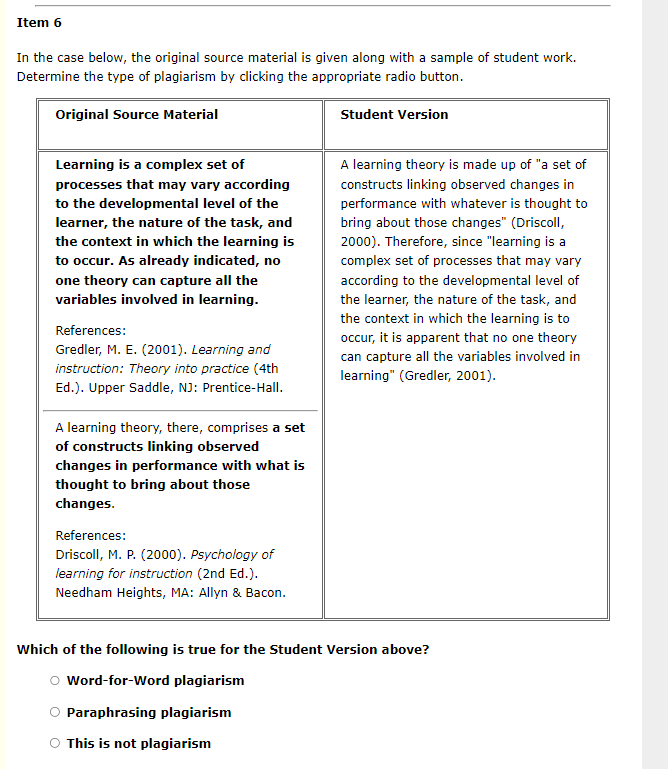
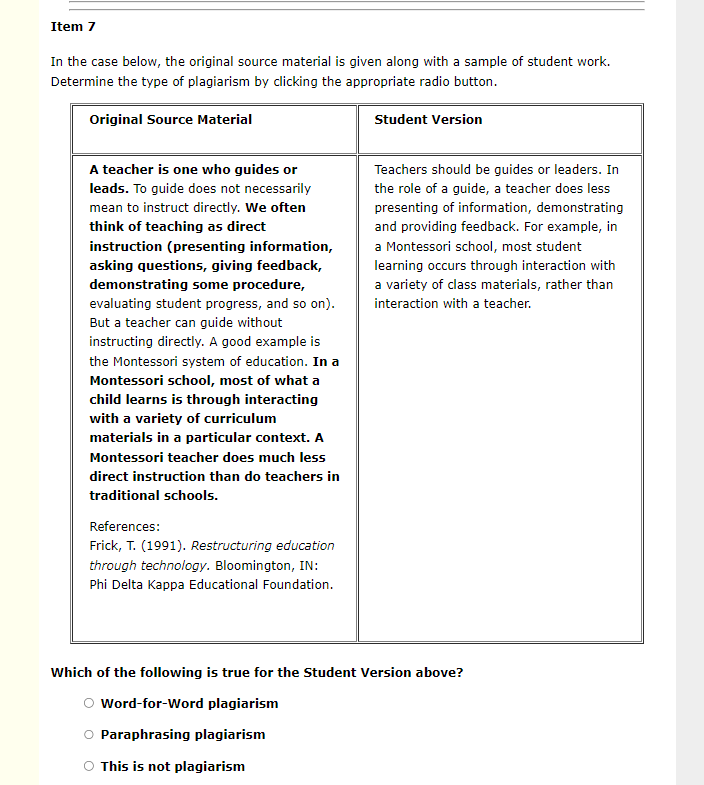
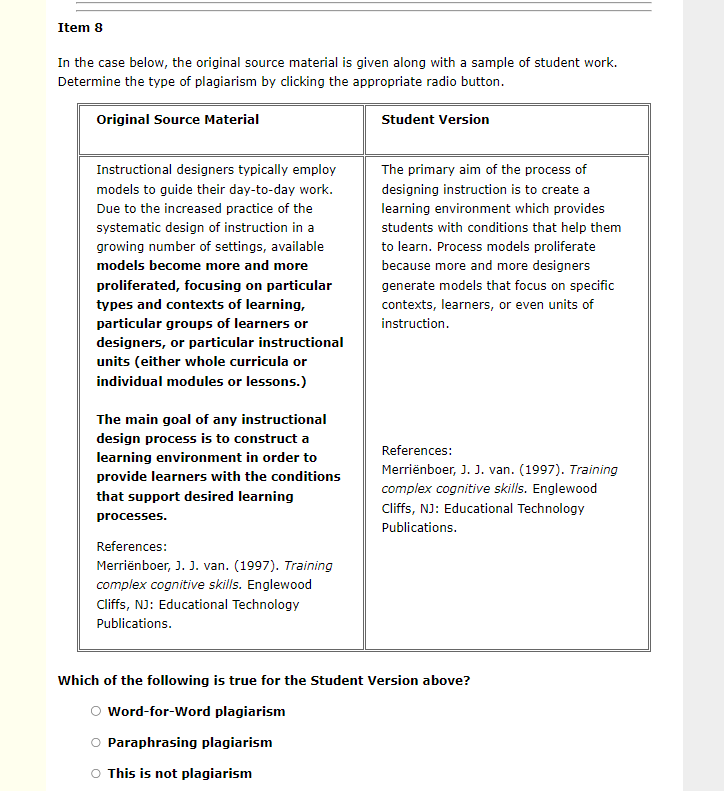
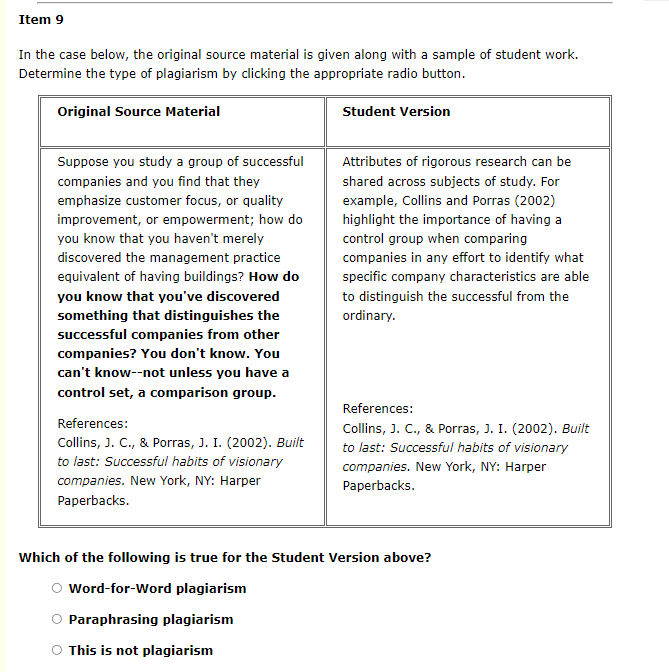
Item 1 In the case below, the original source material is given along with a sample of student work. Determine the type of plagiarism by clicking the appropriate radio button. Original Source Material Student Version The study of learning derives from The study of learning derives from essentially two sources. Because essentially two sources. The first learning involves the acquisition of concerns the nature of knowledge and knowledge, the first concerns the how we come to know things. The nature of knowledge and how we second source concerns the nature and come to know things.... The second representation of mental life. source in which modern learning theory is rooted concerns the nature and representation of mental life. References: References: Driscoll, M. P. (2000). Psychology of Driscoll, M. P. (2000). Psychology of learning for instruction (2nd Ed.). learning for instruction (2nd Ed.). Needham Heights, MA: Allyn & Bacon. Needham Heights, MA: Allyn & Bacon. Which of the following is true for the Student Version above? O Word-for-Word plagiarism O Paraphrasing plagiarism O This is not plagiarismItem 10 In the case below, the original source material is given along with a sample of student work. Determine the type of plagiarism by clicking the appropriate radio button. Original Source Material Student Version APT was compared with numerous extant methodologies, including the linear models approach and event history analysis. The fundamental difference between APT and these other approaches is that no particular mathematical model is assumed in APT. In APT a model is viewed simply as a temporal pattern, whereas in most other approaches parameters of a mathematical model are estimated from data in which variables are measured separately. Moreover, in APT probabilities of temporal patterns are estimated by relative frequency and duration. References: Friclc, T. (1990]. Analysis of Patterns in Time (APT): A Method of Recording and Quantifying Temporal Relations in Education. American Educationai Research Journai, 27(1), 180-204. In this studyr Frick {1990] clarified the distinction between statistical linear models and Analysis of Patterns in Time [APT]. Compared to the linear models approach {which includes particular mathematical models], APT is a straightforward way to create temporal maps and analyze them for recun'ing patterns of events. Moreover, in APT probabilities of temporal patterns are estimated by relative frequency and duration of those events. References: Friclc, T. [1990]. Analysis of Patterns in Time {APT}: A Method of Recording and Quantifying Temporal Relations in Education. American Educational Research Journai, 27H}, 180-204. Which of the following is true for the Student Version above? Word-for-Word plagiarism Paraphrasing plagiarism This is not plagiarism Item 2 In the case below, the original source material is given along with a sample of student work. Determine the type of plagiarism by clicking the appropriate radio button. Original Source Material Student Version There is a desperate need for theorists We "need theorists and researchers to and researchers to generate and generate and refine learning-focused refine a new breed of learning- instructional design theories...." Such focused instructional design theories theories will "help educators and trainers that help educators and trainers to to meet those needs ... that focus on meet those needs, (i.e., that focus on learning and that foster development of learning and that foster initiative, teamwork, thinking skills, and development of initiative, teamwork, diversity." thinking skills, and diversity). The health of instructional-design theory also depends on its ability to involve References: stakeholders in the design process. Reigeluth, C. M. (1999). What is References: instructional design theory and how is it Reigeluth, C. M. (1999). What is changing? In C. M. Reigeluth (Ed.), instructional design theory and how is it Instructional-design theories and models changing? In C. M. Reigeluth (Ed.), volume II: A new paradigm of Instructional-design theories and models instructional theory. Mahwah, NJ: volume II: A new paradigm of Lawrence Erlbaum Associates. instructional theory. Mahwah, NJ: Lawrence Erlbaum Associates. Which of the following is true for the Student Version above? O Word-for-Word plagiarism O Paraphrasing plagiarism O This is not plagiarismItem 3 In the case below, the original source material is given along with a sample of student work. Determine the type of plagiarism by clicking the appropriate radio button. Original Source Material Student Version Cobbling together elements from the Salen and Zimmerman (2004) reviewed previous definition and whittling away many of the major writers on games and the unnecessary bits leaves us with the simulations and synthesized the following definitions: A game is a following definitions: "A game is a system in which players engage in system in which players engage in an an artificial conflict, defined by artificial conflict, defined by rules, that rules, that results in a quantifiable results in a quantifiable outcome" (p. outcome. This definition structurally 80). They contended that some resembles that of Avedon and Sutton- simulations are not games but that most Smith, but contains concepts from many games are some form of simulation. of the other authors as well. References: References: Salen, K., & Zimmerman, E. (2004). Salen, K., & Zimmerman, E. (2004). Rules of play: Game design Rules of play: Game design fundamentals. Cambridge, fundamentals. Cambridge, Massachusetts: The MIT Press. Massachusetts: The MIT Press. Which of the following is true for the Student Version above? O Word-for-Word plagiarism O Paraphrasing plagiarism O This is not plagiarismItem 4 In the case below, the original source material is given along with a sample of student work. Determine the type of plagiarism by clicking the appropriate radio button. Original Source Material Student "Jersion Major changes within organizations When major changes are initiated in are usually initiated by those who are organizations, there is often the in power. Such decisionmakers sponsor implicit assumption that training will the change and then appoint someone 'solye the problem.' And, indeed, else perhaps the director of training - training may solve part of the problem." to be responsible forimplementing and [Dormant, 1985, p. 238}. managing change. Whether the appointed change agent is in training development or notr there is often the implicit assumption that training will "solve the problem." And, indeed, training mayr solve part of the References; Problem-~- The \"35\"\" i5 that Dormant, o. [1936). The aecoa of potentially effective innovations suffer managing chang In Introduction to misuse, or even no use, in the hands of Performance Technology {I1 233_255]_ uncommitted \"SF-"5' 1Washington, D.C.: National Society of References: Performance and Instruction. Dormant, D. [1986]. The nBCDs of managing change. In Introduction to Performance Technology (p. 233-256). Washington, D.C.: National Society of Performance and Instruction. Which of the following is true for the Student Version above? I: Word-for-Word plagiarism Paraphrasing plagiarism This is not plagiarism Item 5 In the case below, the original source material is given along with a sample of student work. Determine the type of plagiarism by clicking the appropriate radio button. Original Source Material APT was compared with numerous extant methodologies, including the linear models approach and event history analysis. The fundamental difference between APT and these other approaches is that no particular mathematical model is assumed in APT. [n APT a model is viewed simply as a temporal pattern,r whereas in most other approaches parameters of a mathematical model are estimated from data in which variables are measured separately. Moreover, in APT probabilities of temporal patterns are estimated by relative frequency and duration. References: Friclc, T. (1990). Analysis of Patterns in Time (APT): A Method of Recording and Quantifying Temporal Relations in Education. American Educational Research Journal, 27(1], 180-204. Word-for-WDrd plagiarism Paraphrasing plagiarism This is not plagiarism Student 1v'ersion The major difference between Analysis of Patterns in Time and linear statistical models is that APT does not assume any specific mathematical model. Linear models attempt to find statistical relations between variables that have been measured separately. In APT, temporal patterns indicate relationships. Those patterns are counted in order to estimate their likelihoods. References: Friclc, T. [1990]. Analysis of Patterns in Time {APT}: A Method of Recording and Quantifying Temporal Relations in Education. Amen-Can Educational Research .i'clo'r'nalI 22:1}, 1811204. Which of the following is true for the Student 'v'ersion above? Item 6 In the case below, the original source material is given along with a sample of student work. Determine the type of plagiarism by clicking the appropriate radio button. Original Source Material Student Version Learning is a complex set of A learning theory is made up of "a set of processes that may vary according constructs linking observed changes in to the developmental level of the performance with whatever is thought to learner, the nature of the task, and bring about those changes" (Driscoll, the context in which the learning is 2000). Therefore, since "learning is a to occur. As already indicated, no complex set of processes that may vary one theory can capture all the according to the developmental level of variables involved in learning. the learner, the nature of the task, and the context in which the learning is to References: occur, it is apparent that no one theory Gredler, M. E. (2001). Learning and can capture all the variables involved in instruction: Theory into practice (4th learning" (Gredler, 2001). Ed.). Upper Saddle, NJ: Prentice-Hall. A learning theory, there, comprises a set of constructs linking observed changes in performance with what is thought to bring about those changes. References: Driscoll, M. P. (2000). Psychology of learning for instruction (2nd Ed.). Needham Heights, MA: Allyn & Bacon. Which of the following is true for the Student Version above? O Word-for-Word plagiarism O Paraphrasing plagiarism O This is not plagiarismItem 3' In the case below, the original source material is given along with a sample of student work. Determine the type of plagiarism by clicking the appropriate radio button. Original Source Material A. teacher is one who guides or leads. To guide does not necessarilyr mean to instruct directly. We often think of teaching as direct instruction [presenting information, asking questions, giving feedback, demonstrating some procedure, evaluating student progress, and so on}. But a teacher can guide without instructing directly. A good example is the Montessori system of education. In a Montessori school, most of what a child learns is through interacting with a varietyr of curriculum materials in a particular context. A Montessori teacher does much less direct instruction than do teachers in traditional schools. References: Frick, T. [1991]. Restructuring education through technology. Bloomington, IN: Phi Delta Kappa Educational Foundation. Word-for-Word plagiarism Paraphrasing plagiarism This is not plagiarism Student Version Teachers should be guides or leaders. In the role of a guide, a teacher does less presenting of information, demonstrating and providing feedback. For example, in a Montessori school, most student learning occurs through interaction with a variety of class materials, rather than interaction Iwith a teacher. which of the following is true for the Student 'v'ersion above? Item 8 In the case below, the original source material is given along with a sample of student work. Determine the type of plagiarism by clicking the appropriate radio button. Original Source Material Student Version Instructional designers typically employ The primary aim of the process of models to guide their day-to-day work. designing instruction is to create a Due to the increased practice of the learning environment which provides systematic design of instruction in a students with conditions that help them growing number of settings, available to learn. Process models proliferate models become more and more because more and more designers proliferated, focusing on particular generate models that focus on specific types and contexts of learning, contexts, learners, or even units of particular groups of learners or instruction. designers, or particular instructional units (either whole curricula or individual modules or lessons.) The main goal of any instructional design process is to construct a learning environment in order to References: provide learners with the conditions Merrienboer, J. J. van. (1997). Training that support desired learning complex cognitive skills. Englewood processes. Cliffs, NJ: Educational Technology Publications. References: Merrienboer, J. J. van. (1997). Training complex cognitive skills. Englewood Cliffs, NJ: Educational Technology Publications. Which of the following is true for the Student Version above? O Word-for-Word plagiarism O Paraphrasing plagiarism O This is not plagiarismItem 9 In the case below, the original source material is given along with a sample of student work. Determine the type of plagiarism by clicking the appropriate radio button. Original Source Material Student Version Suppose you study a group of successful Attributes of rigorous research can be companies and you find that they shared across subjects of study. For emphasize customer focus, or quality example, Collins and Porras (2002) improvement, or empowerment; how do highlight the importance of having a you know that you haven't merely control group when comparing discovered the management practice companies in any effort to identify what equivalent of having buildings? How do specific company characteristics are able you know that you've discovered to distinguish the successful from the something that distinguishes the ordinary. successful companies from other companies? You don't know. You can't know--not unless you have a control set, a comparison group. References: References: Collins, J. C., & Porras, J. I. (2002). Built Collins, J. C., & Porras, J. I. (2002). Built to last: Successful habits of visionary to last: Successful habits of visionary companies. New York, NY: Harper companies. New York, NY: Harper Paperbacks. Paperbacks. Which of the following is true for the Student Version above? O Word-for-Word plagiarism O Paraphrasing plagiarism O This is not plagiarism
Step by Step Solution
There are 3 Steps involved in it
1 Expert Approved Answer
Step: 1 Unlock
Question Has Been Solved by an Expert!
Get step-by-step solutions from verified subject matter experts
Step: 2 Unlock
Step: 3 Unlock
Students Have Also Explored These Related Mathematics Questions!









 Study Help