







Question: It's the year 2 0 5 0 and while everyone is focused on colonizing Mars, NASA has assigned you the task of working on a
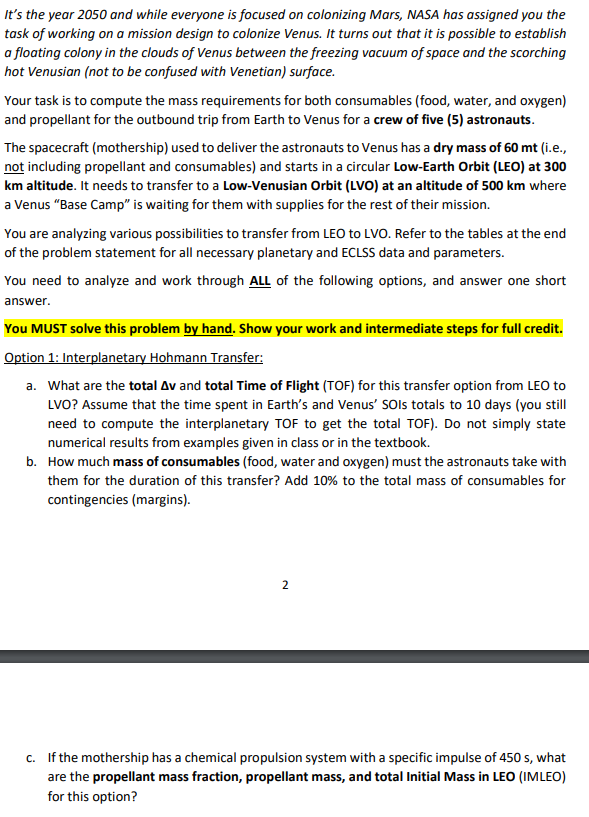
It's the year and while everyone is focused on colonizing Mars, NASA has assigned you the task of working on a mission design to colonize Venus. It turns out that it is possible to establish a floating colony in the clouds of Venus between the freezing vacuum of space and the scorching hot Venusian not to be confused with Venetian surface.
Your task is to compute the mass requirements for both consumables food water, and oxygen and propellant for the outbound trip from Earth to Venus for a crew of five astronauts.
The spacecraft mothership used to deliver the astronauts to Venus has a dry mass of mt ie not including propellant and consumables and starts in a circular LowEarth Orbit LEO at km altitude. It needs to transfer to a LowVenusian Orbit LVO at an altitude of mathbfmathbf~ k m where a Venus "Base Camp" is waiting for them with supplies for the rest of their mission.
You are analyzing various possibilities to transfer from LEO to LVO. Refer to the tables at the end of the problem statement for all necessary planetary and ECLSS data and parameters.
You need to analyze and work through ALL of the following options, and answer one short answer.
You MUST solve this problem by hand. Show your work and intermediate steps for full credit.
Option : Interplanetary Hohmann Transfer:
a What are the total Delta mathbfv and total Time of Flight TOF for this transfer option from LEO to LVO? Assume that the time spent in Earth's and Venus' SOIs totals to days you still need to compute the interplanetary TOF to get the total TOF Do not simply state numerical results from examples given in class or in the textbook.
b How much mass of consumables food water and oxygen must the astronauts take with them for the duration of this transfer? Add to the total mass of consumables for contingencies margins
c If the mothership has a chemical propulsion system with a specific impulse of s what are the propellant mass fraction, propellant mass, and total Initial Mass in LEO IMLEO for this option?
Step by Step Solution
There are 3 Steps involved in it
1 Expert Approved Answer
Step: 1 Unlock

Question Has Been Solved by an Expert!
Get step-by-step solutions from verified subject matter experts
Step: 2 Unlock
Step: 3 Unlock
 Study Help