Question: Please read the attached Tesla HBR case. Please answer the following question below in at least 5 to 6 paragraphs : - Assess Musk's strategy
Please read the attached Tesla HBR case. Please answer the following question below in at least 5 to 6 paragraphs:
- Assess Musk's strategy for SpaceEx - where would you look to position the company for the long-term?
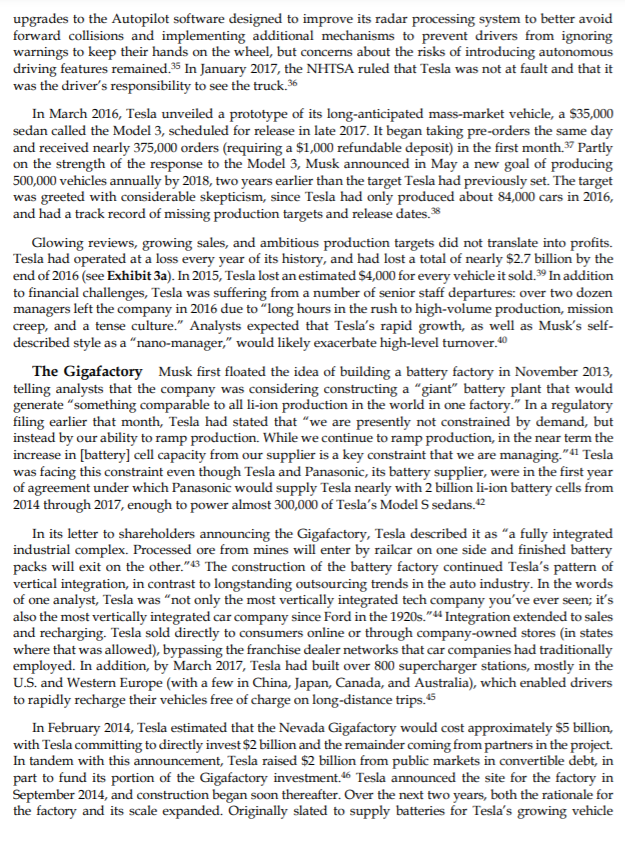
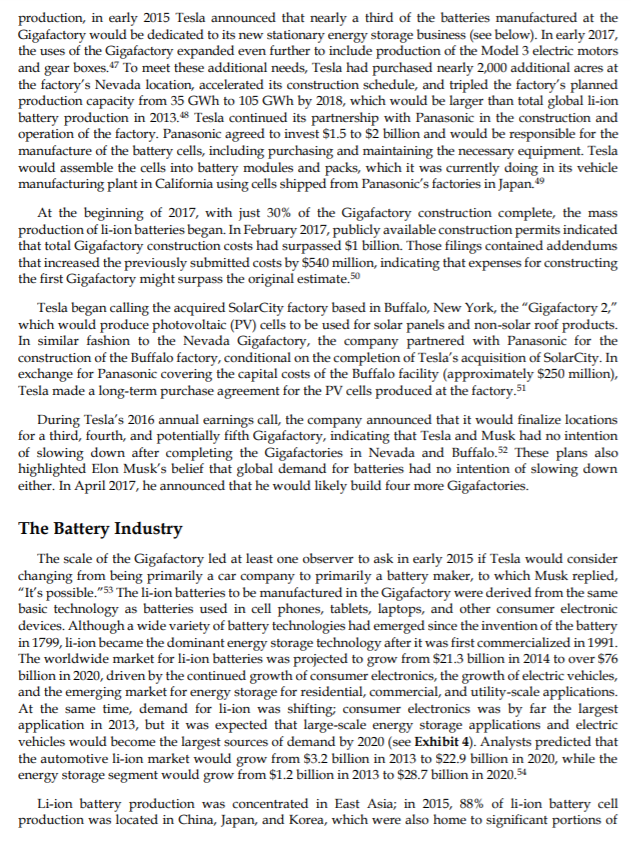
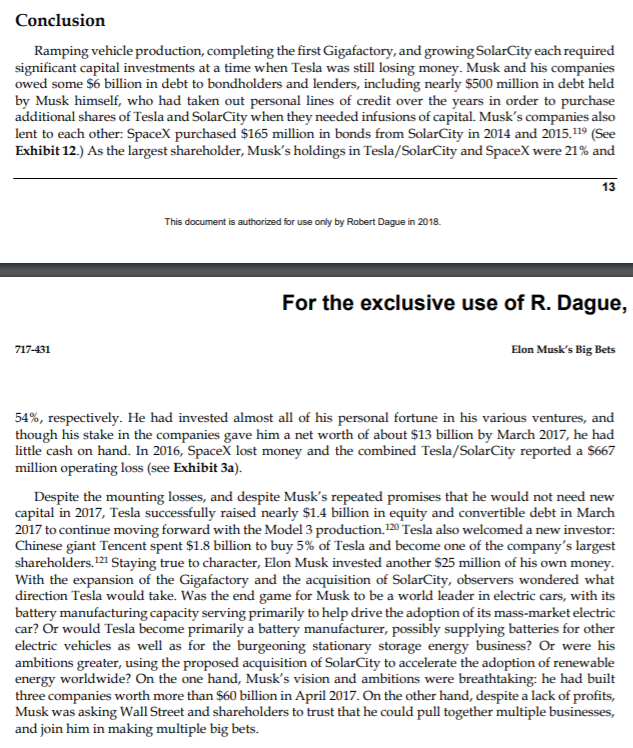
Elon Musk's Big Bets On April 2, 2017, Elon Musk announced that Tesla produced 25,000 cars in the first quarter, setting a new company record. Within two weeks, Tesla's market value zoomed past Ford Motor Company (which manufactured more than 1.5 million cars per quarter) and General Motors (which made more than 2.5 million cars per quarter) to become the most valuable U.S. car manufacturer. Elon Musk used the occasion to needle his naysayers, writing on Twitter: "Stormy weather in Shortville."3 By most measures, Elon Musk was on a roll: Beyond promising to scale Tesla by a factor of 10 between 2015 and 2018, Musk was vowing to deliver fully autonomous driving and an automated car- sharing service. To support his aggressive plans, Tesla was constructing a giant battery factory in the desert outside Reno, Nevada. Everything about the factory was massive: when complete, it would be the largest building in the world. This so-called "Gigafactory" would require $5 billion in investment and would ultimately produce 105 gigawatt hours (GWh) of battery cells per year, more than the entire capacity of the world's li-ion (lithium ion) production in 2015.6 Musk also wanted to turn Tesla into a renewable energy company. In the fall of 2016, Musk made another big bet by orchestrating Tesla's acquisition of the rooftop solar installer SolarCity, where Musk was the chairman and largest shareholder. While the automotive and solar businesses were starkly different, Musk insisted that they were part of Tesla's goal of "accelerating the advent of sustainable energy."7 The Gigafactory plus SolarCity would transform Tesla from an automaker into what Musk called the "world's only vertically integrated energy company offering end-to-end clean energy products to our customers." In his spare time, Musk was also the CEO of the commercial space flight company SpaceX. Musk insisted that SpaceX would begin transporting people to Mars by 2025, achieving his stated goal of making humanity a "multiplanetary species."9 Transforming transportation, pushing forward renewable energy generation and storage, and colonizing Mars: such was the scope of Musk's ambition. Little wonder that a former colleague said that "Elon thinks bigger than just about anyone else I've ever met." 10 Even though Tesla and SolarCity were unprofitable and burning cash, for Musk the question was always: what's next? For Musk's board and shareholders, the question was different: was Musk, as his biographer put it, "a being sent from the future to save mankind from itself or a slick businessman dragging foolish investors along on grand cash-burning bets?"11 Elon Musk's Ventures Elon Musk was born and raised in South Africa, and made his way to Canada in 1989 at the age of 17. Staying with relatives and working odd jobs, Musk enrolled in Queen's University in Ontario and then transferred to the University of Pennsylvania, where he earned degrees in economics and physics. He began a PhD program in applied physics at Stanford, but dropped out in 1995 to start an online map and directory firm called Zip2 with his brother. They sold the company to Compaq for $300 million in 1999. Musk used the money from the sale to launch another startup called X.com, an online bank. In 2000, X.com merged with Confinity, another startup, which ran a money transfer service called PayPal. The combined firm took the name PayPal in 2001 with Musk as the CEO and largest shareholder until the firm was sold to eBay for $1.5 billion in 2002. SpaceX Not content with founding and selling two successful startups, Musk founded Space Exploration Technologies, better known as SpaceX, in 2002. He told a reporter in 2003 that "I like to be involved in things that change the world. The Internet did, and space will probably be more responsible for changing the world than anything else."12 Reaching Mars was the long-term goal, and Musk claimed in 2012 to be on track to get a manned spacecraft to Mars in 10-15 years. In the short term, however, SpaceX concentrated on the commercialization of near-Earth exploration.13 Musk invested some $100 million of his own money in SpaceX and nearly lost it all when SpaceX struggled to achieve a successful test launch of its first rocket. By 2006, SpaceX had won contracts to take commercial and NASA satellites into space despite not yet launching a rocket. Its first three launch attempts ended in failure. By September 2008, SpaceX was on the brink of collapse. As a colleague recalled, Everything hinged on that launch. Elon had lost all his money, but this was more than his fortune at stake it was his credibility."14 The launch succeeded, however. Then, in July 2009, SpaceX had its first successful paying mission. 15 In May 2012, SpaceX became the first commercial firm to successfully dock a vehicle with the International Space Station (ISS), and later that year it delivered its first load of cargo to the ISS. 16 In late 2013, SpaceX carried out its first successful launch of a commercial satellite. SpaceX achieved another milestone in December 2015, when it successfully landed a rocket after launch. Musk saw reusable rockets as an essential step toward making spaceflight truly affordable. SpaceX executives estimated that reusing rockets could cut its launch prices by 30%, from around $61 million to $43 million per launch.17 SpaceX advanced further toward this goal in March 2017, when it successfully launched and landed a previously flown Falcon 9 rocket. Elon Musk was not the only high-profile technology entrepreneur to pursue ventures in space. Amazon founder and CEO Jeff Bezos, the second-richest person on Earth, founded spaceflight company Blue Origin, which directly competed with SpaceX. In November 2015, Blue Origin was the first company in history to successfully launch and land a rocket during a mission to space, proving to the world that reusable rocket technology could work.18 As of March 2017, Blue Origin was focused on launching its first crewed flight into space and building heavy lift rockets to further compete with SpaceX. In order to ensure the company had enough money to accomplish its goals, Bezos pledged to sell $1 billion of his Amazon stock each year to finance Blue Origin. 19 Despite these successes, launching rockets into space remained a risky activity, and SpaceX had lost a few rockets and payloads over the years. On September 1, 2016, a SpaceX rocket exploded on the launch pad at Cape Canaveral. While no one was hurt, the loss was a particularly high-profile one because the satellite on board was to be used as a part of Facebook's effort to bring Internet access to regions of Africa, the Middle East, and Europe. Such setbacks had a significant financial impact on SpaceX: in 2015, SpaceX's revenue declined 6% after multiple years of strong growth, and the company recorded a wide operating loss of $260 million following multiple years of small but positive operating income (see Exhibit 1). An early 2015 funding round valued SpaceX at approximately $12 billion, making it one of the most valuable venture-backed private companies in the world. 20 Meanwhile, the revenue generated by SpaceX's success in near-Earth missions provided the capital to continue working toward the ultimate goal of regular space travel to Mars. While SpaceX sought to address Musk's dreams in the stars, he also had great ambitions for revolutionizing travel on and under the Earth's surface. The Hyperloop, The Boring Company, and Neuralink In August 2013, Musk announced his idea for yet another revolutionary mode of transportation, dubbed the Hyperloop, which Musk claimed would be a faster and cheaper replacement for high-speed rail. Inspired by pneumatic tubes once used to shuttle documents around offices, it would transport passengers at speeds of more than 700 miles per hour in pods enclosed in underground steel tubes under near-vacuum conditions. Given his other obligations, Musk did not attempt to commercialize the idea, but published an open-source white paper describing the technology. A few startups picked up the idea and began developing the technology. One of them, a firm called Hyperloop One, held a demonstration in the Nevada desert in the spring of 2016, propelling a sled one-half mile down a test track at speeds of over 300 miles per hour. The startup had raised $150 million for the venture through January 2017.21 At the end of 2016, Musk tweeted the launch of a Hyperloop-like venture called The Boring Company, which would build underground tunnels to combat traffic. Days after the tweet, he bought the website Boring Company.com and staffed a SpaceX engineer to oversee the new venture. 22 Finally, in the spring of 2017, Musk started yet another company, called Neuralink, which sought to merge the human brain with computers. Musk planned to be CEO of both new startups. Tesla Although Elon Musk was the face of Tesla, he was not one of its founders. The company was started in 2003 by Silicon Valley engineers with the goal of producing a high-performance electric sports car. Musk joined the company in 2004 (two years after launching SpaceX) as its chairman and led its fundraising efforts, which netted $7.5 million in its first round Musk became CEO in 2008, by which time he had invested $55 million of his own money. The company raised $260 million in its 2010 IPO, the first American car company to go public since Ford in 1956.2 At the end of 2016, Musk remained the largest shareholder in Tesla with a 20.8% ownership stake in the company. By March 2017, Tesla had raised over $9.3 billion in financing (see Exhibit 2a). Musk articulated a grand vision for Tesla and the broader electrical vehicle (EV) industry as the key to sustainable transportation, in the context of the looming disaster of climate change. As he put it in 2011, "[l]n order to change the infrastructure such that we avoid having some sort of catastrophic situation [a century from now], we must act now, because we're talking about changing what will probably be 2 billion cars. You don't just change that overnight. A whole industry has to be born." Musk saw Tesla's role as bringing that industry into being with the long-term goal of creating an affordable electric vehicle. Because the cost of electric vehicle technology, particularly battery technology, did not permit the construction of an appealing mass-market electric car in the early 2000s, Tesla and Musk decided to enter the market at the high end and move down-market over time. Musk, tongue-in-cheek, revealed Tesla's "secret plan" in 2006: 1. Build sports car; 2. Use that money to build an affordable car; 3. Use that money to build an even more affordable car." True to the plan, Tesla's first production vehicle, released in 2008, was a high-performance and high-priced sports car called the Roadster. Tesla only manufactured 2,500 Roadsters, but it demonstrated that an electric car could deliver superior performance. The 300 horsepower Roadster went from 0 to 60 in 3.7 seconds, had a top speed of 125 mph, and sold for about $110,000 in 2009. Tesla's next vehicle was a luxury performance sedan called the Model S that was released in 2012 and designed to compete with Mercedes, BMW, and Audi. It was priced starting at $70,000, although optional features (such as a larger battery to provide longer range) could push the price well past $100,000. While not by any means a truly "affordable car, total Model S sales rose from under 5,000 in 2012 to 150,000 by September 2016.26 Initial reviews for the Model S were very positive. In 2013, Consumer Reports gave the first model its highest rating ever, a 99 out of 100, and Motor Trend named the Model Sits Car of the Year. Two years later, Consumer Reports gave an all-wheel-drive version of the Model S a score of 103 out of 100 for its combination of power and efficiency, prompting it to rescale its scoring system to bring the Models down to a perfect 100. Surprisingly, reliability problems with the Model S led Consumer Reports to revoke its recommendation in late 2015, citing "a worse-than-average overall problem rate based on a survey of 1,400 Model S owners.27 Tesla's reputation suffered a further blow when three Tesla vehicles were damaged by battery fires in 2013, caused when the battery pack, which was installed in the car's undercarriage, was damaged by striking roadway debris. Although no one was hurt in the accidents and Tesla pointed out that fires happened at a far higher rate in gasoline-powered cars, the fires raised potentially damaging concerns about battery safety. Tesla's stock fell nearly 4% on the news, and the National Highway Traffic Safety Administration (NHTSA) opened an investigation. In response, Tesla announced in early 2014 that it would modify the Model S to raise its ground clearance at highway speeds and that it would reinforce the vehicle's underbody armor in order, in Musk's words, "to bring this risk down to virtually zero."28 The NHTSA subsequently closed its investigation, saying that "a defect trend has not been identified."29 Safety concerns were renewed, however, when a Model S caught fire while charging at a supercharger in Norway in January 2016, completely destroying the vehicle. Tesla, which ultimately traced the cause to a short circuit, insisted this was an isolated incident and pointed out that vehicles had been charged at supercharging stations 2.5 million times without incident. Norwegian officials concluded that it represented an isolated event.30 Tesla released its next vehicle, an SUV called the Model X, in late 2015, and it had sold and delivered about 37,000 of the vehicles by March 2017 31 Like the Model S, it received rave reviews for its performance, but also faced quality issues in the early months after its release, including problems with the vehicle's unique falcon-wing rear doors and, more seriously, a faulty seat latch that in some cases allowed the rear seats to fold forward during a collision, which led to a recall of 2,700 vehicles in 2016.32 Shortly after the launch of the Model X, Tesla announced the availability of a package of self-driving features, which it called "Autopilot." The system used cameras, radar, GPS, and other sensors to provide semi-autonomous highway driving, keeping the car in its lane, changing lanes when necessary, and maintaining a safe following distance. Musk and Tesla described the system as a "public beta," recommending that drivers keep their hands on the wheel and remain alert and ready to take control at all times. It soon became clear that drivers were not heeding such warnings, posting videos of themselves reading or watching videos while letting the car drive itself. In May 2016, a Tesla driver was killed while driving in Autopilot mode when neither the car's sensors nor the driver detected a tractor-trailer crossing the highway and the vehicle collided at full speed with the trailer. The Tesla driver was reportedly watching a movie at the time of the crash.34 Tesla responded by releasing upgrades to the Autopilot software designed to improve its radar processing system to better avoid forward collisions and implementing additional mechanisms to prevent drivers from ignoring warnings to keep their hands on the wheel, but concerns about the risks of introducing autonomous driving features remained. 35 In January 2017, the NHTSA ruled that Tesla was not at fault and that it was the driver's responsibility to see the truck.36 In March 2016, Tesla unveiled a prototype of its long-anticipated mass-market vehicle, a $35,000 sedan called the Model 3, scheduled for release in late 2017. It began taking pre-orders the same day and received nearly 375,000 orders (requiring a $1,000 refundable deposit) in the first month. Partly on the strength of the response to the Model 3, Musk announced in May a new goal of producing 500,000 vehicles annually by 2018, two years earlier than the target Tesla had previously set. The target was greeted with considerable skepticism, since Tesla had only produced about 84,000 cars in 2016, and had a track record of missing production targets and release dates. 38 Glowing reviews, growing sales, and ambitious production targets did not translate into profits. Tesla had operated at a loss every year of its history, and had lost a total of nearly $2.7 billion by the end of 2016 (see Exhibit 3a). In 2015, Tesla lost an estimated $4,000 for every vehicle it sold. In addition to financial challenges, Tesla was suffering from a number of senior staff departures: over two dozen managers left the company in 2016 due to "long hours in the rush to high-volume production, mission creep, and a tense culture." Analysts expected that Tesla's rapid growth, as well as Musk's self- described style as a "nano-manager," would likely exacerbate high-level turnover.40 The Gigafactory Musk first floated the idea of building a battery factory in November 2013, telling analysts that the company was considering constructing a "giant" battery plant that would generate "something comparable to all li-ion production in the world in one factory." In a regulatory filing earlier that month, Tesla had stated that "we are presently not constrained by demand, but instead by our ability to ramp production. While we continue to ramp production, in the near term the increase in battery] cell capacity from our supplier is a key constraint that we are managing."41 Tesla was facing this constraint even though Tesla and Panasonic, its battery supplier, were in the first year of agreement under which Panasonic would supply Tesla nearly with 2 billion li-ion battery cells from 2014 through 2017, enough to power almost 300,000 of Tesla's Model S sedans.42 In its letter to shareholders announcing the Gigafactory, Tesla described it as "a fully integrated industrial complex. Processed ore from mines will enter by railcar on one side and finished battery packs will exit on the other." The construction of the battery factory continued Tesla's pattern of vertical integration, in contrast to longstanding outsourcing trends in the auto industry. In the words of one analyst, Tesla was "not only the most vertically integrated tech company you've ever seen; it's also the most vertically integrated car company since Ford in the 1920s." Integration extended to sales and recharging. Tesla sold directly to consumers online or through company-owned stores in states where that was allowed), bypassing the franchise dealer networks that car companies had traditionally employed. In addition, by March 2017, Tesla had built over 800 supercharger stations, mostly in the U.S. and Western Europe (with a few in China, Japan, Canada, and Australia), which enabled drivers to rapidly recharge their vehicles free of charge on long-distance trips.45 In February 2014, Tesla estimated that the Nevada Gigafactory would cost approximately $5 billion, with Tesla committing to directly invest $2 billion and the remainder coming from partners in the project. In tandem with this announcement, Tesla raised $2 billion from public markets in convertible debt, in part to fund its portion of the Gigafactory investment.46 Tesla announced the site for the factory in September 2014, and construction began soon thereafter. Over the next two years, both the rationale for the factory and its scale expanded. Originally slated to supply batteries for Tesla's growing vehicle production, in early 2015 Tesla announced that nearly a third of the batteries manufactured at the Gigafactory would be dedicated to its new stationary energy storage business (see below). In early 2017, the uses of the Gigafactory expanded even further to include production of the Model 3 electric motors and gear boxes.47 To meet these additional needs, Tesla had purchased nearly 2,000 additional acres at the factory's Nevada location, accelerated its construction schedule, and tripled the factory's planned production capacity from 35 GWh to 105 GWh by 2018, which would be larger than total global li-ion battery production in 2013. Tesla continued its partnership with Panasonic in the construction and operation of the factory. Panasonic agreed to invest $1.5 to $2 billion and would be responsible for the manufacture of the battery cells, including purchasing and maintaining the necessary equipment. Tesla would assemble the cells into battery modules and packs, which it was currently doing in its vehicle manufacturing plant in California using cells shipped from Panasonic's factories in Japan 19 At the beginning of 2017, with just 30% of the Gigafactory construction complete, the mass production of li-ion batteries began. In February 2017, publicly available construction permits indicated that total Gigafactory construction costs had surpassed $1 billion. Those filings contained addendums that increased the previously submitted costs by $540 million, indicating that expenses for constructing the first Gigafactory might surpass the original estimate.50 Tesla began calling the acquired SolarCity factory based in Buffalo, New York, the Gigafactory 2," which would produce photovoltaic (PV) cells to be used for solar panels and non-solar roof products. In similar fashion to the Nevada Gigafactory, the company partnered with Panasonic for the construction of the Buffalo factory, conditional on the completion of Tesla's acquisition of SolarCity. In exchange for Panasonic covering the capital costs of the Buffalo facility (approximately $250 million), Tesla made a long-term purchase agreement for the PV cells produced at the factory.51 During Tesla's 2016 annual earnings call, the company announced that it would finalize locations for a third, fourth, and potentially fifth Gigafactory, indicating that Tesla and Musk had no intention of slowing down after completing the Gigafactories in Nevada and Buffalo.52 These plans also highlighted Elon Musk's belief that global demand for batteries had no intention of slowing down either. In April 2017, he announced that he would likely build four more Gigafactories. The Battery Industry The scale of the Gigafactory led at least one observer to ask in early 2015 if Tesla would consider changing from being primarily a car company to primarily a battery maker, to which Musk replied, "It's possible."53 The li-ion batteries to be manufactured in the Gigafactory were derived from the same basic technology as batteries used in cell phones, tablets, laptops, and other consumer electronic devices. Although a wide variety of battery technologies had emerged since the invention of the battery in 1799, li-ion became the dominant energy storage technology after it was first commercialized in 1991. The worldwide market for li-ion batteries was projected to grow from $21.3 billion in 2014 to over $76 billion in 2020, driven by the continued growth of consumer electronics, the growth of electric vehicles, and the emerging market for energy storage for residential, commercial, and utility-scale applications. At the same time, demand for li-ion was shifting consumer electronics was by far the largest application in 2013, but it was expected that large-scale energy storage applications and electric vehicles would become the largest sources of demand by 2020 (see Exhibit 4). Analysts predicted that the automotive li-ion market would grow from $3.2 billion in 2013 to $22.9 billion in 2020, while the energy storage segment would grow from $1.2 billion in 2013 to $28.7 billion in 2020.54 Li-ion battery production was concentrated in East Asia; in 2015, 88% of li-ion battery cell production was located in China, Japan, and Korea, which were also home to significant portions of Conclusion Ramping vehicle production, completing the first Gigafactory, and growing SolarCity each required significant capital investments at a time when Tesla was still losing money. Musk and his companies owed some $6 billion in debt to bondholders and lenders, including nearly $500 million in debt held by Musk himself, who had taken out personal lines of credit over the years in order to purchase additional shares of Tesla and SolarCity when they needed infusions of capital. Musk's companies also lent to each other: SpaceX purchased $165 million in bonds from SolarCity in 2014 and 2015.119 (See Exhibit 12.) As the largest shareholder, Musk's holdings in Tesla/SolarCity and SpaceX were 21% and 13 This document is authorized for use only by Robert Dague in 2018. For the exclusive use of R. Dague, 717-431 Elon Musk's Big Bets 54%, respectively. He had invested almost all of his personal fortune in his various ventures, and though his stake in the companies gave him a net worth of about $13 billion by March 2017, he had little cash on hand. In 2016, SpaceX lost money and the combined Tesla/SolarCity reported a $667 million operating loss (see Exhibit 3a). Despite the mounting losses, and despite Musk's repeated promises that he would not need new capital in 2017, Tesla successfully raised nearly $1.4 billion in equity and convertible debt in March 2017 to continue moving forward with the Model 3 production 120 Tesla also welcomed a new investor: Chinese giant Tencent spent $1.8 billion to buy 5% of Tesla and become one of the company's largest shareholders. 121 Staying true to character, Elon Musk invested another $25 million of his own money. With the expansion of the Gigafactory and the acquisition of SolarCity, observers wondered what direction Tesla would take. Was the end game for Musk to be a world leader in electric cars, with its battery manufacturing capacity serving primarily to help drive the adoption of its mass-market electric car? Or would Tesla become primarily a battery manufacturer, possibly supplying batteries for other electric vehicles as well as for the burgeoning stationary storage energy business? Or were his ambitions greater, using the proposed acquisition of SolarCity to accelerate the adoption of renewable energy worldwide? On the one hand, Musk's vision and ambitions were breathtaking: he had built three companies worth more than $60 billion in April 2017. On the other hand, despite a lack of profits, Musk was asking Wall Street and shareholders to trust that he could pull together multiple businesses, and join him in making multiple big bets. Elon Musk's Big Bets On April 2, 2017, Elon Musk announced that Tesla produced 25,000 cars in the first quarter, setting a new company record. Within two weeks, Tesla's market value zoomed past Ford Motor Company (which manufactured more than 1.5 million cars per quarter) and General Motors (which made more than 2.5 million cars per quarter) to become the most valuable U.S. car manufacturer. Elon Musk used the occasion to needle his naysayers, writing on Twitter: "Stormy weather in Shortville."3 By most measures, Elon Musk was on a roll: Beyond promising to scale Tesla by a factor of 10 between 2015 and 2018, Musk was vowing to deliver fully autonomous driving and an automated car- sharing service. To support his aggressive plans, Tesla was constructing a giant battery factory in the desert outside Reno, Nevada. Everything about the factory was massive: when complete, it would be the largest building in the world. This so-called "Gigafactory" would require $5 billion in investment and would ultimately produce 105 gigawatt hours (GWh) of battery cells per year, more than the entire capacity of the world's li-ion (lithium ion) production in 2015.6 Musk also wanted to turn Tesla into a renewable energy company. In the fall of 2016, Musk made another big bet by orchestrating Tesla's acquisition of the rooftop solar installer SolarCity, where Musk was the chairman and largest shareholder. While the automotive and solar businesses were starkly different, Musk insisted that they were part of Tesla's goal of "accelerating the advent of sustainable energy."7 The Gigafactory plus SolarCity would transform Tesla from an automaker into what Musk called the "world's only vertically integrated energy company offering end-to-end clean energy products to our customers." In his spare time, Musk was also the CEO of the commercial space flight company SpaceX. Musk insisted that SpaceX would begin transporting people to Mars by 2025, achieving his stated goal of making humanity a "multiplanetary species."9 Transforming transportation, pushing forward renewable energy generation and storage, and colonizing Mars: such was the scope of Musk's ambition. Little wonder that a former colleague said that "Elon thinks bigger than just about anyone else I've ever met." 10 Even though Tesla and SolarCity were unprofitable and burning cash, for Musk the question was always: what's next? For Musk's board and shareholders, the question was different: was Musk, as his biographer put it, "a being sent from the future to save mankind from itself or a slick businessman dragging foolish investors along on grand cash-burning bets?"11 Elon Musk's Ventures Elon Musk was born and raised in South Africa, and made his way to Canada in 1989 at the age of 17. Staying with relatives and working odd jobs, Musk enrolled in Queen's University in Ontario and then transferred to the University of Pennsylvania, where he earned degrees in economics and physics. He began a PhD program in applied physics at Stanford, but dropped out in 1995 to start an online map and directory firm called Zip2 with his brother. They sold the company to Compaq for $300 million in 1999. Musk used the money from the sale to launch another startup called X.com, an online bank. In 2000, X.com merged with Confinity, another startup, which ran a money transfer service called PayPal. The combined firm took the name PayPal in 2001 with Musk as the CEO and largest shareholder until the firm was sold to eBay for $1.5 billion in 2002. SpaceX Not content with founding and selling two successful startups, Musk founded Space Exploration Technologies, better known as SpaceX, in 2002. He told a reporter in 2003 that "I like to be involved in things that change the world. The Internet did, and space will probably be more responsible for changing the world than anything else."12 Reaching Mars was the long-term goal, and Musk claimed in 2012 to be on track to get a manned spacecraft to Mars in 10-15 years. In the short term, however, SpaceX concentrated on the commercialization of near-Earth exploration.13 Musk invested some $100 million of his own money in SpaceX and nearly lost it all when SpaceX struggled to achieve a successful test launch of its first rocket. By 2006, SpaceX had won contracts to take commercial and NASA satellites into space despite not yet launching a rocket. Its first three launch attempts ended in failure. By September 2008, SpaceX was on the brink of collapse. As a colleague recalled, Everything hinged on that launch. Elon had lost all his money, but this was more than his fortune at stake it was his credibility."14 The launch succeeded, however. Then, in July 2009, SpaceX had its first successful paying mission. 15 In May 2012, SpaceX became the first commercial firm to successfully dock a vehicle with the International Space Station (ISS), and later that year it delivered its first load of cargo to the ISS. 16 In late 2013, SpaceX carried out its first successful launch of a commercial satellite. SpaceX achieved another milestone in December 2015, when it successfully landed a rocket after launch. Musk saw reusable rockets as an essential step toward making spaceflight truly affordable. SpaceX executives estimated that reusing rockets could cut its launch prices by 30%, from around $61 million to $43 million per launch.17 SpaceX advanced further toward this goal in March 2017, when it successfully launched and landed a previously flown Falcon 9 rocket. Elon Musk was not the only high-profile technology entrepreneur to pursue ventures in space. Amazon founder and CEO Jeff Bezos, the second-richest person on Earth, founded spaceflight company Blue Origin, which directly competed with SpaceX. In November 2015, Blue Origin was the first company in history to successfully launch and land a rocket during a mission to space, proving to the world that reusable rocket technology could work.18 As of March 2017, Blue Origin was focused on launching its first crewed flight into space and building heavy lift rockets to further compete with SpaceX. In order to ensure the company had enough money to accomplish its goals, Bezos pledged to sell $1 billion of his Amazon stock each year to finance Blue Origin. 19 Despite these successes, launching rockets into space remained a risky activity, and SpaceX had lost a few rockets and payloads over the years. On September 1, 2016, a SpaceX rocket exploded on the launch pad at Cape Canaveral. While no one was hurt, the loss was a particularly high-profile one because the satellite on board was to be used as a part of Facebook's effort to bring Internet access to regions of Africa, the Middle East, and Europe. Such setbacks had a significant financial impact on SpaceX: in 2015, SpaceX's revenue declined 6% after multiple years of strong growth, and the company recorded a wide operating loss of $260 million following multiple years of small but positive operating income (see Exhibit 1). An early 2015 funding round valued SpaceX at approximately $12 billion, making it one of the most valuable venture-backed private companies in the world. 20 Meanwhile, the revenue generated by SpaceX's success in near-Earth missions provided the capital to continue working toward the ultimate goal of regular space travel to Mars. While SpaceX sought to address Musk's dreams in the stars, he also had great ambitions for revolutionizing travel on and under the Earth's surface. The Hyperloop, The Boring Company, and Neuralink In August 2013, Musk announced his idea for yet another revolutionary mode of transportation, dubbed the Hyperloop, which Musk claimed would be a faster and cheaper replacement for high-speed rail. Inspired by pneumatic tubes once used to shuttle documents around offices, it would transport passengers at speeds of more than 700 miles per hour in pods enclosed in underground steel tubes under near-vacuum conditions. Given his other obligations, Musk did not attempt to commercialize the idea, but published an open-source white paper describing the technology. A few startups picked up the idea and began developing the technology. One of them, a firm called Hyperloop One, held a demonstration in the Nevada desert in the spring of 2016, propelling a sled one-half mile down a test track at speeds of over 300 miles per hour. The startup had raised $150 million for the venture through January 2017.21 At the end of 2016, Musk tweeted the launch of a Hyperloop-like venture called The Boring Company, which would build underground tunnels to combat traffic. Days after the tweet, he bought the website Boring Company.com and staffed a SpaceX engineer to oversee the new venture. 22 Finally, in the spring of 2017, Musk started yet another company, called Neuralink, which sought to merge the human brain with computers. Musk planned to be CEO of both new startups. Tesla Although Elon Musk was the face of Tesla, he was not one of its founders. The company was started in 2003 by Silicon Valley engineers with the goal of producing a high-performance electric sports car. Musk joined the company in 2004 (two years after launching SpaceX) as its chairman and led its fundraising efforts, which netted $7.5 million in its first round Musk became CEO in 2008, by which time he had invested $55 million of his own money. The company raised $260 million in its 2010 IPO, the first American car company to go public since Ford in 1956.2 At the end of 2016, Musk remained the largest shareholder in Tesla with a 20.8% ownership stake in the company. By March 2017, Tesla had raised over $9.3 billion in financing (see Exhibit 2a). Musk articulated a grand vision for Tesla and the broader electrical vehicle (EV) industry as the key to sustainable transportation, in the context of the looming disaster of climate change. As he put it in 2011, "[l]n order to change the infrastructure such that we avoid having some sort of catastrophic situation [a century from now], we must act now, because we're talking about changing what will probably be 2 billion cars. You don't just change that overnight. A whole industry has to be born." Musk saw Tesla's role as bringing that industry into being with the long-term goal of creating an affordable electric vehicle. Because the cost of electric vehicle technology, particularly battery technology, did not permit the construction of an appealing mass-market electric car in the early 2000s, Tesla and Musk decided to enter the market at the high end and move down-market over time. Musk, tongue-in-cheek, revealed Tesla's "secret plan" in 2006: 1. Build sports car; 2. Use that money to build an affordable car; 3. Use that money to build an even more affordable car." True to the plan, Tesla's first production vehicle, released in 2008, was a high-performance and high-priced sports car called the Roadster. Tesla only manufactured 2,500 Roadsters, but it demonstrated that an electric car could deliver superior performance. The 300 horsepower Roadster went from 0 to 60 in 3.7 seconds, had a top speed of 125 mph, and sold for about $110,000 in 2009. Tesla's next vehicle was a luxury performance sedan called the Model S that was released in 2012 and designed to compete with Mercedes, BMW, and Audi. It was priced starting at $70,000, although optional features (such as a larger battery to provide longer range) could push the price well past $100,000. While not by any means a truly "affordable car, total Model S sales rose from under 5,000 in 2012 to 150,000 by September 2016.26 Initial reviews for the Model S were very positive. In 2013, Consumer Reports gave the first model its highest rating ever, a 99 out of 100, and Motor Trend named the Model Sits Car of the Year. Two years later, Consumer Reports gave an all-wheel-drive version of the Model S a score of 103 out of 100 for its combination of power and efficiency, prompting it to rescale its scoring system to bring the Models down to a perfect 100. Surprisingly, reliability problems with the Model S led Consumer Reports to revoke its recommendation in late 2015, citing "a worse-than-average overall problem rate based on a survey of 1,400 Model S owners.27 Tesla's reputation suffered a further blow when three Tesla vehicles were damaged by battery fires in 2013, caused when the battery pack, which was installed in the car's undercarriage, was damaged by striking roadway debris. Although no one was hurt in the accidents and Tesla pointed out that fires happened at a far higher rate in gasoline-powered cars, the fires raised potentially damaging concerns about battery safety. Tesla's stock fell nearly 4% on the news, and the National Highway Traffic Safety Administration (NHTSA) opened an investigation. In response, Tesla announced in early 2014 that it would modify the Model S to raise its ground clearance at highway speeds and that it would reinforce the vehicle's underbody armor in order, in Musk's words, "to bring this risk down to virtually zero."28 The NHTSA subsequently closed its investigation, saying that "a defect trend has not been identified."29 Safety concerns were renewed, however, when a Model S caught fire while charging at a supercharger in Norway in January 2016, completely destroying the vehicle. Tesla, which ultimately traced the cause to a short circuit, insisted this was an isolated incident and pointed out that vehicles had been charged at supercharging stations 2.5 million times without incident. Norwegian officials concluded that it represented an isolated event.30 Tesla released its next vehicle, an SUV called the Model X, in late 2015, and it had sold and delivered about 37,000 of the vehicles by March 2017 31 Like the Model S, it received rave reviews for its performance, but also faced quality issues in the early months after its release, including problems with the vehicle's unique falcon-wing rear doors and, more seriously, a faulty seat latch that in some cases allowed the rear seats to fold forward during a collision, which led to a recall of 2,700 vehicles in 2016.32 Shortly after the launch of the Model X, Tesla announced the availability of a package of self-driving features, which it called "Autopilot." The system used cameras, radar, GPS, and other sensors to provide semi-autonomous highway driving, keeping the car in its lane, changing lanes when necessary, and maintaining a safe following distance. Musk and Tesla described the system as a "public beta," recommending that drivers keep their hands on the wheel and remain alert and ready to take control at all times. It soon became clear that drivers were not heeding such warnings, posting videos of themselves reading or watching videos while letting the car drive itself. In May 2016, a Tesla driver was killed while driving in Autopilot mode when neither the car's sensors nor the driver detected a tractor-trailer crossing the highway and the vehicle collided at full speed with the trailer. The Tesla driver was reportedly watching a movie at the time of the crash.34 Tesla responded by releasing upgrades to the Autopilot software designed to improve its radar processing system to better avoid forward collisions and implementing additional mechanisms to prevent drivers from ignoring warnings to keep their hands on the wheel, but concerns about the risks of introducing autonomous driving features remained. 35 In January 2017, the NHTSA ruled that Tesla was not at fault and that it was the driver's responsibility to see the truck.36 In March 2016, Tesla unveiled a prototype of its long-anticipated mass-market vehicle, a $35,000 sedan called the Model 3, scheduled for release in late 2017. It began taking pre-orders the same day and received nearly 375,000 orders (requiring a $1,000 refundable deposit) in the first month. Partly on the strength of the response to the Model 3, Musk announced in May a new goal of producing 500,000 vehicles annually by 2018, two years earlier than the target Tesla had previously set. The target was greeted with considerable skepticism, since Tesla had only produced about 84,000 cars in 2016, and had a track record of missing production targets and release dates. 38 Glowing reviews, growing sales, and ambitious production targets did not translate into profits. Tesla had operated at a loss every year of its history, and had lost a total of nearly $2.7 billion by the end of 2016 (see Exhibit 3a). In 2015, Tesla lost an estimated $4,000 for every vehicle it sold. In addition to financial challenges, Tesla was suffering from a number of senior staff departures: over two dozen managers left the company in 2016 due to "long hours in the rush to high-volume production, mission creep, and a tense culture." Analysts expected that Tesla's rapid growth, as well as Musk's self- described style as a "nano-manager," would likely exacerbate high-level turnover.40 The Gigafactory Musk first floated the idea of building a battery factory in November 2013, telling analysts that the company was considering constructing a "giant" battery plant that would generate "something comparable to all li-ion production in the world in one factory." In a regulatory filing earlier that month, Tesla had stated that "we are presently not constrained by demand, but instead by our ability to ramp production. While we continue to ramp production, in the near term the increase in battery] cell capacity from our supplier is a key constraint that we are managing."41 Tesla was facing this constraint even though Tesla and Panasonic, its battery supplier, were in the first year of agreement under which Panasonic would supply Tesla nearly with 2 billion li-ion battery cells from 2014 through 2017, enough to power almost 300,000 of Tesla's Model S sedans.42 In its letter to shareholders announcing the Gigafactory, Tesla described it as "a fully integrated industrial complex. Processed ore from mines will enter by railcar on one side and finished battery packs will exit on the other." The construction of the battery factory continued Tesla's pattern of vertical integration, in contrast to longstanding outsourcing trends in the auto industry. In the words of one analyst, Tesla was "not only the most vertically integrated tech company you've ever seen; it's also the most vertically integrated car company since Ford in the 1920s." Integration extended to sales and recharging. Tesla sold directly to consumers online or through company-owned stores in states where that was allowed), bypassing the franchise dealer networks that car companies had traditionally employed. In addition, by March 2017, Tesla had built over 800 supercharger stations, mostly in the U.S. and Western Europe (with a few in China, Japan, Canada, and Australia), which enabled drivers to rapidly recharge their vehicles free of charge on long-distance trips.45 In February 2014, Tesla estimated that the Nevada Gigafactory would cost approximately $5 billion, with Tesla committing to directly invest $2 billion and the remainder coming from partners in the project. In tandem with this announcement, Tesla raised $2 billion from public markets in convertible debt, in part to fund its portion of the Gigafactory investment.46 Tesla announced the site for the factory in September 2014, and construction began soon thereafter. Over the next two years, both the rationale for the factory and its scale expanded. Originally slated to supply batteries for Tesla's growing vehicle production, in early 2015 Tesla announced that nearly a third of the batteries manufactured at the Gigafactory would be dedicated to its new stationary energy storage business (see below). In early 2017, the uses of the Gigafactory expanded even further to include production of the Model 3 electric motors and gear boxes.47 To meet these additional needs, Tesla had purchased nearly 2,000 additional acres at the factory's Nevada location, accelerated its construction schedule, and tripled the factory's planned production capacity from 35 GWh to 105 GWh by 2018, which would be larger than total global li-ion battery production in 2013. Tesla continued its partnership with Panasonic in the construction and operation of the factory. Panasonic agreed to invest $1.5 to $2 billion and would be responsible for the manufacture of the battery cells, including purchasing and maintaining the necessary equipment. Tesla would assemble the cells into battery modules and packs, which it was currently doing in its vehicle manufacturing plant in California using cells shipped from Panasonic's factories in Japan 19 At the beginning of 2017, with just 30% of the Gigafactory construction complete, the mass production of li-ion batteries began. In February 2017, publicly available construction permits indicated that total Gigafactory construction costs had surpassed $1 billion. Those filings contained addendums that increased the previously submitted costs by $540 million, indicating that expenses for constructing the first Gigafactory might surpass the original estimate.50 Tesla began calling the acquired SolarCity factory based in Buffalo, New York, the Gigafactory 2," which would produce photovoltaic (PV) cells to be used for solar panels and non-solar roof products. In similar fashion to the Nevada Gigafactory, the company partnered with Panasonic for the construction of the Buffalo factory, conditional on the completion of Tesla's acquisition of SolarCity. In exchange for Panasonic covering the capital costs of the Buffalo facility (approximately $250 million), Tesla made a long-term purchase agreement for the PV cells produced at the factory.51 During Tesla's 2016 annual earnings call, the company announced that it would finalize locations for a third, fourth, and potentially fifth Gigafactory, indicating that Tesla and Musk had no intention of slowing down after completing the Gigafactories in Nevada and Buffalo.52 These plans also highlighted Elon Musk's belief that global demand for batteries had no intention of slowing down either. In April 2017, he announced that he would likely build four more Gigafactories. The Battery Industry The scale of the Gigafactory led at least one observer to ask in early 2015 if Tesla would consider changing from being primarily a car company to primarily a battery maker, to which Musk replied, "It's possible."53 The li-ion batteries to be manufactured in the Gigafactory were derived from the same basic technology as batteries used in cell phones, tablets, laptops, and other consumer electronic devices. Although a wide variety of battery technologies had emerged since the invention of the battery in 1799, li-ion became the dominant energy storage technology after it was first commercialized in 1991. The worldwide market for li-ion batteries was projected to grow from $21.3 billion in 2014 to over $76 billion in 2020, driven by the continued growth of consumer electronics, the growth of electric vehicles, and the emerging market for energy storage for residential, commercial, and utility-scale applications. At the same time, demand for li-ion was shifting consumer electronics was by far the largest application in 2013, but it was expected that large-scale energy storage applications and electric vehicles would become the largest sources of demand by 2020 (see Exhibit 4). Analysts predicted that the automotive li-ion market would grow from $3.2 billion in 2013 to $22.9 billion in 2020, while the energy storage segment would grow from $1.2 billion in 2013 to $28.7 billion in 2020.54 Li-ion battery production was concentrated in East Asia; in 2015, 88% of li-ion battery cell production was located in China, Japan, and Korea, which were also home to significant portions of Conclusion Ramping vehicle production, completing the first Gigafactory, and growing SolarCity each required significant capital investments at a time when Tesla was still losing money. Musk and his companies owed some $6 billion in debt to bondholders and lenders, including nearly $500 million in debt held by Musk himself, who had taken out personal lines of credit over the years in order to purchase additional shares of Tesla and SolarCity when they needed infusions of capital. Musk's companies also lent to each other: SpaceX purchased $165 million in bonds from SolarCity in 2014 and 2015.119 (See Exhibit 12.) As the largest shareholder, Musk's holdings in Tesla/SolarCity and SpaceX were 21% and 13 This document is authorized for use only by Robert Dague in 2018. For the exclusive use of R. Dague, 717-431 Elon Musk's Big Bets 54%, respectively. He had invested almost all of his personal fortune in his various ventures, and though his stake in the companies gave him a net worth of about $13 billion by March 2017, he had little cash on hand. In 2016, SpaceX lost money and the combined Tesla/SolarCity reported a $667 million operating loss (see Exhibit 3a). Despite the mounting losses, and despite Musk's repeated promises that he would not need new capital in 2017, Tesla successfully raised nearly $1.4 billion in equity and convertible debt in March 2017 to continue moving forward with the Model 3 production 120 Tesla also welcomed a new investor: Chinese giant Tencent spent $1.8 billion to buy 5% of Tesla and become one of the company's largest shareholders. 121 Staying true to character, Elon Musk invested another $25 million of his own money. With the expansion of the Gigafactory and the acquisition of SolarCity, observers wondered what direction Tesla would take. Was the end game for Musk to be a world leader in electric cars, with its battery manufacturing capacity serving primarily to help drive the adoption of its mass-market electric car? Or would Tesla become primarily a battery manufacturer, possibly supplying batteries for other electric vehicles as well as for the burgeoning stationary storage energy business? Or were his ambitions greater, using the proposed acquisition of SolarCity to accelerate the adoption of renewable energy worldwide? On the one hand, Musk's vision and ambitions were breathtaking: he had built three companies worth more than $60 billion in April 2017. On the other hand, despite a lack of profits, Musk was asking Wall Street and shareholders to trust that he could pull together multiple businesses, and join him in making multiple big bets









 Study Help