Question: iu.instructure.com 9 O H-J111-3649 > Files > Problem set 5.3 Activity.pdf Problem set 5.3 Activity.pdf Download Problem set 5.3 Activity.pdf (190 KB) Page of 7
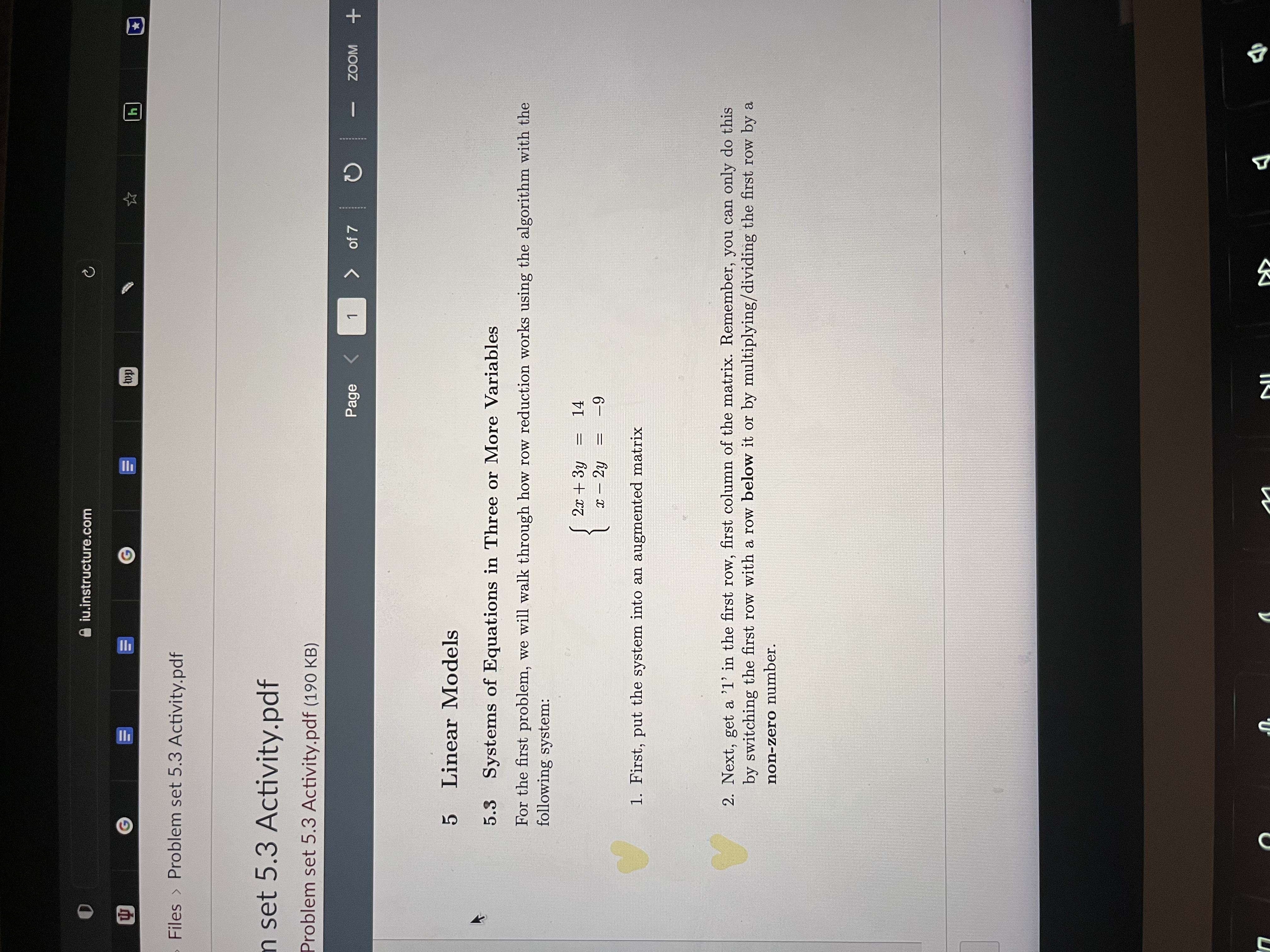
iu.instructure.com 9 O H-J111-3649 > Files > Problem set 5.3 Activity.pdf Problem set 5.3 Activity.pdf Download Problem set 5.3 Activity.pdf (190 KB) Page of 7 0 - ZOOM + 3. Next, get Os everywhere else in the first column. For this example "everywhere else" only refers to the entry in the second row, first column (which should now be a 2). You get a zero here by multiplying the first row by a non-zero number, add it to the second row, and then replace the second row. Make sure you do this calculation to the side and not in your head! 4. Now that the first column looks like it should, we should move on to the second column. Our next step is to get a 'l' in the second row, second column. Remember, you can only do this by switching the second row with a row below it or by multiplying/ dividing the second row by a non-zero number. In our case, there is no row below the second row, so we must multiply / divide by a non-zero number. Net Previous F10 F11 N Files > Problem set 5.3 Activity.pdf Problem set 5.3 Activity.pdf Download Problem set 5.3 Activity.pdf (190 KB) Page 3 > of 7 O - ZOOM + 8. Using the steps you just gave in the previous problem, solve the system of equations: Sy = 3x + 7y + 2z = 10 00 2x - 5y 42 0 ement it ) Next " Previous F10 F11 F12 N * # Files > Problem set 5.3 Activity.pdf Problem set 5.3 Activity.pdf Download Problem set 5.3 Activity.pdf (190 KB) Page of 7 - ZOOM + 5. Finally, we need Os everywhere else in the second column. For this example "everywhere else" only refers to the entry in the first row, second column (which should be -2). You get a zero here by multiplying the second row by a non-zero number, add it to the first row, and then replace the first row. Make sure you do this calculation to the side and not in your head! 6. In ordered pair form, what is the solution to this system of equations? Remark. In the case of two equations and two variables, you should always use elimination (or possibly substitution,) as it is much faster than row reduction. We will see examples later in the section, however, where this method is our only option. ent 7. Suppose now that we had three equations and three variables. Write out the steps to solve it using our row reduction method. (Hint: Steps 0, la, 1b, 2a, and 2b will be exactly the same! You should only need two more steps to complete the algorithm.) Previous 90 N F10 F11 F * EA Problem set 5.3 Activity.pdf n set 5.3 Activity.pdf Problem set 5.3 Activity.pdf (190 KB) Page of 7 - ZOOM + 5 Linear Models 5.3 Systems of Equations in Three or More Variables For the first problem, we will walk through how row reduction works using the algorithm with the following system: 2x + 3y = 14 x - 2y = -9 1. First, put the system into an augmented matrix 2. Next, get a 'l' in the first row, first column of the matrix. Remember, you can only do this by switching the first row with a row below it or by multiplying/ dividing the first row by a non-zero number
Step by Step Solution
There are 3 Steps involved in it
1 Expert Approved Answer
Step: 1 Unlock
Question Has Been Solved by an Expert!
Get step-by-step solutions from verified subject matter experts
Step: 2 Unlock
Step: 3 Unlock
Students Have Also Explored These Related Mathematics Questions!












 Study Help