







Question: I've included 2 snippets of the same problem. Please use the 2 sets of Test Data from the first snippet below to test your program
I've included 2 snippets of the same problem. Please use the 2 sets of Test Data from the first snippet below to test your program and please use Eclipse to write the C++ program. Please include a picture or snippet or something of your console or output, so that I can see that the program is working. Thank you.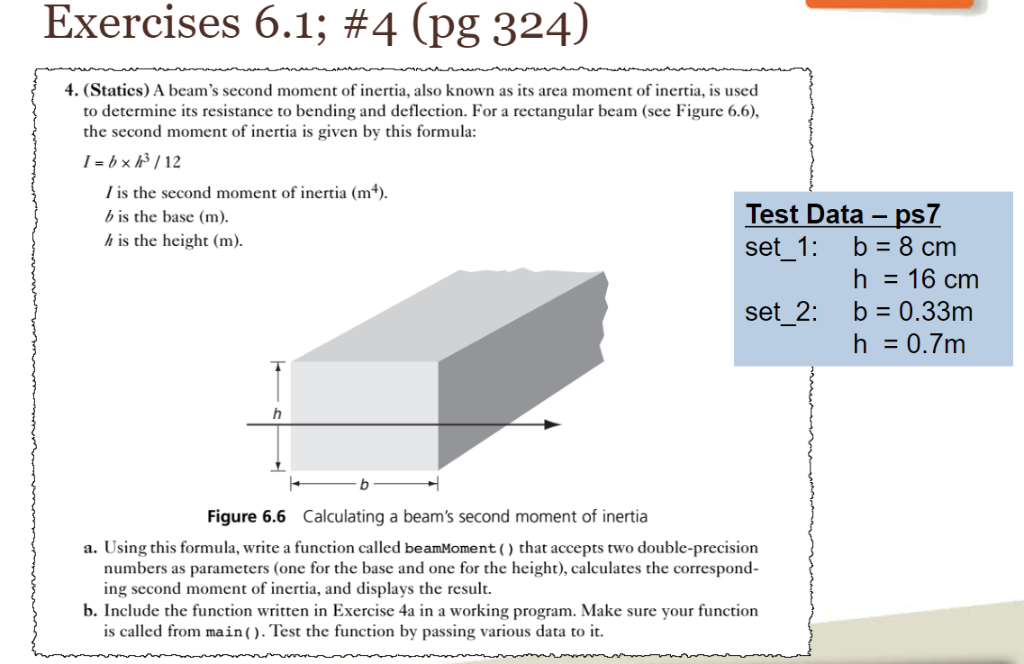
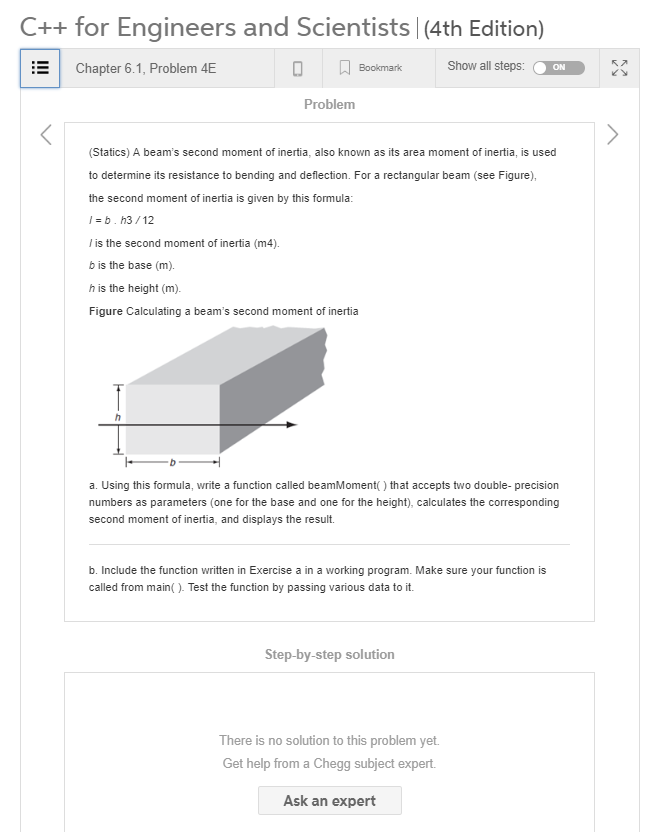
Exercises 6.1: #4 (pg 324) 4. (Statics) A beam's second moment of inertia, also known as its area moment of inertia, is used to determine its resistance to bending and deflection. For a rectangular beam (see Figure 6.6), the second moment of inertia is given by this formula / is the second moment of inertia (m4). b is the base (m) h is the height (m). Test Data- ps7 set 1: b 8 cm cm set 2: b:0.33m h = 0.7m Figure 6.6 Calculating a beam's second moment of inertia a. Using this formula, write a function called beamMoment () that accepts two double-precision numbers as parameters (one for the base and one for the height), calculates the correspond- ing second moment of inertia, and displays the result. b. Include the function written in Exercise 4a in a working program. Make sure your function is called from main(). Test the function by passing various data to it. C++ for Engineers and Scientists (4th Edition) Chapter 6.1, Problem 4E D Bookmark Show all steps: ON Problem (Statics) A beam's second moment of inertia, also known as its area moment of inertia, is used to determine its resistance to bending and deflection. For a rectangular beam (see Figure) the second moment of inertia is given by this formula: I-b. h3/12 l is the second moment of inertia (m4) b is the base (m) h is the height (m). Figure Calculating a beam's second moment of inertia a. Using this formula, write a function called beamMoment) that accepts two double- precision numbers as parameters (one for the base and one for the height), calculates the corresponding second moment of inertia, and displays the result. b. Include the function written in Exercise a in a working program. Make sure your function is called from main(). Test the function by passing various data to it Step-by-step solution There is no solution to this problem yet Get help from a Chegg subject expert Ask an expert
Step by Step Solution
There are 3 Steps involved in it

Get step-by-step solutions from verified subject matter experts
 Study Help