







Question: J 3 Proposition 1.3 Let c be a positive number. Then there is a (unique) positive number whose square is c; that is, the oquation
J 3
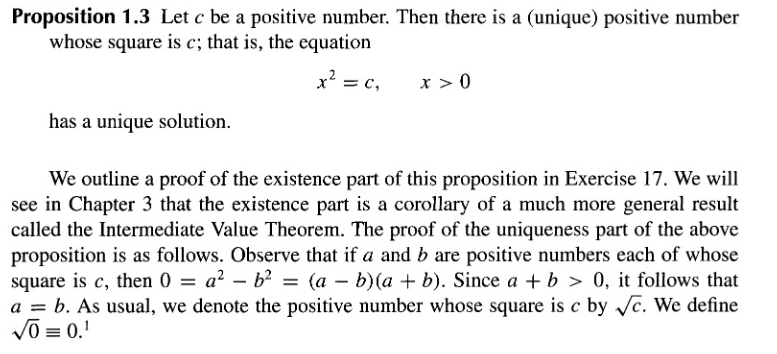
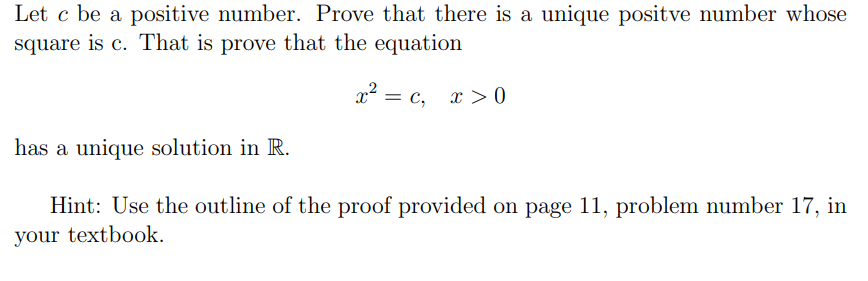
Proposition 1.3 Let c be a positive number. Then there is a (unique) positive number whose square is c; that is, the oquation xz=c, x'o has a unique solution. We outline a proof of the existence pan of this proposition in Exercise 1?. We will see in Chapter 3 that the existence part is a corollary of a much more general result called the Intermediate Value Theorem. The proof of the uniqueness part of the above proposition is as follows. Observe that if a and b are positive numbers each of whose square is c, then 0 = a2 b2 = {a - b)[o + b). Since a + b n- 0, it follows that o = b. As usual, we denote the positive number whose square is c by JE. We dene ail] Let c be a positive number. Prove that there is a unique positve number whose square is c. That is prove that the equation has a unique solution in R. Hint: Use the outline of the proof provided on page 11, problem number 17, in your textbook
Step by Step Solution
There are 3 Steps involved in it

Get step-by-step solutions from verified subject matter experts
 Study Help