







Question: j . Problems Related to Model 7. Which beakers contain solid, insoluble substances? Wat evidence is provided to show these substances are solids? 8. Which
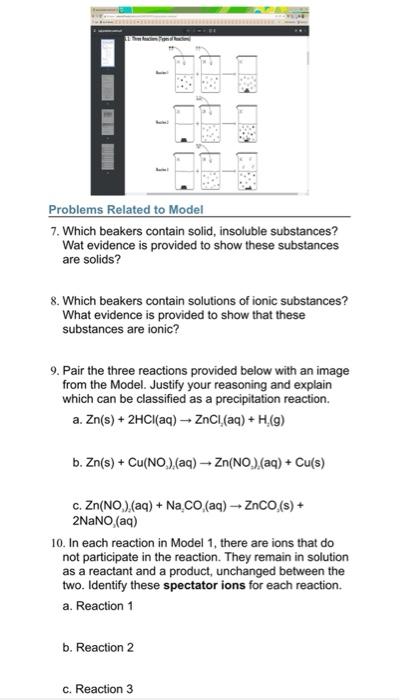
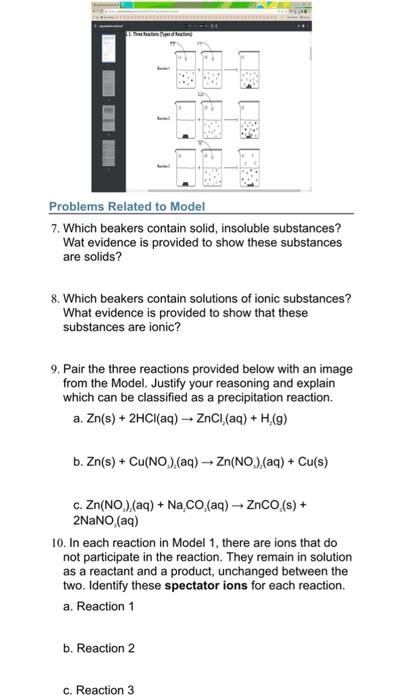
j . Problems Related to Model 7. Which beakers contain solid, insoluble substances? Wat evidence is provided to show these substances are solids? 8. Which beakers contain solutions of ionic substances? What evidence is provided to show that these substances are ionic? 9. Pair the three reactions provided below with an image from the Model. Justify your reasoning and explain which can be classified as a precipitation reaction. a. Zn(s) + 2HCl(aq) -- ZnCl (aq) + H.(9) b. Zn(s) + Cu(NO) (aq) - Zn(NO), (aq) + Cu(s) c. Zn(NO) (aq) + NaCO (aq) ZnCO.(s) + 2NaNO (aq) 10. In each reaction in Model 1, there are ions that do not participate in the reaction. They remain in solution as a reactant and a product, unchanged between the two. Identify these spectator ions for each reaction. a. Reaction 1 b. Reaction 2 c. Reaction 3 ] TEBIBI 1 Problems Related to Model 7. Which beakers contain solid, insoluble substances? Wat evidence is provided to show these substances are solids? 8. Which beakers contain solutions of ionic substances? What evidence is provided to show that these substances are ionic? 9. Pair the three reactions provided below with an image from the Model. Justify your reasoning and explain which can be classified as a precipitation reaction. a. Zn(s) + 2HCl(aq) ZnCl(aq) + H,(9) b. Zn(s) + Cu(NO) (aq) - Zn(NO),(aq) + Cu(s) C. Zn(NO),(aq) + Na CO (aq) -- ZnCO.(s) + 2NaNO (aq) 10. In each reaction in Model 1, there are ions that do not participate in the reaction. They remain in solution as a reactant and a product, unchanged between the two. Identify these spectator ions for each reaction. a. Reaction 1 b. Reaction 2 c. Reaction 3
Step by Step Solution
There are 3 Steps involved in it

Get step-by-step solutions from verified subject matter experts
 Study Help