







Question: J the consumer consumes only two goods with quantities :51 and 12 respectively. J 's utility function is: n(.1:1,32) = lnzl + $2 + 2.
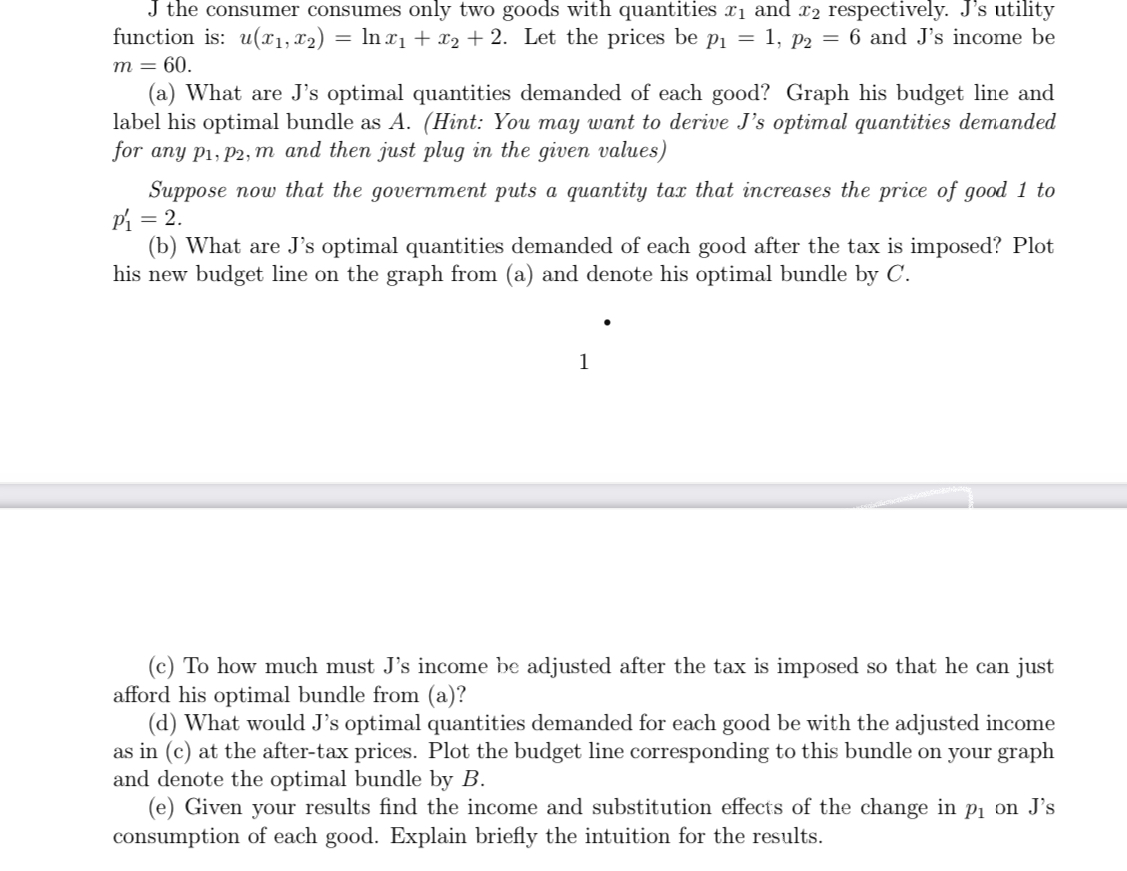
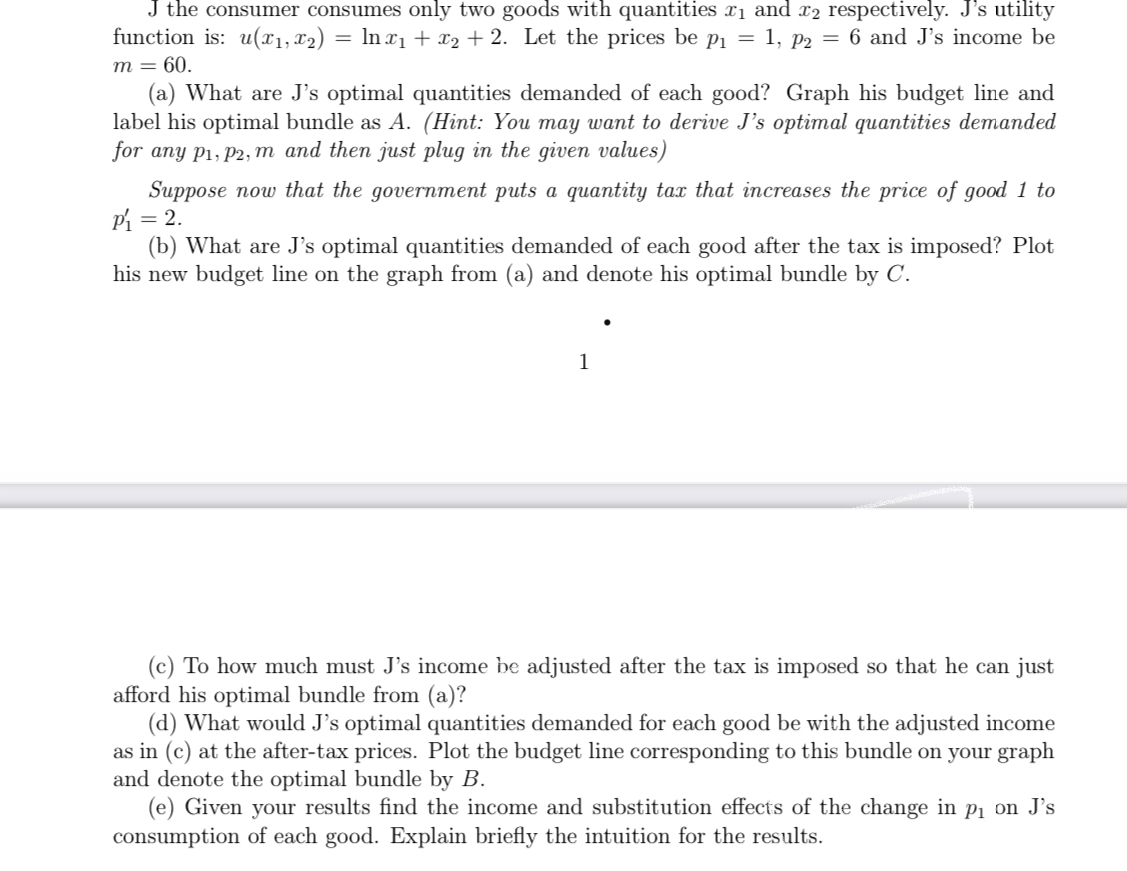
J the consumer consumes only two goods with quantities :51 and 12 respectively. J 's utility function is: n(.1:1,32) = lnzl + $2 + 2. Let the prices be p1 = 1, p2 = 6 and J's income be m = 60. (a) What are J 's optimal quantities demanded of each good? Graph his budget line and label his optimal bundle as A. (Hint: You may want to derive J's optimal quantities denmnded for any p1, p2,m and then just ping in the given values) Suppose now that the government puts a quantity tea: that increases the price of good 1 to Pi = 2. (b) What are J 's optimal quantities demanded of each good after the tax is imposed? Plot his new budget line on the graph from (a) and denote his optimal bundle by C. (c) To how much must J's income be adjusted after the tax is imposed so that he can just afford his optimal bundle from (a)? (d) What would J's optimal quantities demanded for each good be with the adjusted income as in (c) at the after-tax prices. Plot the budget line corresponding to this bundle on your graph and denote the optimal bundle by B. (e) Given your results nd the income and substitutiOn effects of the change in pl on J 's consumption of each good. Explain briey the intuitiOn for the results
Step by Step Solution
There are 3 Steps involved in it

Get step-by-step solutions from verified subject matter experts
 Study Help