







Question: JAVA 9.7 (The Account class) Design a class named Account that contains: A private int data field named id for the account (default 0) A
JAVA
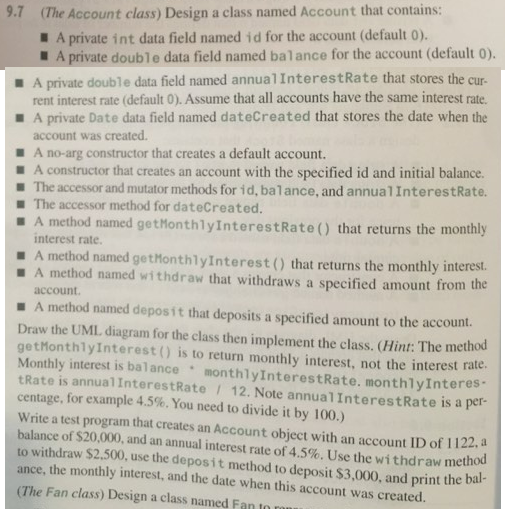
9.7 (The Account class) Design a class named Account that contains: A private int data field named id for the account (default 0) A private double data field named annual Inte restRate that stores the cur- A private Date data field named dateCreated that stores the date when the A private double data field named balance for the account (default 0). rent interest rate (default 0). Assume that all accounts have the same interest rate. account was created A no-arg constructor that creates a default account. A constructor that creates an account with the specified id and initial balance. The accessor and mutator methods for id, balance, and annual InterestRate. The accessor method for dateCreated. A method named getMonthly InterestRate() that returns the monthly interest rate. A method named getMonthlyInterest() that returns the monthly interest. A method named withdraw that withdraws a specified amount from the account A method named deposit that deposits a specified amount to the account. Draw the UML. diagram for the class then implement the class. (Hint: The method getMonthlyInterest() is to return monthly interest, not the interest rate Monthly interest is balance monthlyInterestRate. monthlyInteres- tRate is annualInterestRate 12. Note annualInterestRate is a per- entage, for example 4.5%. You need to divide it by 100,) Write a test program that creates an Account object with an account ID of 1122. balance of $20,000, and an annual interest rate of 4.5%. Use the withdraw met to withdraw $2.500, use the deposit method to deposit $3,000, and print the ba ance, the monthly interest, and the date when this account was created (The Fan class) Design a class named Fan tn
Step by Step Solution
There are 3 Steps involved in it

Get step-by-step solutions from verified subject matter experts
 Study Help