







Question: Java Data Structure For this exercise, implement a Table. It is an Abstract Data Type that models a dictionary or look - up table, with
Java Data Structure
For this exercise, implement a Table. It is an Abstract Data Type that models a dictionary or lookup
table, with information on collected items accessed by a unique, designated "key" for each item. One
example is the Motor Vehicle Department's driver information data accessed by driver identification code.
For this exercise, define a Table that supports the following operations:
initialize initialize an empty table this is the constructor
insert insert an item in the table, given the item.
search given a key, return the associated data item.
getHeight return the height of the tree.
getSize return the number of nodes in the tree.
getAverageLevel return the average level of the nodes in the tree.
showTree display the contents of the tree in a treelike fashion
toString display the entire contents of the table in order by their keys.
Remember that a Table is a collection of items with unique keys no duplicates If an insertion attempts
to add an item with a key that is already in the set, just ignore the insertion. This is intended as a general
purpose tool, so there will be no input from the user and no output to the user inside the Table class
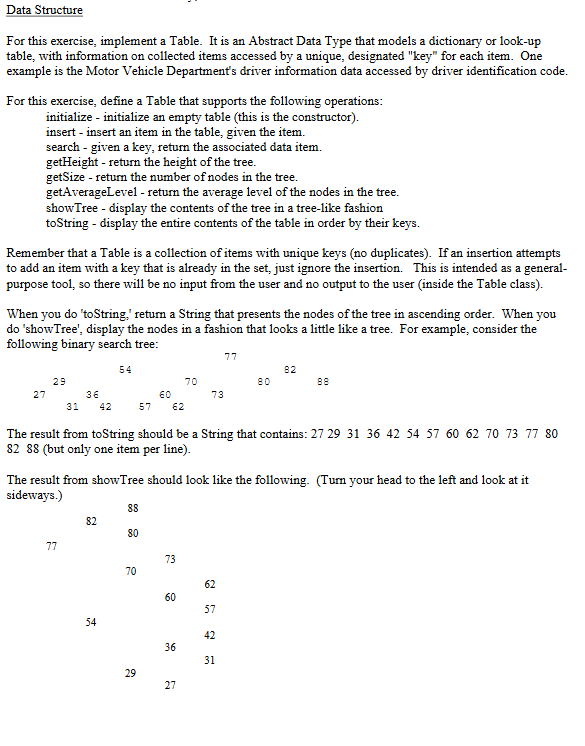
When you do 'toString, return a String that presents the nodes of the tree in ascending order. When you
do 'showTree', display the nodes in a fashion that looks a little like a tree. For example, consider the
following binary search tree:
::
but only one item per line
The result from showTree should look like the following. Turn your head to the left and look at it
sideways.
Implementation:
Implement the Table as a Binary Search Tree. Define a Table class for the entire tree and a TNode class
for each node of the tree. In the TNode class, use three 'public' data members, and no member functions
except possibly a constructor with one parameter For the Binary Search Tree, keep only one data
member: a reference to the root. Represent the empty tree with null, and leaf nodes referring to two nulls
just as we have done in class and in the examples Use recursive algorithms for all the tree operations.
To compute the average level, write a function that computes the sum of the levels of the nodes in the
tree, then take the result of this function divided by the number of nodes getSize.
To generalize the implementation, define a Keyed interface and use it as the type of all items and keys.
The Keyed interface must support the following operations:
int keyCompKeyed other;
return a negative number if less than other, if equal, and positive if greater
String briefSummary;
return a short string that summarizes the item, to fit in the showTree display
Notice that 'briefSummary' is not a replacement for 'toString'. It is an alternative that produces an
abbreviated summary of the item instead of the complete summary that comes from 'toString' It is only
to be used by the 'showTree' method.
To support the application, define two simple classes to provide objects in the tables.
First, an 'NBAPlayerKey', which includes an integer jersey number and a string to represent the team
name like for the Suns For this class, provide a constructor that initializes both data members, and
accessors for both, as well as the methods necessary to implement the 'Keyed' interface. In the 'keyComp'
method, order the data items by team name, and then by jersey number. Two instances are equal only if
both data fields are the same. For example, jersey # for the "Suns" is "less than" the jersey # for the
"Suns", and jersey # for the "Suns" is greater than jersey # for the "Lakers". In the 'briefSummary"
method, just return the jersey number and the first three letters of the team name to keep it short for the
'showTree' method. You can use the 'substr' method in the String class.
Second, an 'NBAPlayer', which includes an integer jersey number, a string for the team name, a string for
the name of the player, and a double for the points per game average. This class must be a subclass of
'NBAPlayerKey'. In addition to the inherited data members and member functions, add data members for
player name and points per game. Also add an accessor for each of these. This class will also implement
the 'Keyed' interface, but using the methods inherited from the parent class to satisfy the requirements.
For the showTree method, do a reverseorder traversal rightrootleft and pass the level of the root to the
recursive function that displays each subtree. Recall that the level of the child is one more than the level
of the parent. Use the level of each node to compute how many spaces to insert in front of the data of
each node. Call the briefSummary method from showTree but not toString
Application:
For phase I, exercise all the operations of a table. Create one table of 'NBAPlayer's, then allow the user to
repeatedly perform selected operations on this table. Include a menu option for each of the operations
listed for a Table including the c
Step by Step Solution
There are 3 Steps involved in it
1 Expert Approved Answer
Step: 1 Unlock

Question Has Been Solved by an Expert!
Get step-by-step solutions from verified subject matter experts
Step: 2 Unlock
Step: 3 Unlock
 Study Help