







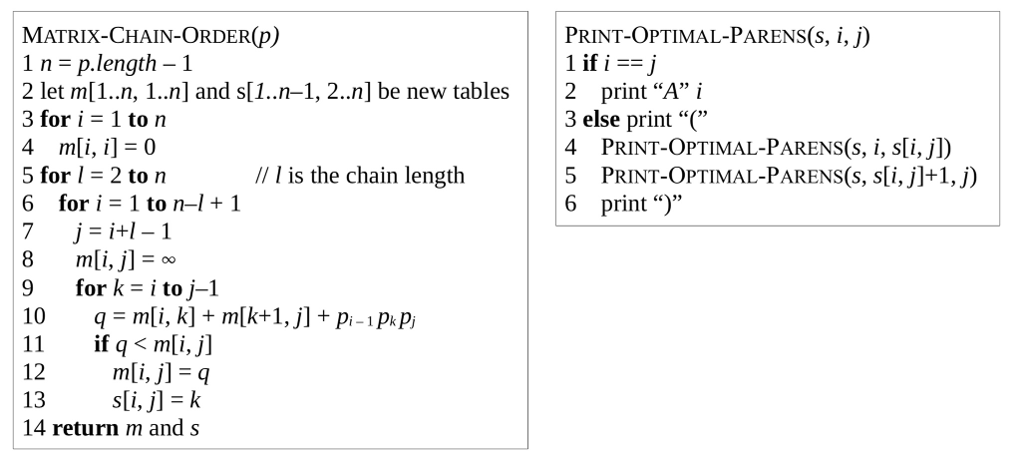
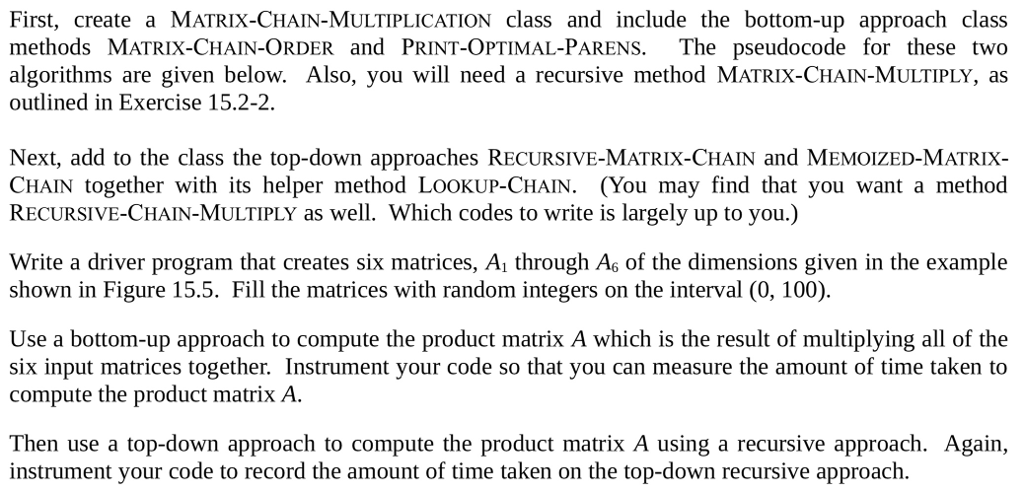
Question: Java dynamic programming: for this project, we will implement Matrix Chain Multiplication Exercise 15.2-2: Figure 15.5 PRINT-OPTIMAL-PARENS(s, i, j) MATRIX-CHAIN-ORDER(p) 1 n = p.length-1 2
Java dynamic programming: for this project, we will implement Matrix Chain Multiplication
![2 let m[1..n, 1..n] and s[1..n-1, 2.n] be new tables2 print "A"](https://dsd5zvtm8ll6.cloudfront.net/si.experts.images/questions/2024/09/66f5197b3d1f8_87466f5197aaf5f0.jpg)
Exercise 15.2-2:
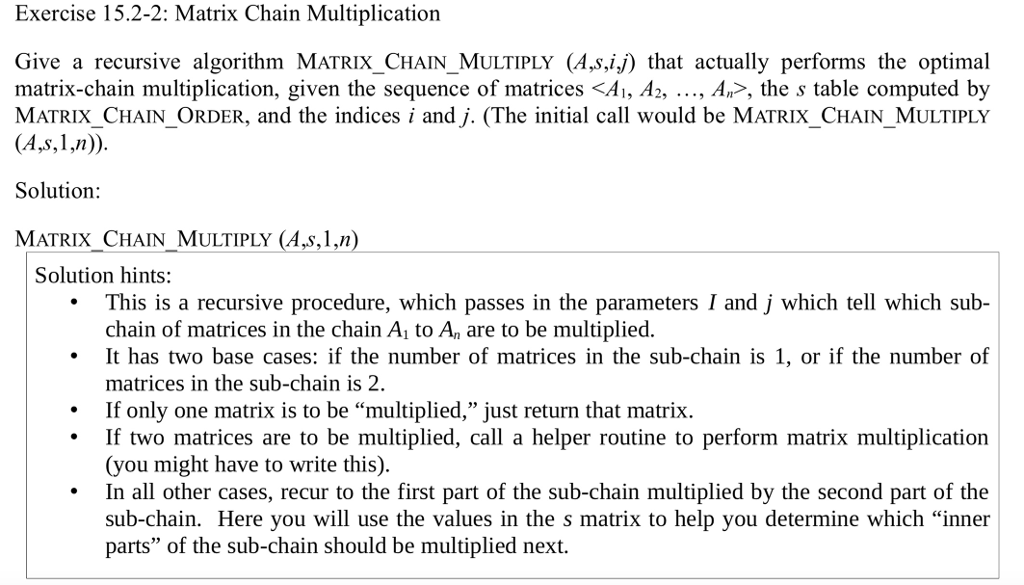
Figure 15.5
![s[i,j]) 5 PRINT-OPTIMAL-PARENS(s, s[i,j]+1,j) 5 for l- 2 to n /I I](https://dsd5zvtm8ll6.cloudfront.net/si.experts.images/questions/2024/09/66f5197d12f03_87666f5197c70fc7.jpg)
PRINT-OPTIMAL-PARENS(s, i, j) MATRIX-CHAIN-ORDER(p) 1 n = p.length-1 2 let m[1..n, 1..n] and s[1..n-1, 2.n] be new tables2 print "A" i 3 fori-1 to n 3 else print "C" 4 PRINT-OPTIMAL-PARENS(s, ?, s[i,j]) 5 PRINT-OPTIMAL-PARENS(s, s[i,j]+1,j) 5 for l- 2 to n /I I is the chain length 6 for i -1 to n- 1 6 print ") j=i+1-1 8 m[i, j] 9 for k i to j-1 10 q = mli, k] + m[k+1, j] + pi-1 pp, 11 ifq?m[i,j] 12 13 14 return m and s m[i, j] = q sli, jl k
Step by Step Solution
There are 3 Steps involved in it
1 Expert Approved Answer
Step: 1 Unlock

Question Has Been Solved by an Expert!
Get step-by-step solutions from verified subject matter experts
Step: 2 Unlock
Step: 3 Unlock
 Study Help