







Question: **JAVA** Fill in both classes - Flight and Airport with all implementation and methods 1. This question involves a system to manage flights at an
**JAVA**
Fill in both classes - Flight and Airport with all implementation and methods
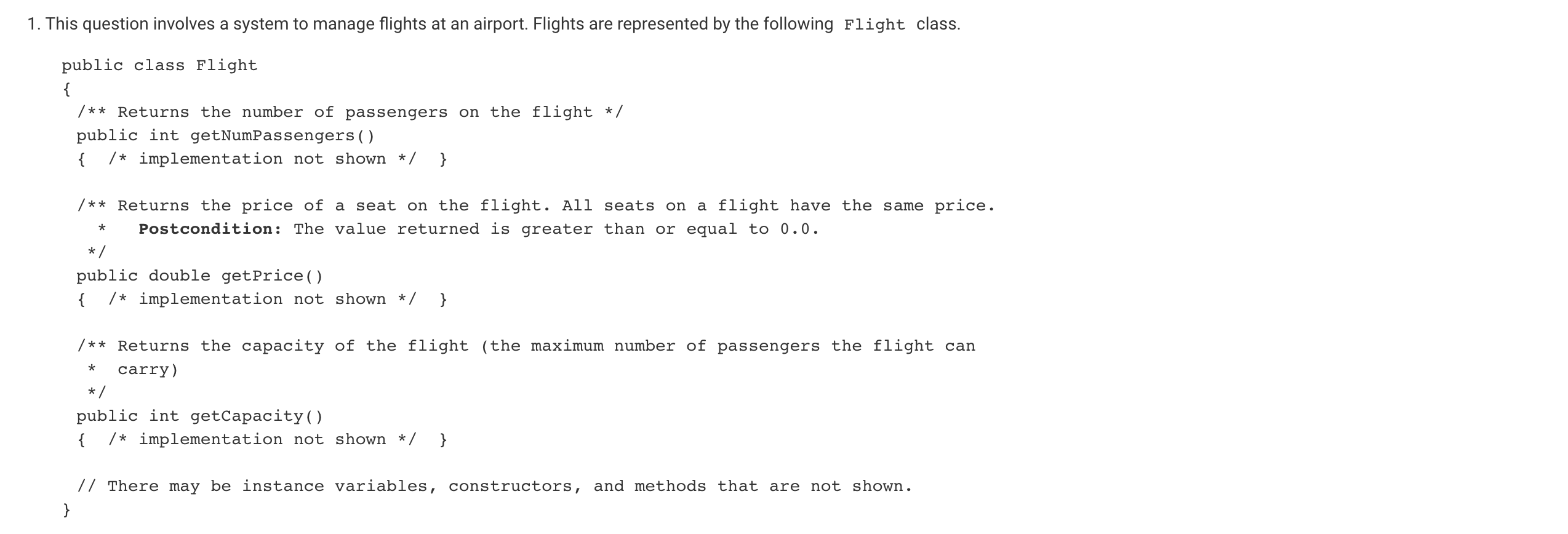
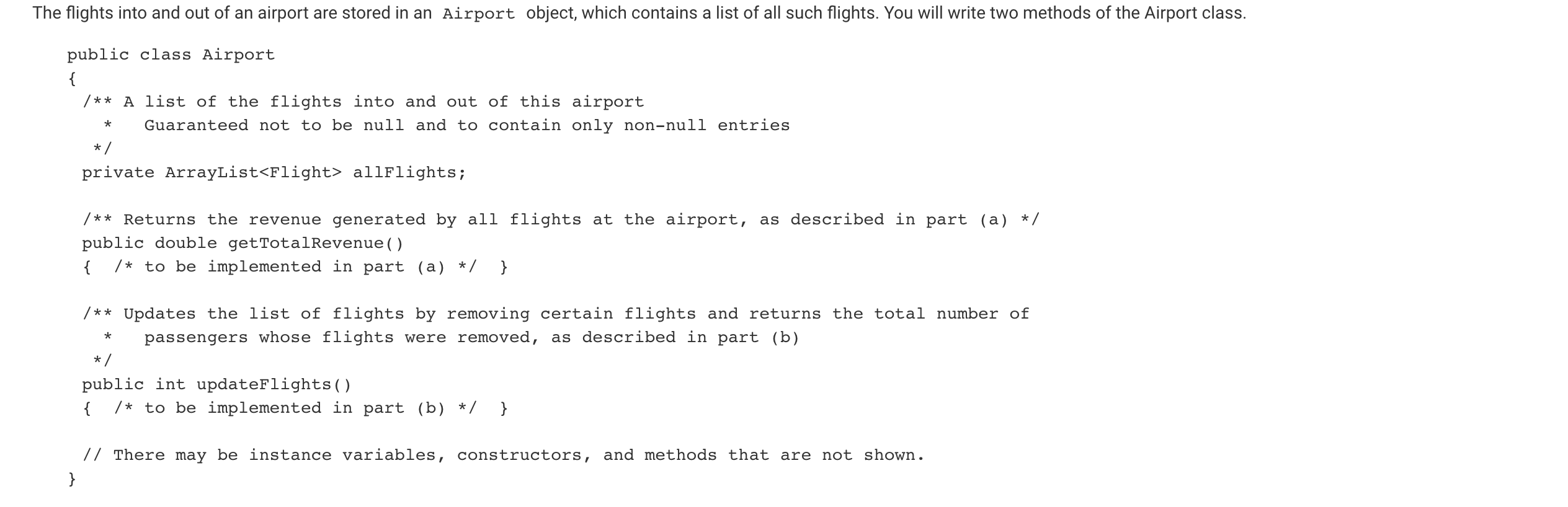
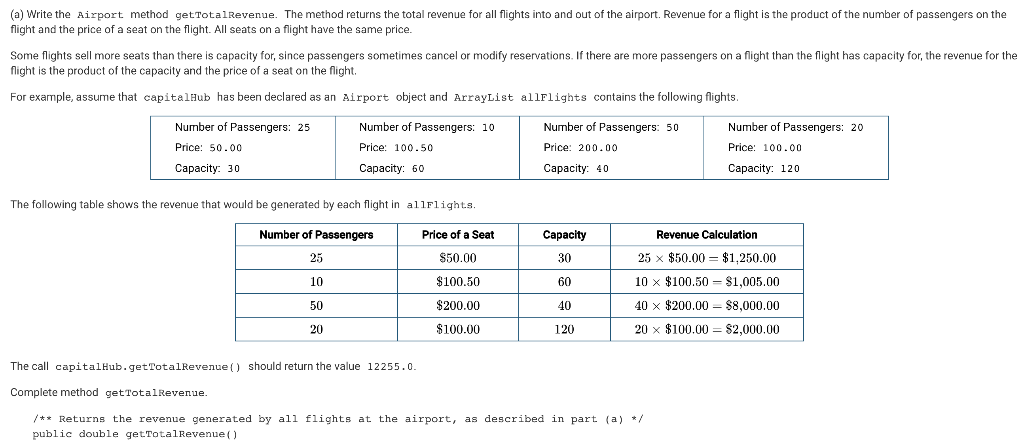
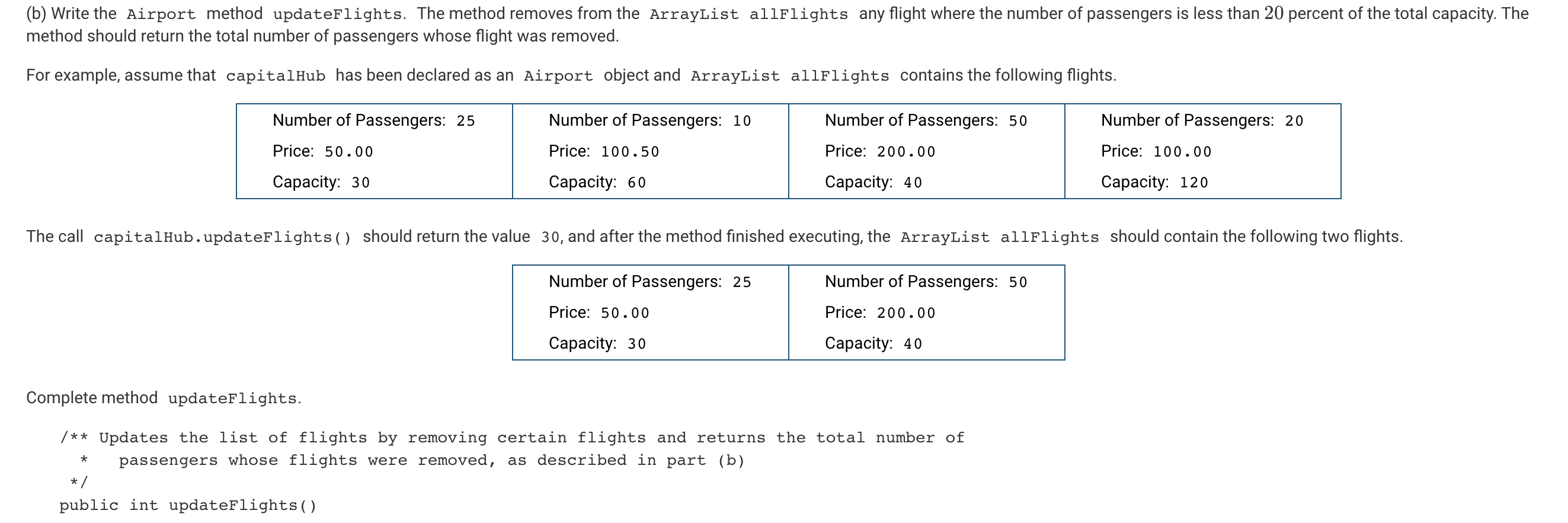
1. This question involves a system to manage flights at an airport. Flights are represented by the following Flight class. public class Flight { /** Returns the number of passengers on the flight */ public int getNumPassengers() { /* implementation not shown */ } * /** Returns the price of a seat on the flight. All seats on a flight have the same price. Postcondition: The value returned is greater than or equal to 0.0. */ public double getPrice () { /* implementation not shown */ } * /** Returns the capacity of the flight (the maximum number of passengers the flight can carry) */ public int getCapacity ( ) { /* implementation not shown */ } // There may be instance variables, constructors, and methods that are not shown. } (a) Write the Airport method getTotalRevenue. The method returns the total revenue for all flights into and out of the airport. Revenue for a flight is the product of the number of passengers on the flight and the price of a seat on the flight. All seats on a flight have the same price. Some flights sell more seats than there is capacity for, since passengers sometimes cancel or modify reservations. If there are more passengers on a flight than the flight has capacity for, the revenue for the flight is the product of the capacity and the price of a seat on the flight. For example, assume that capitalhub has been declared as an Airport object and ArrayList allFlights contains the following flights. Number of Passengers: 25 Price: 50.00 Capacity: 30 Number of Passengers: 10 Price: 100.50 Capacity: 60 Number of Passengers: 50 Price: 200.00 Capacity: 40 Number of Passengers: 20 Price: 100.00 Capacity: 120 The following table shows the revenue that would be generated by each flight in allFlights. Number of Passengers Price of a Seat Capacity 25 $50.00 30 $100.50 60 10 50 Revenue Calculation 25 x $50.00 = $1,250.00 10 x $100.50 = $1,005.00 40 x $200.00 = $8,000.00 20 x $100.00 = $2,000.00 $200.00 40 20 $100.00 120 The call capitalHub.getTotalRevenue() should return the value 12255.0. Complete method getTotalRevenue. /** Returns the revenue generated by all flights at the airport, as described in part (a) */ public double getTotalRevenue) (b) Write the Airport method updateFlights. The method removes from the ArrayList allFlights any flight where the number of passengers is less than 20 percent of the total capacity. The method should return the total number of passengers whose flight was removed. For example, assume that capitalHub has been declared as an Airport object and ArrayList allFlights contains the following flights. Number of Passengers: 25 Number of Passengers: 10 Number of Passengers: 50 Number of Passengers: 20 Price: 50.00 Price: 100.50 Price: 200.00 Price: 100.00 Capacity: 30 Capacity: 60 Capacity: 40 Capacity: 120 The call capitalHub.updateFlights() should return the value 30, and after the method finished executing, the ArrayList allFlights should contain the following two flights. Number of Passengers: 50 Number of Passengers: 25 Price: 50.00 Price: 200.00 Capacity: 30 Capacity: 40 Complete method updateFlights. * /** Updates the list of flights by removing certain flights and returns the total number of passengers whose flights were removed, as described in part (b) */ public int updateFlights()
Step by Step Solution
There are 3 Steps involved in it

Get step-by-step solutions from verified subject matter experts
 Study Help