







Question: Java-Answer plus screenshot A. 1 B.2 C.3 D.4 import static org.junit.jupiter.api.Assertions.*; import java.math.BigDecimal; import org.junit.jupiter.api. Test; class Test Demo [ BigDecimal b1 = new BigDecimal(1.0);
Java-Answer plus screenshot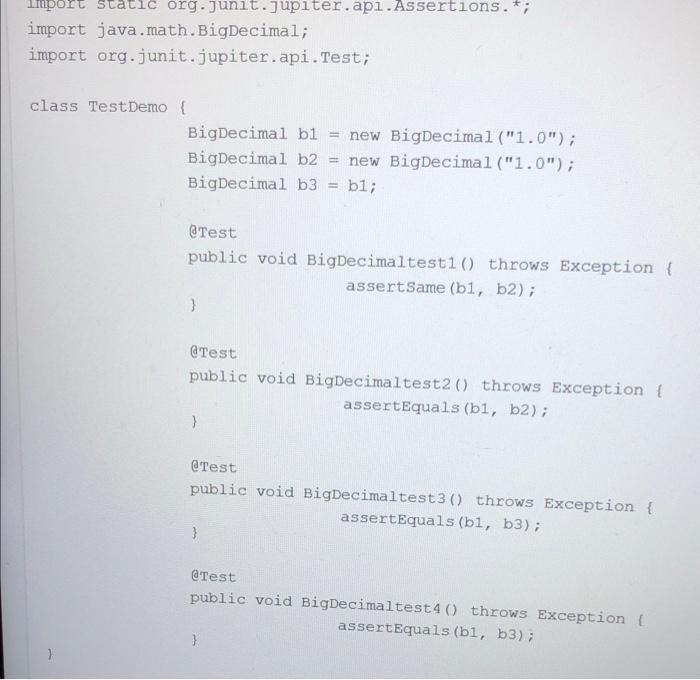
A. 1
B.2
C.3
D.4
import static org.junit.jupiter.api.Assertions.*; import java.math.BigDecimal; import org.junit.jupiter.api. Test; class Test Demo [ BigDecimal b1 = new BigDecimal("1.0"); BigDecimal b2 = new BigDecimal("1.0"); BigDecimal b3 b1; @Test public void BigDecimaltest1() throws Exception { assert Same (bi, b2); } @Test public void BigDecimaltest2() throws Exception { assertEquals (bi, b2); 1 @Test public void BigDecimaltest3() throws Exception { assertEquals (bi, b3); } @Test public void BigDecimaltest 4 () throws Exception assertEquals (bi, b3); }
Step by Step Solution
There are 3 Steps involved in it
1 Expert Approved Answer
Step: 1 Unlock

Question Has Been Solved by an Expert!
Get step-by-step solutions from verified subject matter experts
Step: 2 Unlock
Step: 3 Unlock
 Study Help