Jet Air is the only airline which fly between two islands. There is no alternative ways of transportation. Jet Air is considering whether to offer two types of tickets differentiated by the size of the seat and the quality of service: a premium-class and an economy-class.
Market analysis data shows that there are three different types of passengers distinguished by a willingness to pay for a ticket: H1, H2 and L. The following table summarizes the willingness to pay for a round-trip ticket and number of passengers of three groups. Group H1 and H2 have the higher willingness to pay for both classes than Group L. Group H1 and H2s willingness to pay for a premium-class is the same, but H2 has a higher willingness to pay for an economy-class. Unit costs for a premium and economy-class are $30 and $10 respectively
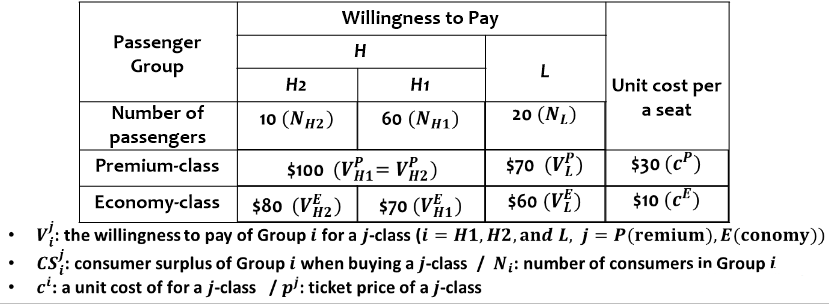
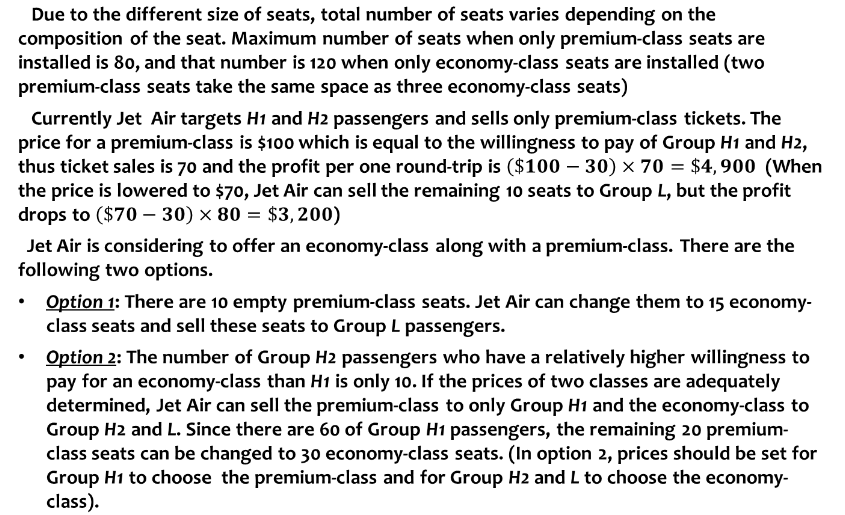
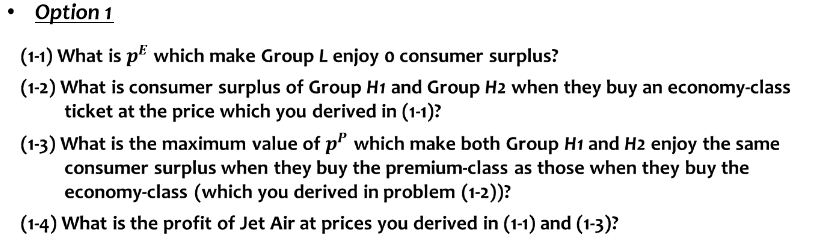
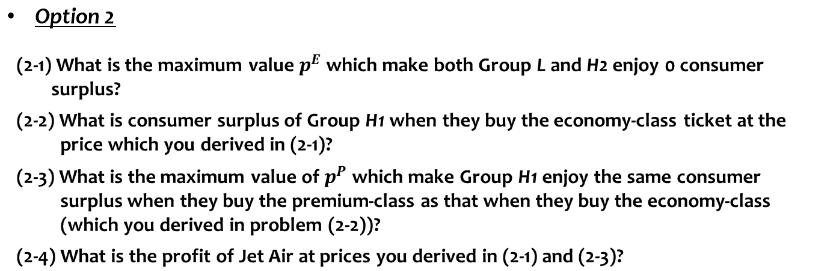
Vij : the willingness to pay of Group i for a j-class (i=H1,H2, and L,j=P( remium ),E (conomy) ) CSij : consumer surplus of Group i when buying a j-class /Ni : number of consumers in Group i ci : a unit cost of for a j-class /pj : ticket price of a j-class Due to the different size of seats, total number of seats varies depending on the composition of the seat. Maximum number of seats when only premium-class seats are installed is 80 , and that number is 120 when only economy-class seats are installed (two premium-class seats take the same space as three economy-class seats) Currently Jet Air targets H1 and H2 passengers and sells only premium-class tickets. The price for a premium-class is $100 which is equal to the willingness to pay of Group H1 and H2, thus ticket sales is 70 and the profit per one round-trip is ($10030)70=$4,900 (When the price is lowered to $70, Jet Air can sell the remaining 10 seats to Group L, but the profit drops to ($7030)80=$3,200) Jet Air is considering to offer an economy-class along with a premium-class. There are the following two options. - Option 1: There are 10 empty premium-class seats. Jet Air can change them to 15 economyclass seats and sell these seats to Group L passengers. - Option 2: The number of Group H2 passengers who have a relatively higher willingness to pay for an economy-class than H1 is only 10 . If the prices of two classes are adequately determined, Jet Air can sell the premium-class to only Group H1 and the economy-class to Group H2 and L. Since there are 60 of Group H1 passengers, the remaining 20 premiumclass seats can be changed to 30 economy-class seats. (In option 2, prices should be set for Group H1 to choose the premium-class and for Group H2 and L to choose the economyclass). (1-1) What is pE which make Group L enjoy o consumer surplus? (1-2) What is consumer surplus of Group H1 and Group H2 when they buy an economy-class ticket at the price which you derived in (1-1)? (1-3) What is the maximum value of pP which make both Group H1 and H2 enjoy the same consumer surplus when they buy the premium-class as those when they buy the economy-class (which you derived in problem (1-2))? (14) What is the profit of Jet Air at prices you derived in (1-1) and (1-3)? (2-1) What is the maximum value pE which make both Group L and H2 enjoy o consumer surplus? (2-2) What is consumer surplus of Group H1 when they buy the economy-class ticket at the price which you derived in (2-1)? (2-3) What is the maximum value of pP which make Group H1 enjoy the same consumer surplus when they buy the premium-class as that when they buy the economy-class (which you derived in problem (2-2))? (24) What is the profit of Jet Air at prices you derived in (2-1) and (2-3)




