







Question: JOSH: Yes, I do . Let's see if we can make these terms make sense by talking through their meaning and their significance to investors.
JOSH: Yes, I do Let's see if we can make these terms make sense by talking through their meaning and their significance to investors.
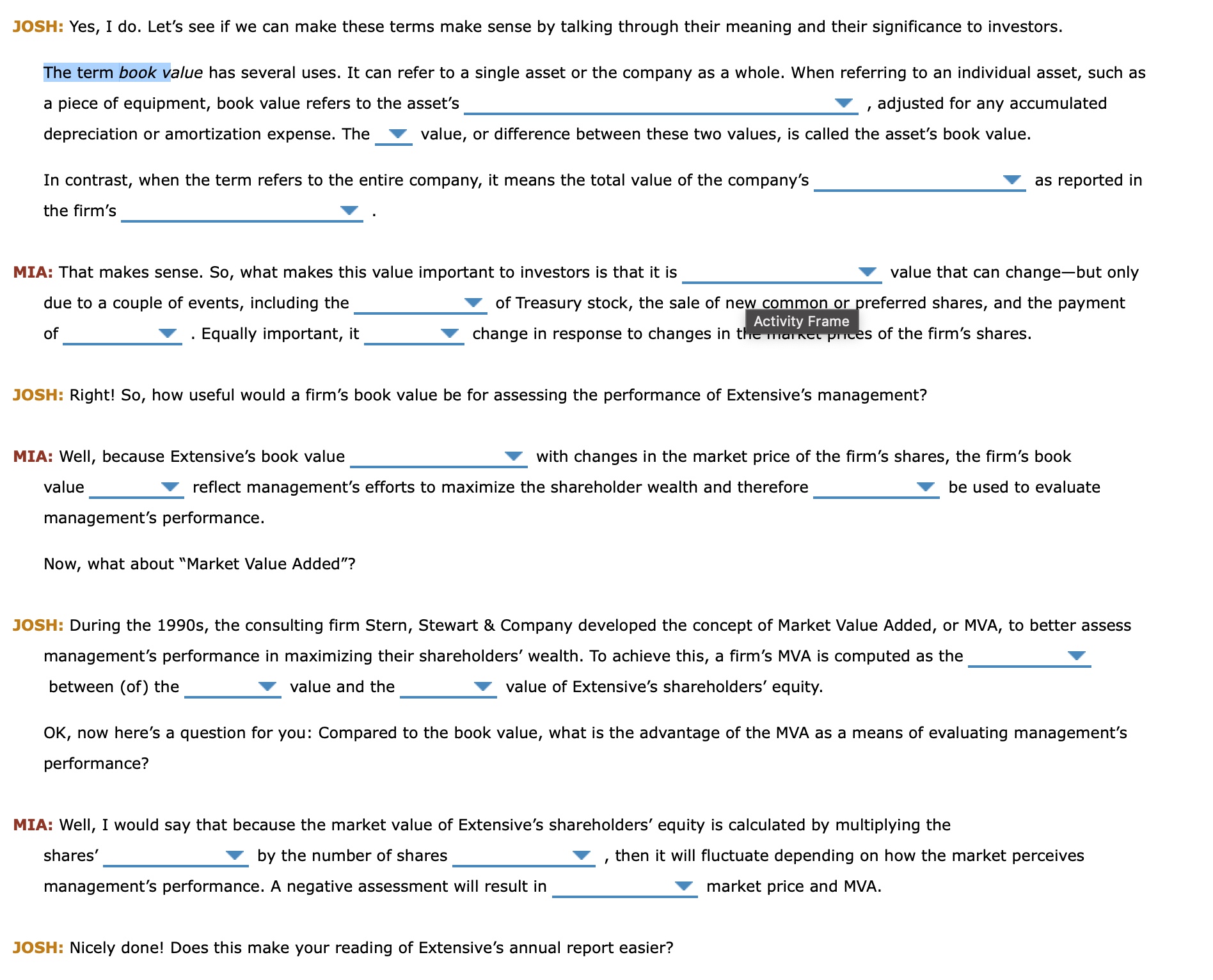
The term book value has several uses. It can refer to a single asset or the company as a whole. When referring to an individual asset, such as
a piece of equipment, book value refers to the asset's
adjusted for any accumulated
depreciation or amortization expense. The value, or difference between these two values, is called the asset's book value.
In contrast, when the term refers to the entire company, it means the total value of the company's
as reported in
the firm's
MIA: That makes sense. So what makes this value important to investors is that it is
value that can changebut only
due to a couple of events, including the
of
Equally important, it
of Treasury stock, the sale of new common or preferred shares, and the payment
change in response to changes in
Activity Frame
JOSH: Right! So how useful would a firm's book value be for assessing the performance of Extensive's management?
MIA: Well, because Extensive's book value
I with changes in the market price of the firm's shares, the firm's book
value
reflect management's efforts to maximize the shareholder wealth and therefore
be used to evaluate
management's performance.
Now, what about "Market Value Added"?
JOSH: During the s the consulting firm Stern, Stewart & Company developed the concept of Market Value Added, or MVA, to better assess
management's performance in maximizing their shareholders' wealth. To achieve this, a firm's MVA is computed as the
between of the
value and the
value of Extensive's shareholders' equity.
OK now here's a question for you: Compared to the book value, what is the advantage of the MVA as a means of evaluating management's
performance?
MIA: Well, I would say that because the market value of Extensive's shareholders' equity is calculated by multiplying the
shares'
by the number of shares
then it will fluctuate depending on how the market perceives
management's performance. A negative assessment will result in
market price and MVA.
JOSH: Nicely done! Does this make your reading of Extensive's annual report easier?
Step by Step Solution
There are 3 Steps involved in it
1 Expert Approved Answer
Step: 1 Unlock

Question Has Been Solved by an Expert!
Get step-by-step solutions from verified subject matter experts
Step: 2 Unlock
Step: 3 Unlock
 Study Help