







Question: Just complete the Base Case sheet please CAPEX Problem Instructions Using the following assumptions, Calculate the NPV and IRR for a Base Case, a Downside
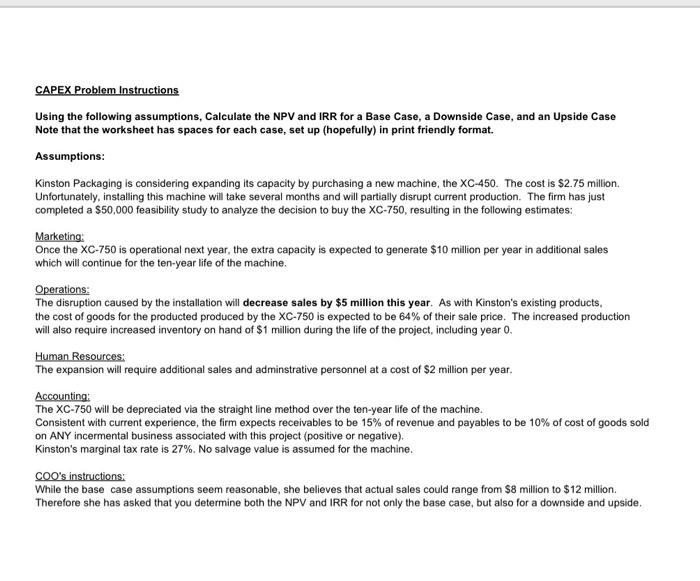
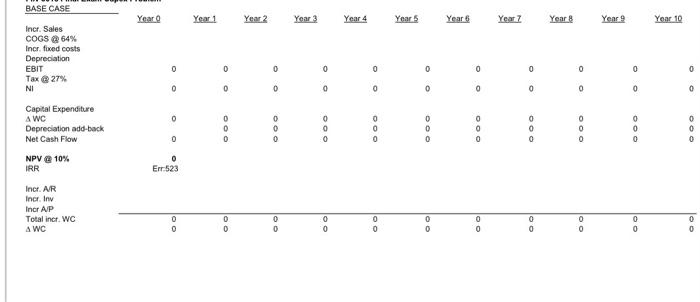
CAPEX Problem Instructions Using the following assumptions, Calculate the NPV and IRR for a Base Case, a Downside Case, and an Upside Case Note that the worksheet has spaces for each case, set up (hopefully) in print friendly format. Assumptions: Kinston Packaging is considering expanding its capacity by purchasing a new machine, the XC-450. The cost is $2.75 million. Unfortunately, installing this machine will take several months and will partially disrupt current production. The firm has just completed a $50,000 feasibility study to analyze the decision to buy the XC-750, resulting in the following estimates: Marketing: Once the XC-750 is operational next year, the extra capacity is expected to generate $10 million per year in additional sales which will continue for the ten-year life of the machine. Operations: The disruption caused by the installation will decrease sales by $5 million this year. As with Kinston's existing products, the cost of goods for the producted produced by the XC-750 is expected to be 64% of their sale price. The increased production will also require increased inventory on hand of $1 million during the life of the project, including year 0 . Human Resources: The expansion will require additional sales and adminstrative personnel at a cost of $2 million per year. Accounting: The XC-750 will be depreciated via the straight line method over the ten-year life of the machine. Consistent with current experience, the firm expects receivables to be 15% of revenue and payables to be 10% of cost of goods sold on ANY incermental business associated with this project (positive or negative). Kinston's marginal tax rate is 27%. No salvage value is assumed for the machine. COO's instructions: While the base case assumptions seem reasonable, she believes that actual sales could range from $8 million to $12 million. Therefore she has asked that you determine both the NPV and IRR for not only the base case, but also for a downside and upside. BASE CASE Incr. Sales cocs of 64% Incr, fixed costs Depreciation EBIT Tax 27% NI Capital Expenditure WC Depreciation add-back Net Cash Flow NPV 10% IRR Err.523 Inet. A/R incr. In incr A.P Total iner. WC WC \begin{tabular}{lllllllllll} \hline 0 & 0 & 0 & 0 & 0 & 0 & 0 & 0 & 0 & 0 & 0 \\ 0 & 0 & 0 & 0 & 0 & 0 & 0 & 0 & 0 & 0 & 0 \end{tabular}
Step by Step Solution
There are 3 Steps involved in it

Get step-by-step solutions from verified subject matter experts
 Study Help