







Question: Just do question 4-5 thank you for your help. This really saves my life. Thanks a ton Question 5 (Hedge funds vs. mutual funds 4pt
Just do question 4-5 thank you for your help. This really saves my life. Thanks a ton
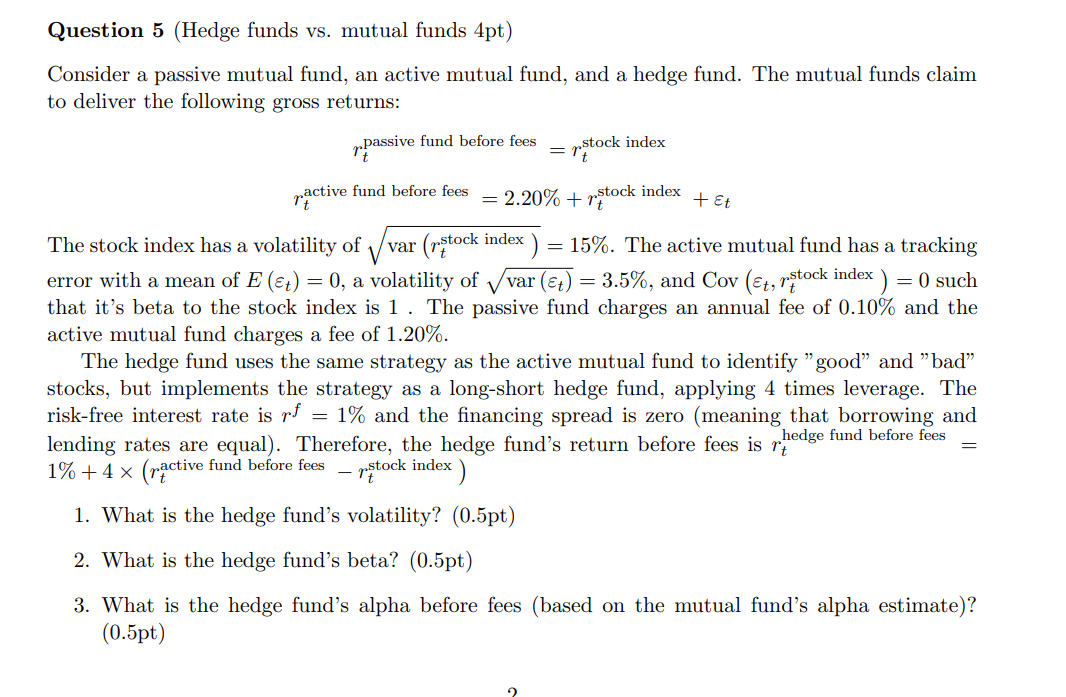
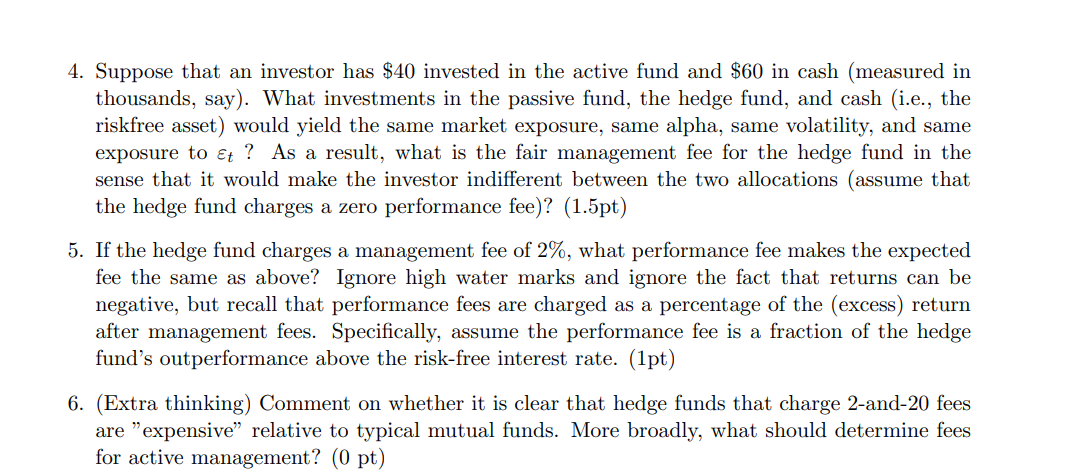
Question 5 (Hedge funds vs. mutual funds 4pt ) Consider a passive mutual fund, an active mutual fund, and a hedge fund. The mutual funds claim to deliver the following gross returns: rtpassivefundbeforefees=rtstockindex rtactivefundbeforefees=2.20%+rtstockindex+t The stock index has a volatility of var(rtstockindex)=15%. The active mutual fund has a tracking error with a mean of E(t)=0, a volatility of var(t)=3.5%, and Cov(t,rtstockindex)=0 such that it's beta to the stock index is 1 . The passive fund charges an annual fee of 0.10% and the active mutual fund charges a fee of 1.20%. The hedge fund uses the same strategy as the active mutual fund to identify "good" and "bad" stocks, but implements the strategy as a long-short hedge fund, applying 4 times leverage. The risk-free interest rate is rf=1% and the financing spread is zero (meaning that borrowing and lending rates are equal). Therefore, the hedge fund's return before fees is rthedgefundbeforefees= 1%+4(rtactivefundbeforefeesrtstockindex) 1. What is the hedge fund's volatility? (0.5pt) 2. What is the hedge fund's beta? (0.5pt) 3. What is the hedge fund's alpha before fees (based on the mutual fund's alpha estimate)? (0.5pt) 4. Suppose that an investor has $40 invested in the active fund and $60 in cash (measured in thousands, say). What investments in the passive fund, the hedge fund, and cash (i.e., the riskfree asset) would yield the same market exposure, same alpha, same volatility, and same exposure to t ? As a result, what is the fair management fee for the hedge fund in the sense that it would make the investor indifferent between the two allocations (assume that the hedge fund charges a zero performance fee)? (1.5pt) 5. If the hedge fund charges a management fee of 2%, what performance fee makes the expected fee the same as above? Ignore high water marks and ignore the fact that returns can be negative, but recall that performance fees are charged as a percentage of the (excess) return after management fees. Specifically, assume the performance fee is a fraction of the hedge fund's outperformance above the risk-free interest rate. (1pt) 6. (Extra thinking) Comment on whether it is clear that hedge funds that charge 2-and-20 fees are "expensive" relative to typical mutual funds. More broadly, what should determine fees for active management? (0pt) Question 5 (Hedge funds vs. mutual funds 4pt ) Consider a passive mutual fund, an active mutual fund, and a hedge fund. The mutual funds claim to deliver the following gross returns: rtpassivefundbeforefees=rtstockindex rtactivefundbeforefees=2.20%+rtstockindex+t The stock index has a volatility of var(rtstockindex)=15%. The active mutual fund has a tracking error with a mean of E(t)=0, a volatility of var(t)=3.5%, and Cov(t,rtstockindex)=0 such that it's beta to the stock index is 1 . The passive fund charges an annual fee of 0.10% and the active mutual fund charges a fee of 1.20%. The hedge fund uses the same strategy as the active mutual fund to identify "good" and "bad" stocks, but implements the strategy as a long-short hedge fund, applying 4 times leverage. The risk-free interest rate is rf=1% and the financing spread is zero (meaning that borrowing and lending rates are equal). Therefore, the hedge fund's return before fees is rthedgefundbeforefees= 1%+4(rtactivefundbeforefeesrtstockindex) 1. What is the hedge fund's volatility? (0.5pt) 2. What is the hedge fund's beta? (0.5pt) 3. What is the hedge fund's alpha before fees (based on the mutual fund's alpha estimate)? (0.5pt) 4. Suppose that an investor has $40 invested in the active fund and $60 in cash (measured in thousands, say). What investments in the passive fund, the hedge fund, and cash (i.e., the riskfree asset) would yield the same market exposure, same alpha, same volatility, and same exposure to t ? As a result, what is the fair management fee for the hedge fund in the sense that it would make the investor indifferent between the two allocations (assume that the hedge fund charges a zero performance fee)? (1.5pt) 5. If the hedge fund charges a management fee of 2%, what performance fee makes the expected fee the same as above? Ignore high water marks and ignore the fact that returns can be negative, but recall that performance fees are charged as a percentage of the (excess) return after management fees. Specifically, assume the performance fee is a fraction of the hedge fund's outperformance above the risk-free interest rate. (1pt) 6. (Extra thinking) Comment on whether it is clear that hedge funds that charge 2-and-20 fees are "expensive" relative to typical mutual funds. More broadly, what should determine fees for active management? (0pt)
Step by Step Solution
There are 3 Steps involved in it

Get step-by-step solutions from verified subject matter experts
 Study Help