







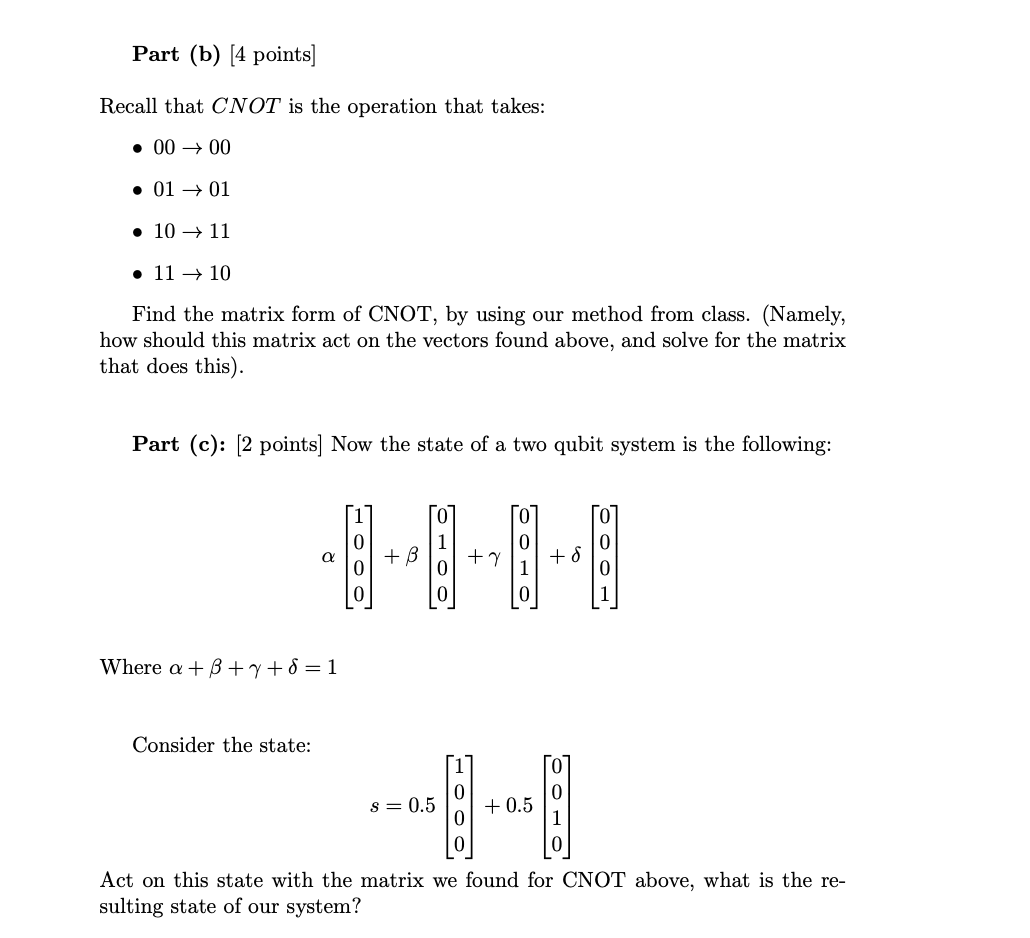
Question: just do the bonus question, please as soon as possible! Thank you so much! Part (b) [4 points] Recall that CN OT is the operation
just do the bonus question, please as soon as possible! Thank you so much!
![so much! Part (b) [4 points] Recall that CN OT is the](https://dsd5zvtm8ll6.cloudfront.net/si.experts.images/questions/2024/10/67068d0ce5908_57267068d0ca7cdb.jpg)
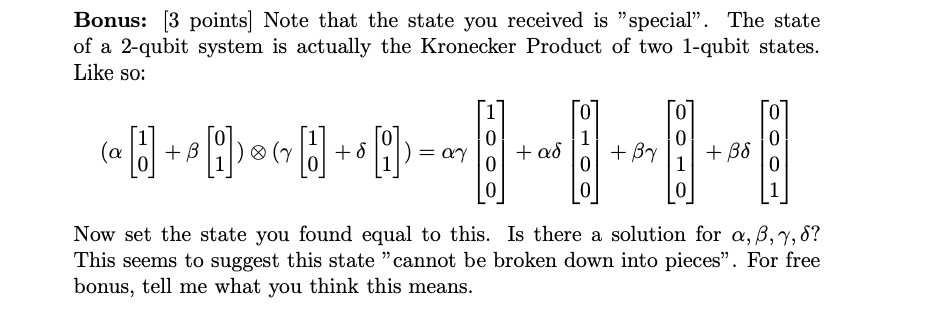
Part (b) [4 points] Recall that CN OT is the operation that takes: 0 00 } 00 o 01 > 01 o 10 } 11 o 11}10 Find the matrix form of CNOT, by using our method from class. (Namely, how should this matrix act on the vectors found above, and solve for the matrix that does this]. Part (c): [2 points] Now the state of a two qubit system is the following: Where ou++ql+6=1 Consider the state: Act on this state with the matrix we found for CNOT above, what is the re- sulting state of our system? Question 3: [8 points total] This question will be on boolean logic, and our easy quantum bit. Recall that we let 0 = . 1=[9] We also define the "new and correct" Kronecker Product as: ac 8 ad bc bd Now recall that we represent 00,01,10,11 as: 080,0 0 1,10 0,101 Furthermore, recall that an easy quantum bit is: a [8] + $ 19] Where a + = 1, as a, S are the associated probabilities of observing 0 or 1. Part (a) [2 points] With the operation defined above, as done in class (but now with the correct operation): Compute the states 00, 01, 10, 11.Bonus: [3 points] Note that the state you received is "special". The state of a 2-qubit system is actually the Kronecker Product of two 1-qubit states. Like so: + ad + By JOHOO + Bo HOOD, OOHO, Now set the state you found equal to this. Is there a solution for a, B, y, 6? This seems to suggest this state "cannot be broken down into pieces". For free bonus, tell me what you think this means
Step by Step Solution
There are 3 Steps involved in it

Get step-by-step solutions from verified subject matter experts
 Study Help