







Question: Just Multiple Choice, No real explanation/work needed, Thanks. 5. Which of the following is not a valid concern with proof testing a SIF too often?
Just Multiple Choice, No real explanation/work needed, Thanks.



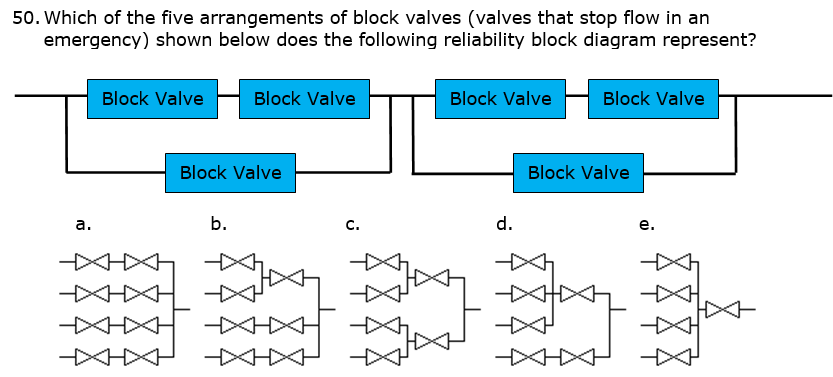
5. Which of the following is not a valid concern with proof testing a SIF too often? a. There is unavailability associated with proof testing too often, which impacts the PFD AvG b. The maintenance cost increases, which means less money can be spent in other areas to improve safety c. Frequent proof testing ( > once every 2 years) will wear out valves d. All the above are equally valid concerns 6. Several countries, including the United Kingdom, Hong Kong, and Australia, mandate ranges for risk in industry. All three of these countries have established the same mandates. What is the range for industrial risk in these three countries? a. Less than 0.01 fatalities per 100,000 work-years is negligible; more than 1,000 fatalities per 100,000 work-years is unacceptable b. Less than 0.1 fatalities per 100,000 work-years is negligible; more than 100 fatalities per 100,000 work-years is unacceptable c. Less than 1 fatality per 100,000 work-years is negligible; more than 10 fatalities per 100,000 work-years is unacceptable d. Less than 1 fatality per 100,000 work-years is negligible; more than 1 fatality per 100,000 work-years is unacceptable 9. Which of the following statements is not true about proof tests? a. Proof tests are important because immediately upon putting a component back into service following a proof test, its PFD is close to zero. b. Proof tests must consist of full field calibration to NIST-traceable standard of sensors and bench testing of the final control elements. c. Proof tests of safety instrumented functions must look at the entire loopsensors, logic solver, and final control element. d. All the above statement are true. 12. What is the term used to describe reducing risk by reducing consequences? a. Inherently safer design b. Minimization c. Mitigation d. Prevention 14. Continuous ventilation may be an appropriate independent layer of protection. Credit may be 0.1 or 0.01 . To what is the difference attributed? a. Extremely toxic releases vs. Ordinary toxic releases b. Simple asphyxiation vs. Chemical asphyxiation c. Unmonitored vs. Monitored operation d. All of the above 16. What does the term "prevention" mean when used to discuss the process risk of a hazardous scenario? a. Eliminate all possible causes b. Make the final event impossible c. Reduce the impact severity of the final event d. Reduce the likelihood of the final event 21. A human response should be expected to fail almost always unless it allows a. Sufficient buffer time b. Time to detect the problem c. Time to decide what to do d. Time to act e. Time for the action to take effect f. All the above 22. A good reason to have more than three sensors in the design of a safety function include all the following except a. Detecting localized problems b. Detecting separate hazards c. Measuring process profiles d. Redundancy 23. If valves exist in the following arrangement in a plant and their purpose is to open flow through the pipe in an emergency, how should they be represented on a reliability block diagram? c. Either could be correct depending on the type of valve d. Neither is correct 24. A LOPA should take into account the role that people play in a scenario. This is best described as a. Human action can serve as an independent layer of protection when there is time to respond b. Human action can serve as the cause or initiating event of the scenario c. Human operators can serve as "receptors" of the consequences-victims d. Humans can fill any of these roles and all can be applied to a LOPA scenario analysis 25. Risk that is so small it can be ignored, lost in the noise of background risk, is called a. De manifestus risk b. De minimus risk c. Latent Risk d. Tolerable Risk Criteria the inlet temperature of a heat exchanger with the outlet temperature of the heat exchanger and trips when the difference is too low? a. 1001 b. 1002 c. 2002 d. 21001 50. Which of the five arrangements of block valves (valves that stop flow in an emergency) shown below does the following reliability block diagram represent
Step by Step Solution
There are 3 Steps involved in it

Get step-by-step solutions from verified subject matter experts
 Study Help