







Question: K Q QUESTION 8 The second variation will have you graphing pq vs. p + q. Manipulate the Lens Equation into a form that


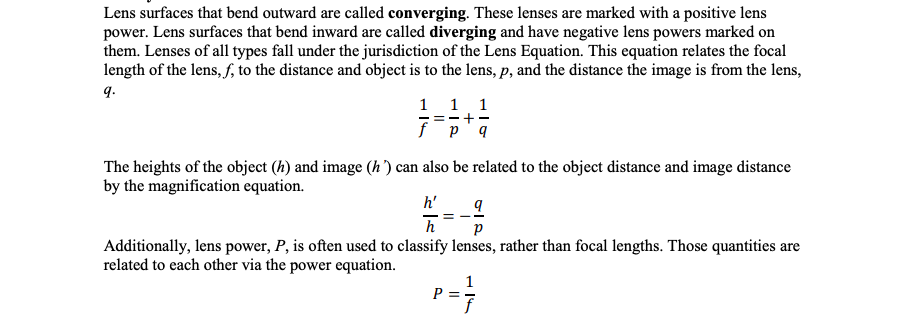
K Q QUESTION 8 The second variation will have you graphing pq vs. p + q. Manipulate the Lens Equation into a form that provides an appropriate line of best fit. For the toolbar, press ALT+F10 (PC) or ALT+FN+F10 (Mac). 2 points Save Answer BIUS Paragraph Arial 10pt = = = = > < - +- + * T >> + P L+ ABC III III A QUESTION 10 What kind of fit will you use on this graph? Linear? Quadratic? Exponential? Something else? Explain your answer. For the toolbar, press ALT+F10 (PC) or ALT+FN+F10 (Mac). BIUS Paragraph Arial 10pt ABC B P A 2 Tx x 2 points Save Answer Q 0 WORDS POWERED BY TINY Lens surfaces that bend outward are called converging. These lenses are marked with a positive lens power. Lens surfaces that bend inward are called diverging and have negative lens powers marked on them. Lenses of all types fall under the jurisdiction of the Lens Equation. This equation relates the focal length of the lens, f, to the distance and object is to the lens, p, and the distance the image is from the lens, 9. 1 1 1 =-+- fp q The heights of the object (h) and image (h) can also be related to the object distance and image distance by the magnification equation. h' h = q P Additionally, lens power, P, is often used to classify lenses, rather than focal lengths. Those quantities are related to each other via the power equation. 17 P =
Step by Step Solution
There are 3 Steps involved in it

Get step-by-step solutions from verified subject matter experts
 Study Help