Question: Kindly Answer Carefully Question Number 3: Note: Read the given case and answer the given questions accordingly. a. Analyze the role of Money Market Instruments
Kindly Answer Carefully
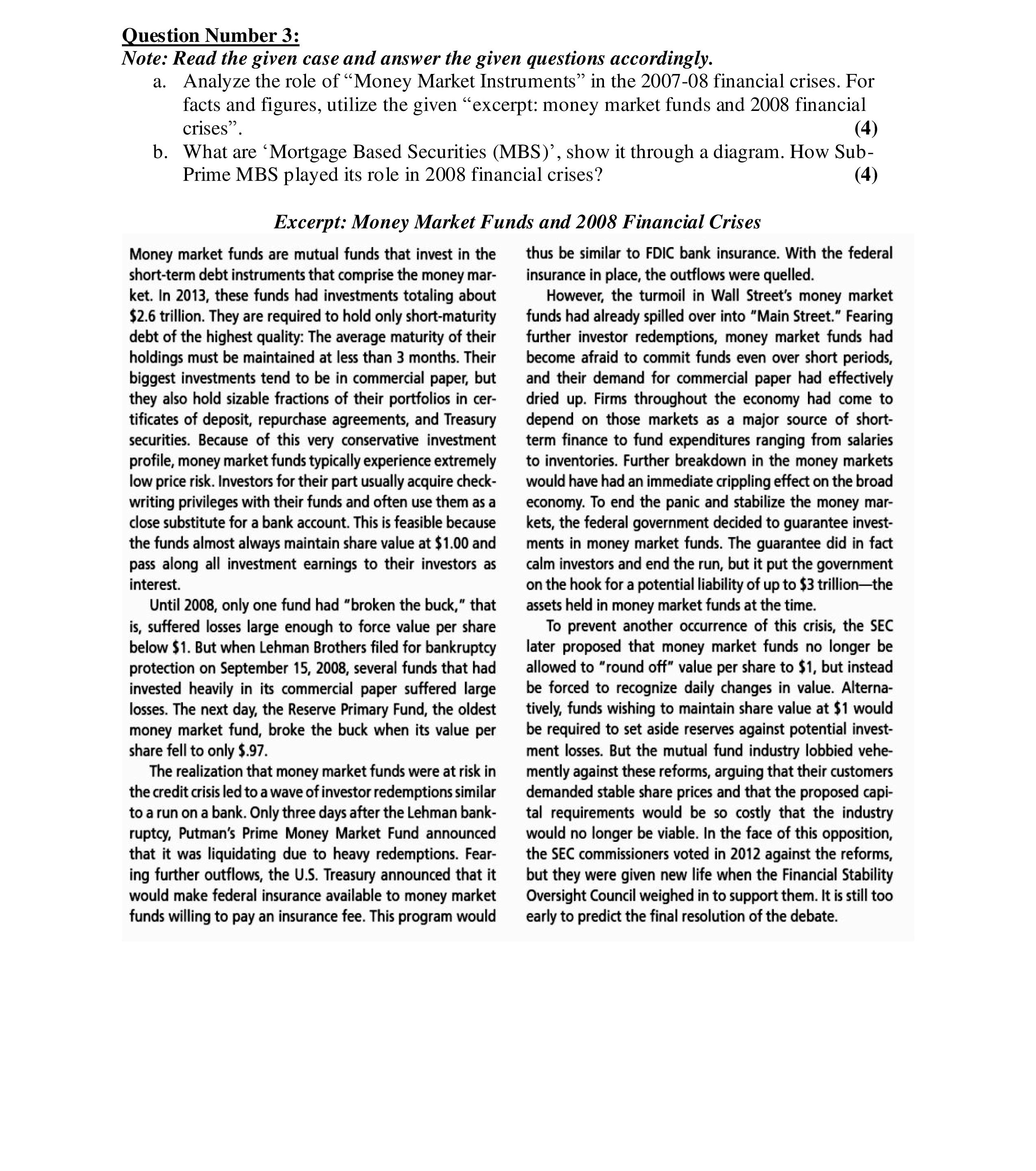
Question Number 3: Note: Read the given case and answer the given questions accordingly. a. Analyze the role of \"Money Market Instruments\" in the 2007-08 financial crises. For facts and figures, utilize the given \"excerpt: money market funds and 2008 financial crises\". (4) b. What are 'Mortgage Based Securities (MBS)', show it through a diagram. How Sub- Prime MBS played its role in 2008 financial crises? (4) Excerpt: Money Market Funds and 2008 Financial Crises Money market funds are mutual funds that invest in the short-term debt instmments that comprise the money mar- ket. In 2013. these funds had investments totaling about $2.6 trillion. They are required to hold only short-maturity debt of the highest quality: The average maturity of their holdings must be maintained at less than 3 months. Their biggest investments tend to be in commercial paper, but they also hold sizable fractions of their portfolios in cer- ticates of deposit, repurchase agreements, and Treasury securities. Because of this very conservative investment profile. money market funds typically experience extremely low price risk. investors for their part usually acquire chedc- writing privileges with their funds and often use them as a close substitute for a bank account. This is feasible because the funds almost always maintain share value at $1.00 and pass along all investment earnings to their investors as interest. Until 2008. only one fund had \"broken the buck.\" that is, suffered losses large enough to force value per share below 51. But when Lehman Brothers led for bankruptcy protection on September 15, 2008, several funds that had invested heavily in its commercial paper suffered large losses. The next day. the Reserve Primary Fund. the oldest money market fund, broke the buck when its value per share fell to only $.97. The realization that money market funds were at risk in meoedit crisisledto awaveofinvestorredemptions similar to a run on a bank. Only three days after the Lehman bank ruptcy, Putrnan's Prime Money Market Fund announced that it was liquidating clue to heavy redemptions. Fear- ing further outflows, the U5. Treasury announced that it would make federal insurance available to money market funds willing to pay an insurance fee. This program would thus be similar to FDIC bank insurance. With the federal insurance in place, the outflows were quelled. However. the turmoil in Wall Street's money market funds had already spilled over into \"Main Street.\" Fearing further investor redemptions, money market funds had become afraid to commit funds even over short periods. and their demand for commercial paper had effectively dried up. Firms throughout the economy had come to depend on those markets as a major source of short- tenn nance to fund expendtures ranging from salaries to inventories. further breakdown in the money markets would have had an immediate crippling effect on the broad economy. To end the panic and stabilize the money mar- kets, the federal government decided to guarantee invest ments in money market funds. The guarantee did in fact calm investors and end the run, but it put the government on the hook for a potential liabilityof up to $3 trillionthe assets held in money market funds at the time. To prevent another oooarrence of this crisis, the SEC later proposed that money market funds no longer be allowed to 'round off" value per share to 51, but instead be forced to recognize daily changes in value. Altema- tively. funds wishing to maintain share value at $1 would be required to set aside reserves against potential invest- ment losses. But the mutual fund industry lobbied vehe- mentiy against these reforms, arguing thattheir customers demanded stable share prices and that the proposed capl- tal requirements would be so costly that the industry would no longer be viable. In the face of this opposition, the SEC commissioners voted in 2012 against the reforms. but they were given new life when the Financial Stability Oversight Council weighed in to support them. it is still too early to predict the final resolution of the debate









 Study Help