



Question: Kindly help me out We are interested in the effect of sleeping time on exam performance. Suppose that we have collected data on 1000 students
Kindly help me out
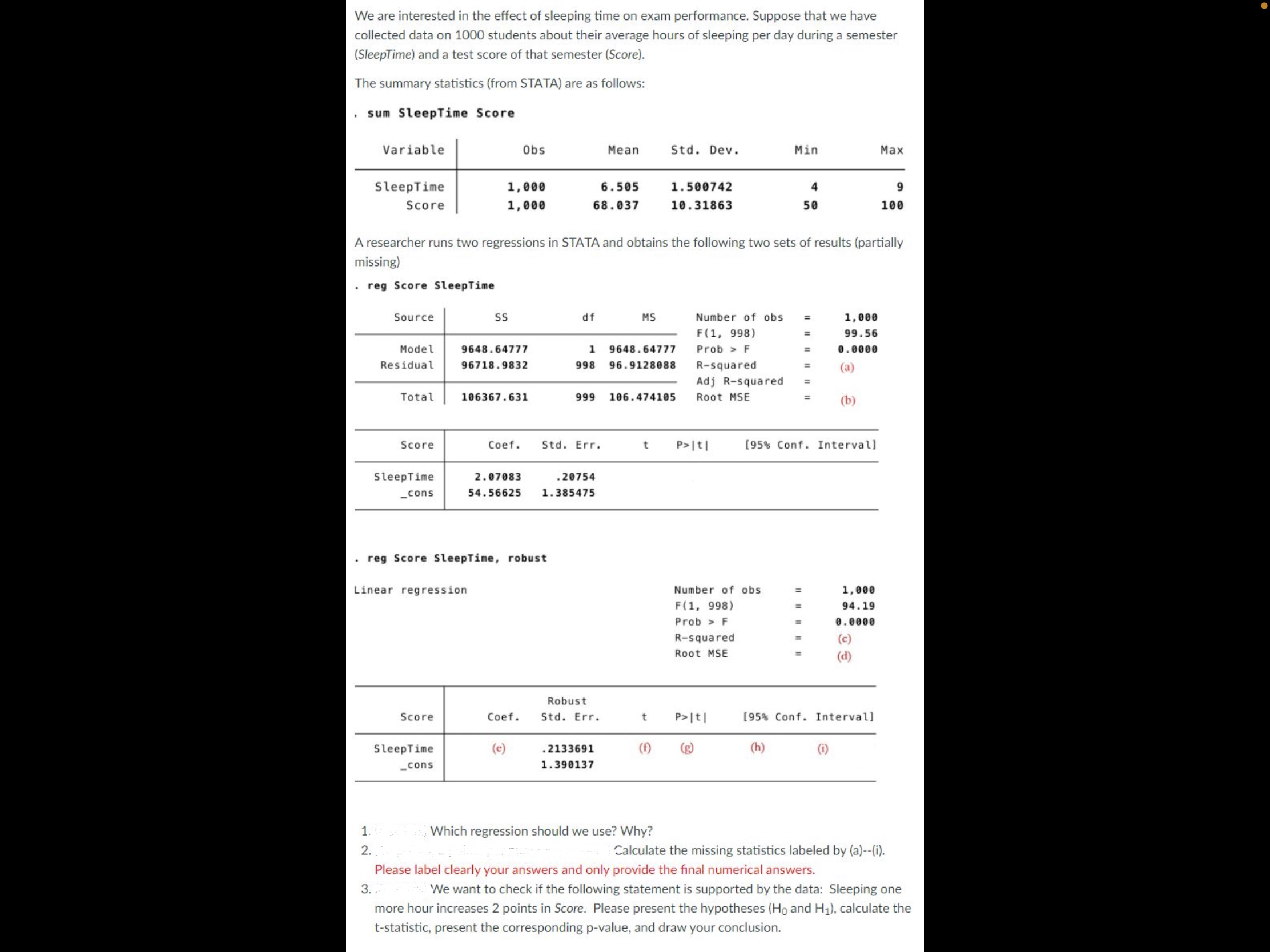
We are interested in the effect of sleeping time on exam performance. Suppose that we have collected data on 1000 students about their average hours of sleeping per day during a semester SleepTime) and a test score of that semester (Score). The summary statistics (from STATA) are as follows: sum SleepTime Score Variable Obs Mean Std. Dev. Min Max SleepTime 1, 000 6.505 1. 500742 9 Score 1, 000 68.037 10. 31863 50 100 A researcher runs two regressions in STATA and obtains the following two sets of results (partially missing . reg Score SleepTime Source SS df MS Number of obs 1, 000 F (1, 998) 99. 56 Model 9648 . 64777 1 9648.64777 Prob > 0 . 00.0 Residual 96718 . 9832 998 96.9128088 R-squared Adj R-squared Total 106367 .631 999 106.474105 Root MSE 11 (a (b Score Coef. Std. Err. [95% Conf. Interval] SleepTime 2. 07083 . 20754 _cons 54.56625 1. 385475 reg Score SleepTime, robust Linear regression Number of obs 1, 000 F (1, 998) 94. 19 Prob > F 0. 0000 R-squared (C Root MSE (d) Robust Score Coef. Std. Err. [95% Conf. Interval] SleepTime (e) . 2133691 (f) (g) (h) (i) _cons 1. 390137 1. Which regression should we use? Why? 2. Calculate the missing statistics labeled by (a)--(i). Please label clearly your answers and only provide the final numerical answers. 3. We want to check if the following statement is supported by the data: Sleeping one more hour increases 2 points in Score. Please present the hypotheses (Ho and H1), calculate the t-statistic, present the corresponding p-value, and draw your conclusion
Step by Step Solution
There are 3 Steps involved in it

Get step-by-step solutions from verified subject matter experts