







Question: Kindly make a work-centered analysis (WCA) for the above case. provide the following: customers, products or services, business process, participants, information, and technology. RESUMLX: PROCESSING
Kindly make a work-centered analysis (WCA) for the above case.
provide the following: customers, products or services, business process, participants, information, and technology.
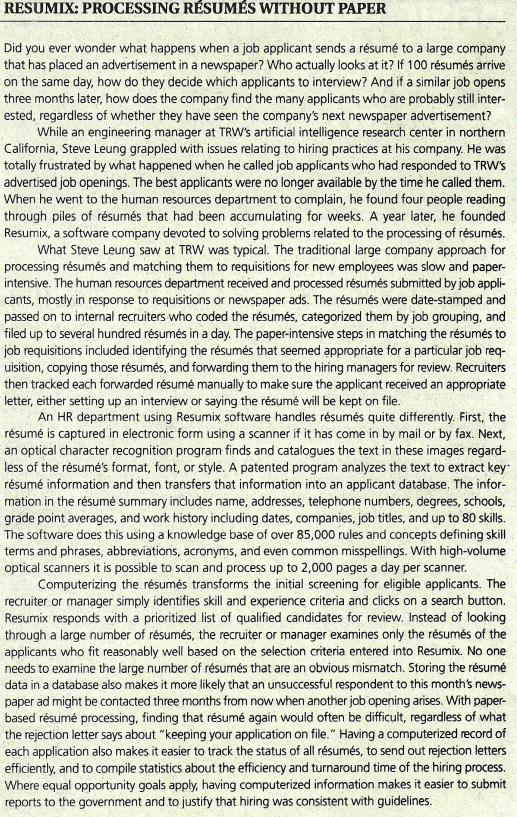
RESUMLX: PROCESSING REESUMS WITHOUT PAPER Did you ever wonder what happens when a job applicant sends a rsum to a large company that has placed an advertisement in a newspaper? Who actually looks at it? If 100 rsums arrive on the same day, how do they decide which applicants to interview? And if a similar job opens three months later, how does the company find the many applicants who are probably still interested, regardless of whether they have seen the company's next newspaper advertisement? While an engineering manager at TRW's artificial intelligence research center in northern California, Steve Leung grappled with issues relating to hiring practices at his company. He was totally frustrated by what happened when he called job applicants who had responded to TRW's advertised job openings. The best applicants were no longer available by the time he called them. When he went to the human resources department to complain, he found four people reading through piles of rsums that had been accumulating for weeks. A year later, he founded Resumix, a software company devoted to solving problems related to the processing of rsums. What Steve Leung saw at TRW was typical. The traditional large company approach for processing rsums and matching them to requisitions for new employees was slow and paperintensive. The human resources department received and processed rsums submitted by job applicants, mostly in response to requisitions or newspaper ads. The rsums were date-stamped and passed on to internal recruiters who coded the rsums, categorized them by job grouping, and filed up to several hundred rsums in a day. The paper-intensive steps in matching the rsums to job requisitions included identifying the rsums that seemed appropriate for a particular job requisition, copying those rsums, and forwarding them to the hiring managers for review. Recruiters then tracked each forwarded rsum manually to make sure the applicant received an appropriate letter, either setting up an interview or saying the rsum will be kept on file. An HR department using Resumix software handles rsums quite differently. First, the rsum is captured in electronic form using a scanner if it has come in by mail or by fax. Next, an optical character recognition program finds and catalogues the text in these images regardless of the rsum's format, font, or style. A patented program analyzes the text to extract keyrsum information and then transfers that information into an applicant database. The information in the rsum summary includes name, addresses, telephone numbers, degrees, schools, grade point averages, and work history including dates, companies, job titles, and up to 80 skills. The software does this using a knowledge base of over 85,000 rules and concepts defining skill terms and phrases, abbreviations, acronyms, and even common misspellings. With high-volume optical scanners it is possible to scan and process up to 2,000 pages a day per scanner. Computerizing the rsums transforms the initial screening for eligible applicants. The recruiter or manager simply identifies skill and experience criteria and clicks on a search button. Resumix responds with a prioritized list of qualified candidates for review. Instead of looking through a large number of rsums, the recruiter or manager examines only the rsums of the applicants who fit reasonably well based on the selection criteria entered into Resumix. No one needs to examine the large number of rsums that are an obvious mismatch. Storing the rsum data in a database also makes it more likely that an unsuccessful respondent to this month's newspaper ad might be contacted three months from now when another job opening arises. With paperbased rsum processing, finding that rsum again would often be difficult, regardless of what the rejection letter says about "keeping your application on file." Having a computerized record of each application also makes it easier to track the status of all rsums, to send out rejection letters efficiently, and to compile statistics about the efficiency and turnaround time of the hiring process. Where equal opportunity goals apply, having computerized information makes it easier to submit reports to the government and to justify that hiring was consistent with guidelinesStep by Step Solution
There are 3 Steps involved in it
1 Expert Approved Answer
Step: 1 Unlock

Question Has Been Solved by an Expert!
Get step-by-step solutions from verified subject matter experts
Step: 2 Unlock
Step: 3 Unlock
 Study Help