



Question: kindly only answer every question in detailed paragraphs without any subheadings. ( Company Case Gillette: Searching for the Right Price in a Volatile Market) Questions
kindly only answer every question in detailed paragraphs without any subheadings.
(Company Case Gillette: Searching for the Right Price in a Volatile Market)
Questions for Discussion
10-15 Based on the concept of customer value-based pricing, explain Gillettes rise to market dominance.?
10-16 Why did Gillettes red-hot growth slow down? List multiple reasons, includingbut also other thanthose related to the companys pricing strategy.?
10-17 What are some directions in which Gillette can innovatively redesign its pricing strategy to support its market share and profitability?
10-18 Small group exercise: Gillettes competitor Schick has worked around Gillettes patents and launched a razor and blade that incorporates almost all of Gillettes differentiatorsa vibrating razor, a razor head with five blades and a precision trimmer, a proprietary soothing gel, an exfoliating strip, and even a heated shaving surface. Schick has positioned its product againstbut priced it at a 40 percent discount belowGillettes corresponding top-end product. Assume the role of a consulting team and advise Gillettes CEO on the various steps that Gillette should take in response?
need all these answer in paragraph forms urgently.
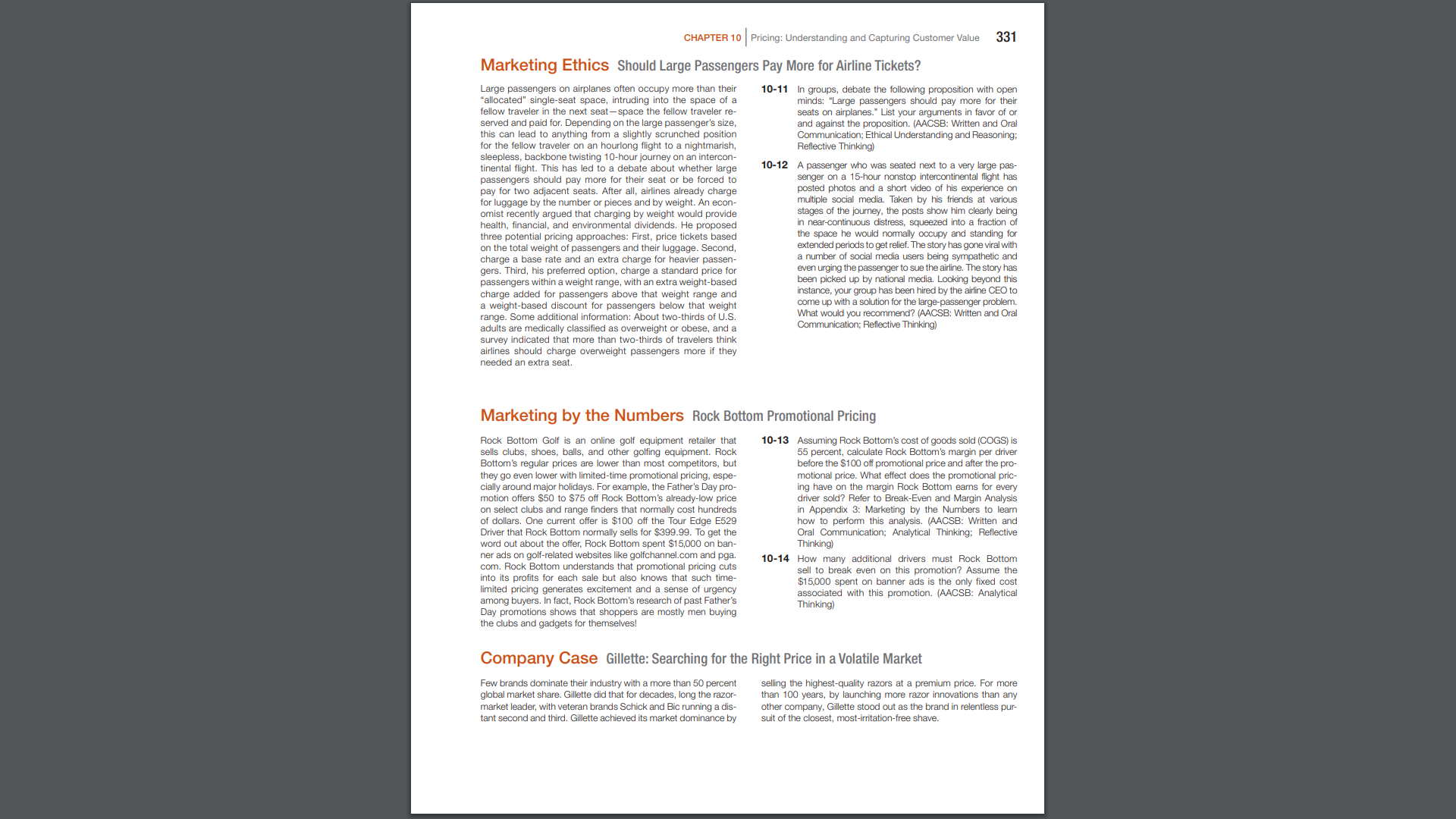
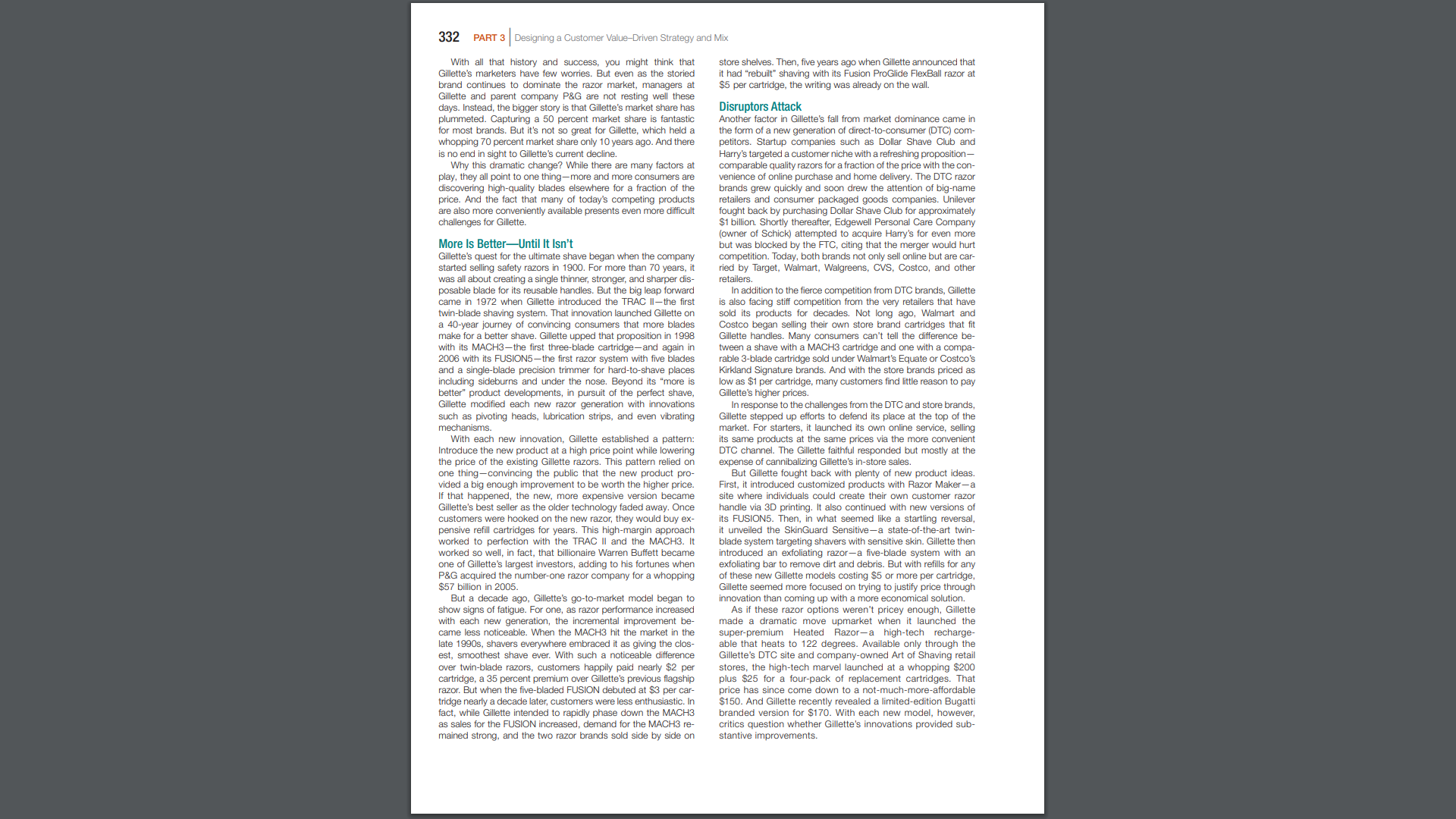
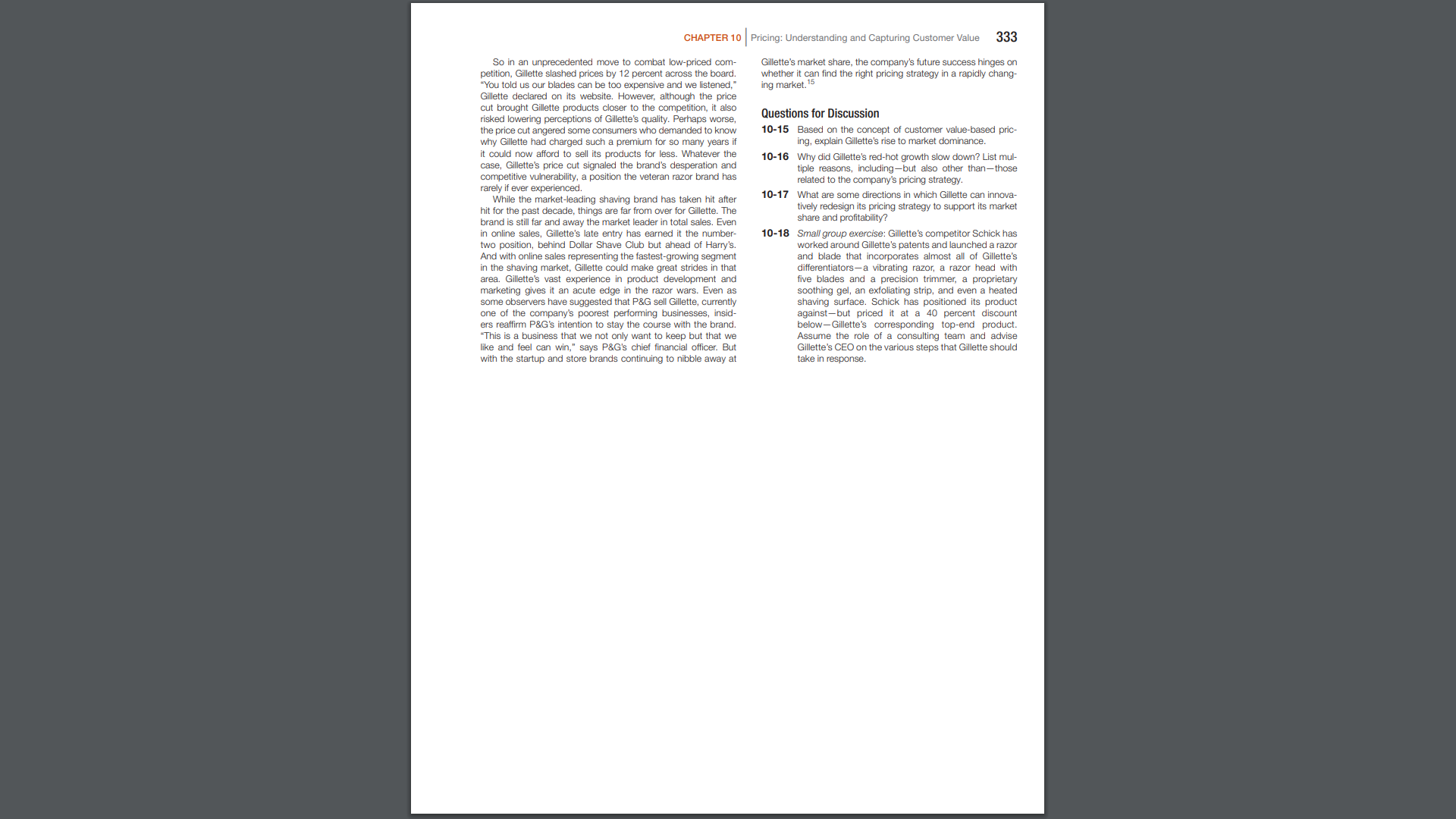
CHAPTER 10 |Pricing: Understanding and Capturing Customer Value 331 Marketing Ethics Should Large Passengers Pay More for Airline Tickets? Large passengers on airplanes often occupy more than their "allocated" single-seat space, intruding into the space of a fellow traveler in the next seat-space the fellow traveler reserved and paid for. Depending on the large passenger's size, this can lead to anything from a slightly scrunched position for the fellow traveler on an hourlong flight to a nightmarish, sleepless, backbone twisting 10-hour journey on an intercontinental flight. This has led to a debate about whether large passengers should pay more for their seat or be forced to pay for two adjacent seats. After all, airlines already charge for luggage by the number or pieces and by weight. An economist recently argued that charging by weight would provide health, financial, and environmental dividends. He proposed three potential pricing approaches: First, price tickets based on the total weight of passengers and their luggage. Second, charge a base rate and an extra charge for heavier passengers. Third, his preferred option, charge a standard price for passengers within a weight range, with an extra weight-based charge added for passengers above that weight range and a weight-based discount for passengers below that weight range. Some additional information: About two-thirds of U.S. adults are medically classified as overweight or obese, and a survey indicated that more than two-thirds of travelers think airlines should charge overweight passengers more if they needed an extra seat. 10-11 In groups, debate the following proposition with open minds: "Large passengers should pay more for their seats on airplanes." List your arguments in favor of or and against the proposition. (AACSB: Written and Oral Communication; Ethical Understanding and Reasoning; Reflective Thinking) 10-12 A passenger who was seated next to a very large passenger on a 15-hour nonstop intercontinental flight has posted photos and a short video of his experience on multiple social media. Taken by his friends at various stages of the journey, the posts show him clearly being in near-continuous distress, squeezed into a fraction of the space he would normally occupy and standing for extended periods to get relief. The story has gone viral with a number of social media users being sympathetic and even urging the passenger to sue the airline. The story has been picked up by national media. Looking beyond this instance, your group has been hired by the airline CEO to come up with a solution for the large-passenger problem. Communication; Reflective Thinking) Marketing by the Numbers Rock Bottom Promotional Pricing Rock Bottom Golf is an online golf equipment retailer that sells clubs, shoes, balls, and other golfing equipment. Rock Bottom's regular prices are lower than most competitors, but they go even lower with limited-time promotional pricing, especially around major holidays. For example, the Father's Day promotion offers $50 to $75 off Rock Bottom's already-low price on select clubs and range finders that normally cost hundreds of dollars. One current offer is $100 off the Tour Edge E529 Driver that Rock Bottom normally sells for $399.99. To get the word out about the offer, Rock Bottom spent $15,000 on banner ads on golf-related websites like golfchannel.com and pga. com. Rock Bottom understands that promotional pricing cuts into its profits for each sale but also knows that such timeinto its profits for each sale but also knows that such time- limited pricing generates excitement and a sense of urgency among buyers. In fact, Rock Bottom's research of past Father's Day promotions shows that shoppers are mostly men buying the clubs and gadgets for themselves! 10-13 Assuming Rock Bottom's cost of goods sold (COGS) is 55 percent, calculate Rock Bottom's margin per driver 55 percent, calculate Rock Bottom's margin per driver before the $100 off promotional price and after the promotional price. What effect does the promotional pricing have on the margin Rock Bottom earns for every driver sold? Refer to Break-Even and Margin Analysis in Appendix 3: Marketing by the Numbers to learn how to perform this analysis. (AACSB: Written and Thinking) 10-14 How many additional drivers must Rock Bottom sell to break even on this promotion? Assume the $15,000 spent on banner ads is the only fixed cost associated with this promotion. (AACSB: Analytical Thinking) Company Case Gillette: Searching for the Right Price in a Volatile Market Few brands dominate their industry with a more than 50 percent global market share. Gillette did that for decades, long the razormarket leader, with veteran brands Schick and Bic running a dis- tant second and third. Gillette achieved its market dominance by selling the highest-quality razors at a premium price. For more than 100 years, by launching more razor innovations than any other company, Gillette stood out as the brand in relentless pursuit of the closest, most-irritation-free shave. With all that history and success, you might think that Gillette's marketers have few worries. But even as the storied brand continues to dominate the razor market, managers at Gillette and parent company P\&G are not resting well these days. Instead, the bigger story is that Gillette's market share has plummeted. Capturing a 50 percent market share is fantastic for most brands. But it's not so great for Gillette, which held a whopping 70 percent market share only 10 years ago. And there is no end in sight to Gillette's current decline. Why this dramatic change? While there are many factors at play, they all point to one thing - more and more consumers are discovering high-quality blades elsewhere for a fraction of the price. And the fact that many of today's competing products are also more conveniently available presents even more difficult challenges for Gillette. More Is Better-Until It Isn't Gillette's quest for the ultimate shave began when the company started selling safety razors in 1900 . For more than 70 years, it was all about creating a single thinner, stronger, and sharper disposable blade for its reusable handles. But the big leap forward came in 1972 when Gillette introduced the TRAC II-the first twin-blade shaving system. That innovation launched Gillette on a 40 -year journey of convincing consumers that more blades make for a better shave. Gillette upped that proposition in 1998 with its MACH3 - the first three-blade cartridge-and again in 2006 with its FUSION5 - the first razor system with five blades and a single-blade precision trimmer for hard-to-shave places including sideburns and under the nose. Beyond its "more is better" product developments, in pursuit of the perfect shave, Gillette modified each new razor generation with innovations such as pivoting heads, lubrication strips, and even vibrating mechanisms. With each new innovation, Gillette established a pattern: Introduce the new product at a high price point while lowering the price of the existing Gillette razors. This pattern relied on one thing-convincing the public that the new product provided a big enough improvement to be worth the higher price. If that happened, the new, more expensive version became Gillette's best seller as the older technology faded away. Once customers were hooked on the new razor, they would buy expensive refill cartridges for years. This high-margin approach worked to perfection with the TRAC II and the MACH3. It worked so well, in fact, that billionaire Warren Buffett became one of Gillette's largest investors, adding to his fortunes when P\&G acquired the number-one razor company for a whopping $57 billion in 2005. But a decade ago, Gillette's go-to-market model began to show signs of fatigue. For one, as razor performance increased with each new generation, the incremental improvement became less noticeable. When the MACH3 hit the market in the late 1990 s, shavers everywhere embraced it as giving the closest, smoothest shave ever. With such a noticeable difference over twin-blade razors, customers happily paid nearly $2 per cartridge, a 35 percent premium over Gillette's previous flagship razor. But when the five-bladed FUSION debuted at $3 per cartridge nearly a decade later, customers were less enthusiastic. In fact, while Gillette intended to rapidly phase down the MACH3 as sales for the FUSION increased, demand for the MACH3 remained strong, and the two razor brands sold side by side on store shelves. Then, five years ago when Gillette announced that it had "rebuilt" shaving with its Fusion ProGlide FlexBall razor at $5 per cartridge, the writing was already on the wall. Disruptors Attack Another factor in Gillette's fall from market dominance came in the form of a new generation of direct-to-consumer (DTC) competitors. Startup companies such as Dollar Shave Club and Harry's targeted a customer niche with a refreshing propositioncomparable quality razors for a fraction of the price with the convenience of online purchase and home delivery. The DTC razor brands grew quickly and soon drew the attention of big-name retailers and consumer packaged goods companies. Unilever fought back by purchasing Dollar Shave Club for approximately $1 billion. Shortly thereafter, Edgewell Personal Care Company (owner of Schick) attempted to acquire Harry's for even more but was blocked by the FTC, citing that the merger would hurt competition. Today, both brands not only sell online but are carried by Target, Walmart, Walgreens, CVS, Costco, and other retailers. In addition to the fierce competition from DTC brands, Gillette is also facing stiff competition from the very retailers that have sold its products for decades. Not long ago, Walmart and Costco began selling their own store brand cartridges that fit Gillette handles. Many consumers can't tell the difference between a shave with a MACH3 cartridge and one with a comparable 3-blade cartridge sold under Walmart's Equate or Costco's Kirkland Signature brands. And with the store brands priced as low as $1 per cartridge, many customers find little reason to pay Gillette's higher prices. In response to the challenges from the DTC and store brands, Gillette stepped up efforts to defend its place at the top of the market. For starters, it launched its own online service, selling its same products at the same prices via the more convenient DTC channel. The Gillette faithful responded but mostly at the expense of cannibalizing Gillette's in-store sales. But Gillette fought back with plenty of new product ideas. First, it introduced customized products with Razor Maker-a site where individuals could create their own customer razor handle via 3D printing. It also continued with new versions of its FUSION5. Then, in what seemed like a startling reversal, it unveiled the SkinGuard Sensitive-a state-of-the-art twinblade system targeting shavers with sensitive skin. Gillette then introduced an exfoliating razor - a five-blade system with an exfoliating bar to remove dirt and debris. But with refills for any of these new Gillette models costing $5 or more per cartridge, Gillette seemed more focused on trying to justify price through innovation than coming up with a more economical solution. As if these razor options weren't pricey enough, Gillette made a dramatic move upmarket when it launched the super-premium Heated Razor-a high-tech rechargeable that heats to 122 degrees. Available only through the Gillette's DTC site and company-owned Art of Shaving retail stores, the high-tech marvel launched at a whopping $200 plus $25 for a four-pack of replacement cartridges. That price has since come down to a not-much-more-affordable $150. And Gillette recently revealed a limited-edition Bugatti branded version for $170. With each new model, however, critics question whether Gillette's innovations provided substantive improvements. So in an unprecedented move to combat low-priced competition, Gillette slashed prices by 12 percent across the board. "You told us our blades can be too expensive and we listened," Gillette declared on its website. However, although the price cut brought Gillette products closer to the competition, it also risked lowering perceptions of Gillette's quality. Perhaps worse, the price cut angered some consumers who demanded to know why Gillette had charged such a premium for so many years if it could now afford to sell its products for less. Whatever the case, Gillette's price cut signaled the brand's desperation and competitive vulnerability, a position the veteran razor brand has rarely if ever experienced. While the market-leading shaving brand has taken hit after hit for the past decade, things are far from over for Gillette. The brand is still far and away the market leader in total sales. Even in online sales, Gillette's late entry has earned it the numbertwo position, behind Dollar Shave Club but ahead of Harry's. And with online sales representing the fastest-growing segment in the shaving market, Gillette could make great strides in that area. Gillette's vast experience in product development and marketing gives it an acute edge in the razor wars. Even as some observers have suggested that P\&G sell Gillette, currently one of the company's poorest performing businesses, insiders reaffirm P\&G's intention to stay the course with the brand. "This is a business that we not only want to keep but that we like and feel can win," says P\&G's chief financial officer. But with the startup and store brands continuing to nibble away at Gillette's market share, the company's future success hinges on whether it can find the right pricing strategy in a rapidly changing market. 15 Questions for Discussion 10-15 Based on the concept of customer value-based pricing, explain Gillette's rise to market dominance. 10-16 Why did Gillette's red-hot growth slow down? List multiple reasons, including-but also other than-those related to the company's pricing strategy. 10-17 What are some directions in which Gillette can innovatively redesign its pricing strategy to support its market share and profitability? 10-18 Small group exercise: Gillette's competitor Schick has worked around Gillette's patents and launched a razor and blade that incorporates almost all of Gillette's differentiators - a vibrating razor, a razor head with five blades and a precision trimmer, a proprietary soothing gel, an exfoliating strip, and even a heated shaving surface. Schick has positioned its product against-but priced it at a 40 percent discount below-Gillette's corresponding top-end product. Assume the role of a consulting team and advise Gillette's CEO on the various steps that Gillette should take in response
Step by Step Solution
There are 3 Steps involved in it

Get step-by-step solutions from verified subject matter experts