







Question: 1. Based on the concept of customer valuebased pricing, explain Gillettes rise to market dominance. 2. Historically, did Gillette employ good-value pricing or value-added pricing?
1. Based on the concept of customer valuebased pricing, explain Gillettes rise to market dominance.
2. Historically, did Gillette employ good-value pricing or value-added pricing?
Explain.
3. Based on those same concepts of value-based pricing, explain how Gillettes pricing strategy stopped working.
4. What can Gillette do to improve its position in the market?
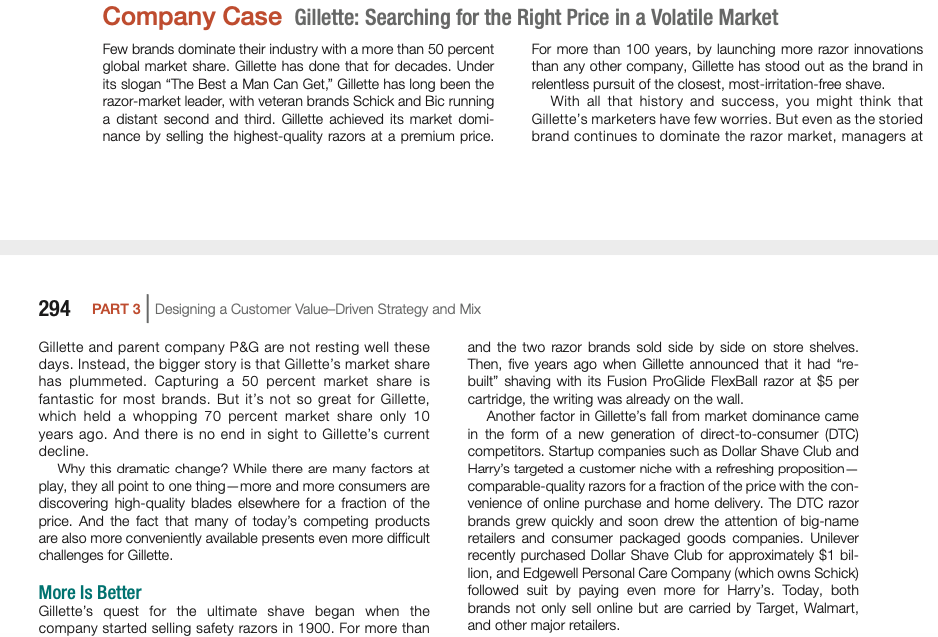
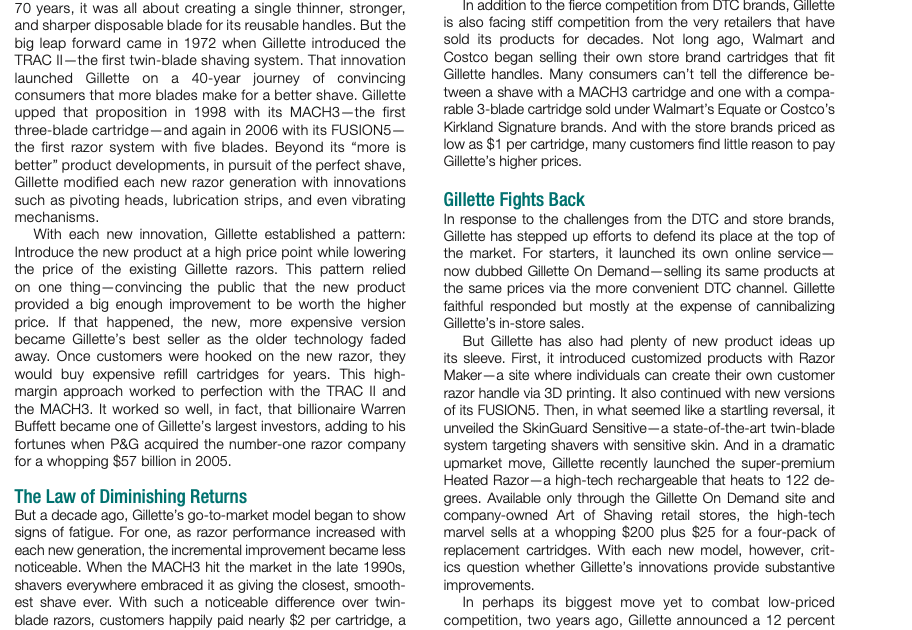
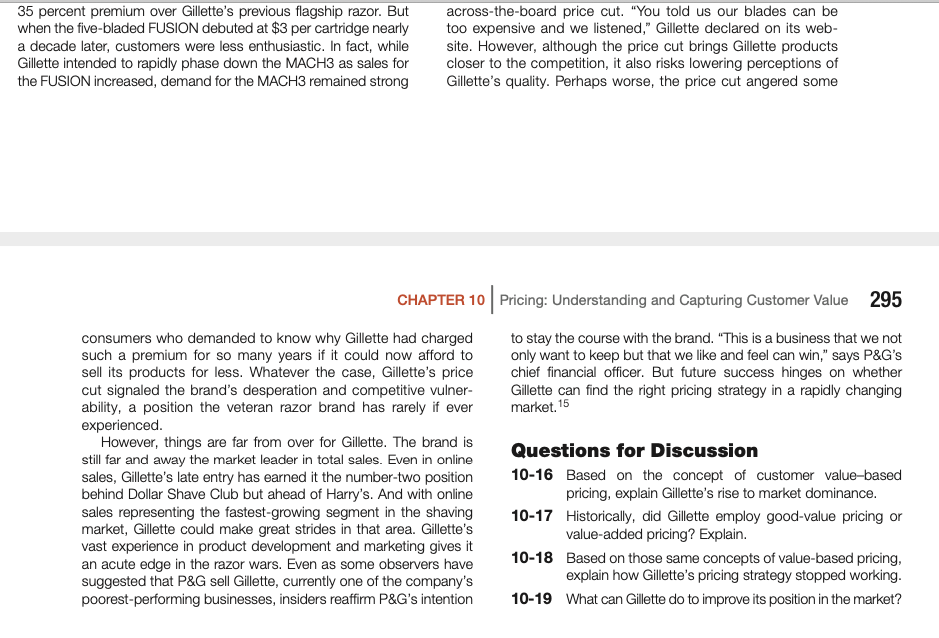
Company Case Gillette: Searching for the Right Price in a Volatile Market Few brands dominate their industry with a more than 50 percent For more than 100 years, by launching more razor innovations global market share. Gillette has done that for decades. Under than any other company, Gillette has stood out as the brand in its slogan "The Best a Man Can Get," Gillette has long been the relentless pursuit of the closest, most-irritation-free shave. razor-market leader, with veteran brands Schick and Bic running With all that history and success, you might think that a distant second and third. Gillette achieved its market domi- Gillette's marketers have few worries. But even as the storied nance by selling the highest-quality razors at a premium price. brand continues to dominate the razor market, managers at 294 PART 3 | Designing a Customer Value-Driven Strategy and Mix Gillette and parent company P&G are not resting well these and the two razor brands sold side by side on store shelves. days. Instead, the bigger story is that Gillette's market share Then, five years ago when Gillette announced that it had re- has plummeted. Capturing a 50 percent market share is built" shaving with its Fusion Proglide FlexBall razor at $5 per fantastic for most brands. But it's not so great for Gillette, cartridge, the writing was already on the wall. which held a whopping 70 percent market share only 10 Another factor in Gillette's fall from market dominance came years ago. And there is no end in sight to Gillette's current in the form of a new generation of direct-to-consumer (DTC) decline. competitors. Startup companies such as Dollar Shave Club and Why this dramatic change? While there are many factors at Harry's targeted a customer niche with a refreshing proposition, play, they all point to one thing-more and more consumers are comparable-quality razors for a fraction of the price with the con- discovering high-quality blades elsewhere for a fraction of the venience of online purchase and home delivery. The DTC razor price. And the fact that many of today's competing products brands grew quickly and soon drew the attention of big-name are also more conveniently available presents even more difficult retailers and consumer packaged goods companies. Unilever challenges for Gillette. recently purchased Dollar Shave Club for approximately $1 bil- lion, and Edgewell Personal Care Company (which owns Schick) More Is Better followed suit by paying even more for Harry's. Today, both Gillette's quest for the ultimate shave began when the brands not only sell online but are carried by Target, Walmart, company started selling safety razors in 1900. For more than and other major retailers. In addition to the fierce competition from DTC brands, Gillette is also facing stiff competition from the very retailers that have sold its products for decades. Not long ago, Walmart and Costco began selling their own store brand cartridges that fit Gillette handles. Many consumers can't tell the difference be- tween a shave with a MACH3 cartridge and one with a compa- rable 3-blade cartridge sold under Walmart's Equate or Costco's Kirkland Signature brands. And with the store brands priced as low as $1 per cartridge, many customers find little reason to pay Gillette's higher prices. 70 years, it was all about creating a single thinner, stronger, and sharper disposable blade for its reusable handles. But the big leap forward came in 1972 when Gillette introduced the TRAC II-the first twin-blade shaving system. That innovation launched Gillette on a 40-year journey of convincing consumers that more blades make for a better shave. Gillette upped that proposition in 1998 with its MACH3-the first three-blade cartridge-and again in 2006 with its FUSION5 the first razor system with five blades. Beyond its "more is better" product developments, in pursuit of the perfect shave, Gillette modified each new razor generation with innovations such as pivoting heads, lubrication strips, and even vibrating mechanisms. With each new innovation, Gillette established a pattern: Introduce the new product at a high price point while lowering the price of the existing Gillette razors. This pattern relied on one thing-convincing the public that the new product provided a big enough improvement to be worth the higher price. If that happened, the new, more expensive version became Gillette's best seller as the older technology faded away. Once customers were hooked on the new razor, they would buy expensive refill cartridges for years. This high- margin approach worked to perfection with the TRAC II and the MACH3. It worked so well, in fact, that billionaire Warren Buffett became one of Gillette's largest investors, adding to his fortunes when P&G acquired the number-one razor company for a whopping $57 billion in 2005. Gillette Fights Back In response to the challenges from the DTC and store brands, Gillette has stepped up efforts to defend its place at the top of the market. For starters, it launched its own online service- now dubbed Gillette On Demand-selling its same products at the same prices via the more convenient DTC channel. Gillette faithful responded but mostly at the expense of cannibalizing Gillette's in-store sales. But Gillette has also had plenty of new product ideas up its sleeve. First, it introduced customized products with Razor Maker-a site where individuals can create their own customer razor handle via 3D printing. It also continued with new versions of its FUSION5. Then, in what seemed like a startling reversal, it unveiled the SkinGuard Sensitive-a state-of-the-art twin-blade system targeting shavers with sensitive skin. And in a dramatic upmarket move, Gillette recently launched the super-premium Heated Razor-a high-tech rechargeable that heats to 122 de- grees. Available only through the Gillette On Demand site and company-owned Art of Shaving retail stores, the high-tech marvel sells at a whopping $200 plus $25 for a four-pack of replacement cartridges. With each new model, however, crit- ics question whether Gillette's innovations provide substantive improvements. In perhaps its biggest move yet to combat low-priced competition, two years ago, Gillette announced a 12 percent The Law of Diminishing Returns But a decade ago, Gillette's go-to-market model began to show signs of fatigue. For one, as razor performance increased with each new generation, the incremental improvement became less noticeable. When the MACH3 hit the market in the late 1990s, shavers everywhere embraced it as giving the closest, smooth- est shave ever. With such a noticeable difference over twin- blade razors, customers happily paid nearly $2 per cartridge, a 35 percent premium over Gillette's previous flagship razor. But when the five-bladed FUSION debuted at $3 per cartridge nearly a decade later, customers were less enthusiastic. In fact, while Gillette intended to rapidly phase down the MACH3 as sales for the FUSION increased, demand for the MACH3 remained strong across-the-board price cut. "You told us our blades can be too expensive and we listened," Gillette declared on its web- site. However, although the price cut brings Gillette products closer to the competition, it also risks lowering perceptions of Gillette's quality. Perhaps worse, the price cut angered some CHAPTER 10 Pricing: Understanding and Capturing Customer Value 295 to stay the course with the brand. This is a business that we not only want to keep but that we like and feel can win," says P&G's chief financial officer. But future success hinges on whether Gillette can find the right pricing strategy in a rapidly changing market.15 consumers who demanded to know why Gillette had charged such a premium for so many years if it could now afford to sell its products for less. Whatever the case, Gillette's price cut signaled the brand's desperation and competitive vulner- ability, a position the veteran razor brand has rarely if ever experienced. However, things are far from over for Gillette. The brand is still far and away the market leader in total sales. Even in online sales, Gillette's late entry has earned it the number-two position behind Dollar Shave Club but ahead of Harry's. And with online sales representing the fastest-growing segment in the shaving market, Gillette could make great strides in that area. Gillette's vast experience in product development and marketing gives it an acute edge in the razor wars. Even as some observers have suggested that P&G sell Gillette, currently one of the company's poorest-performing businesses, insiders reaffirm P&G's intention Questions for Discussion 10-16 Based on the concept of customer value-based pricing, explain Gillette's rise to market dominance. 10-17 Historically, did Gillette employ good-value pricing or value-added pricing? Explain. 10-18 Based on those same concepts of value-based pricing, explain how Gillette's pricing strategy stopped working. 10-19 What can Gillette do to improve its position in the market
Step by Step Solution
There are 3 Steps involved in it
1 Expert Approved Answer
Step: 1 Unlock

Question Has Been Solved by an Expert!
Get step-by-step solutions from verified subject matter experts
Step: 2 Unlock
Step: 3 Unlock
 Study Help