



Question: Kindly provide Summary Recommendation/Solution of this case CASE STUDY BIOPHARMA, INC. In 2005. Phillip (Phil) Landgraf faced several glaring of production, can be assigned to
Kindly provide
Summary
Recommendation/Solution
of this case
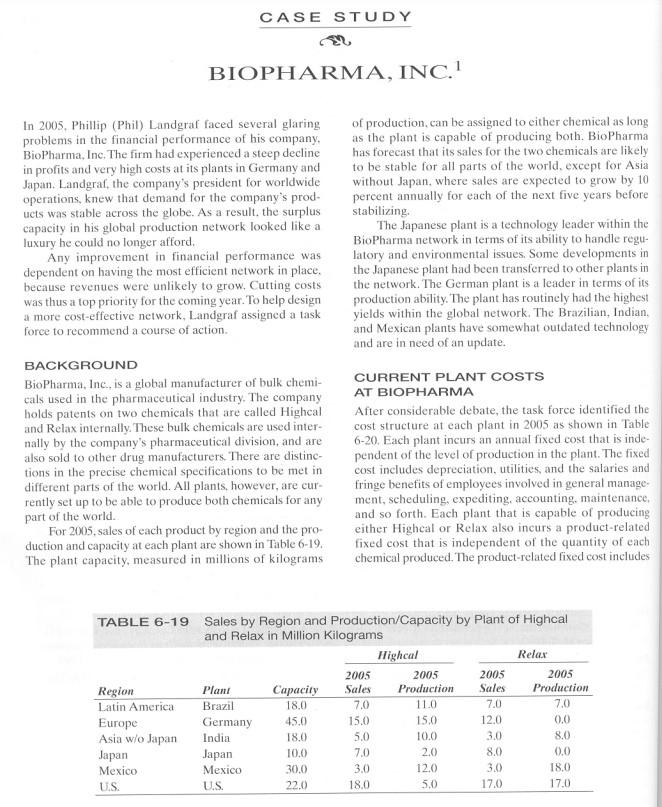
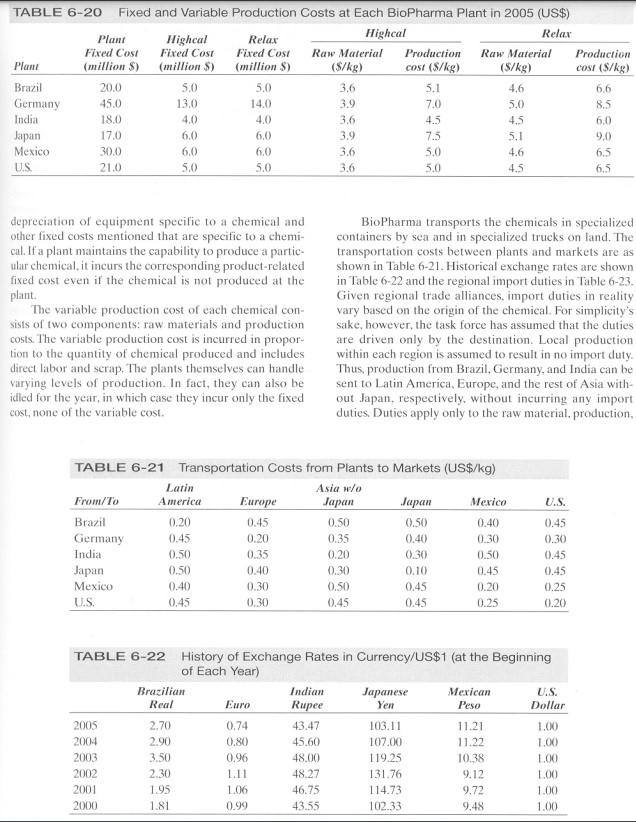
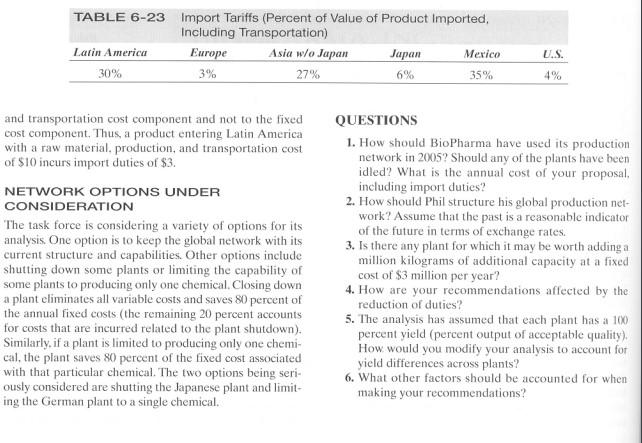
CASE STUDY BIOPHARMA, INC. In 2005. Phillip (Phil) Landgraf faced several glaring of production, can be assigned to either chemical as long problems in the financial performance of his company, as the plant is capable of producing both. BioPharma BioPharma, Inc. The firm had experienced a steep decline has forecast that its sales for the two chemicals are likely in profits and very high costs at its plants in Germany and to be stable for all parts of the world. except for Asia Japan. Landgraf, the company's president for worldwide without Japan, where sales are expected to grow by 10 operations, knew that demand for the company's prod- percent annually for each of the next five years before ucts was stable across the globe. As a result. the surplus stabilizing. capacity in his global production network looked like a The Japanese plant is a technology leader within the luxury he could no longer afford. BioPharma network in terms of its ability to handle reguAny improvement in financial performance was latory and environmental issues. Some developments in dependent on having the most efficient network in place. the Japanese plant had been transferred to other plants in because revenues were unlikely to grow. Cutting costs the network. The German plant is a leader in terms of its was thus a top priority for the coming year. To help design production ability. The plant has routinely had the highest a more cost-effective network, Landgraf assigned a task yields within the global network. The Brazilian, Indian, force to recommend a course of action. and Mexican plants have somewhat outdated technology and are in need of an update. BACKGROUND BioPharma, Inc., is a global manufacturer of bulk chemi- CURRENT PLANT COSTS cals used in the pharmaceutical industry. The company AT BIOPHARMA holds patents on two chemicals that are called Highcal After considerable debate, the task force identified the and Relax internally. These bulk chemicals are used inter- cost structure at each plant in 2005 as shown in Table nally by the company's pharmaceutical division, and are 6-20. Each plant incurs an annual fixed cost that is indealso sold to other drug manufacturers. There are distine- pendent of the level of production in the plant. The fixed tions in the precise chemical specifications to be met in cost includes depreciation, utilities, and the salaries and different parts of the world. All plants, however, are cur- fringe benefits of employees involved in general managerently set up to be able to produce both chemicals for any ment, scheduling, expediting, accounting. maintenance, part of the world. and so forth. Each plant that is capable of producing For 2005 , sales of each product by region and the pro-_ either Highcal or Relax also incurs a product-related duction and capacity at each plant are shown in Table 6-19. fixed cost that is independent of the quantity of each The plant capacity, measured in millions of kilograms chemical produced. The product-related fixed cost includes TABLE 6-19 Sales by Region and Production/Capacity by Plant of Highcal and Relax in Million Kilograms depreciation of equipment specific to a chemical and BioPharma transports the chemicals in specialized other fixed costs mentioned that are specific to a chemi- containers by sea and in specialized trucks on land. The cal. If a plant maintains the capability to produce a partic- transportation costs between plants and markets are as ular chemical, it incurs the corresponding product-related shown in Table 6-21. Historical exchange rates are shown fixed cost even if the chemical is not produced at the in Table 622 and the regional import duties in Table 6-23. plant. Given regional trade alliances, import duties in reality The variable production cost of each chemical con- vary based on the origin of the chemical. For simplicity's sists of two components: raw materials and production sake, however, the task force has assumed that the duties costs. The variable production cost is incurred in propor- are driven only by the destination. Local production tion to the quantity of chemical produced and includes within each region is assumed to result in no import duty. direct labor and scrap. The plants themselves can handle Thus, production from Brazil, Germany, and India can be varying levels of production. In fact, they can also be sent to Latin America, Europe, and the rest of Asia withidled for the year, in which case they incur only the fixed out Japan, respectively, without incurring any import cost, none of the variable cost. duties, Duties apply only to the raw material, production, TABLE 6-22 History of Exchange Rates in Currency/US\$1 (at the Beginning of Each Year) TABLE 6-23 Import Tariffs (Percent of Value of Product Imported, Including Transportation) and transportation cost component and not to the fixed QUESTIONS cost component. Thus, a product entering Latin America 1. How should BioPharma have used its production with a raw material, production, and transportation cost network in 2005? Should any of the plants have been of $10 incurs import duties of $3. idled? What is the annual cost of your proposal. NETWORK OPTIONS UNDER including import duties? CONSIDERATION 2. How should Phil structure his global production net- The task force is considering a variety of options for its work? Assume that the past is a reasonable indicator analysis. One option is to keep the global network with its of the future in terms of exchange rates. current structure and capabilities. Other options include 3. Is there any plant for which it may be worth adding a shutting down some plants or limiting the capability of million kilograms of additional capacity at a fixed some plants to producing only one chemical. Closing down cost of $3 million per year? a plant eliminates all variable costs and saves 80 percent of 4. How are your recommendations affected by the the annual fixed costs (the remaining 20 percent accounts reduction of duties? for costs that are incurred related to the plant shutdown). 5. The analysis has assumed that each plant has a 100 Similarly, if a plant is limited to producing only one chemipercent yield (percent output of acceptable quality). cal, the plant saves 80 pereent of the fixed cost associated How would you modify your analysis to account for with that particular chemical. The two options being seriyield differences across plants? ously considered are shutting the Japanese plant and limit- 6. What other factors should be accounted for when ing the German plant to a single chemical. making your recommendations
Step by Step Solution
There are 3 Steps involved in it
1 Expert Approved Answer
Step: 1 Unlock

Question Has Been Solved by an Expert!
Get step-by-step solutions from verified subject matter experts
Step: 2 Unlock
Step: 3 Unlock