



Question: kindly read and summarize this text for me in a way that I understand what it is about that forms my idea of the text
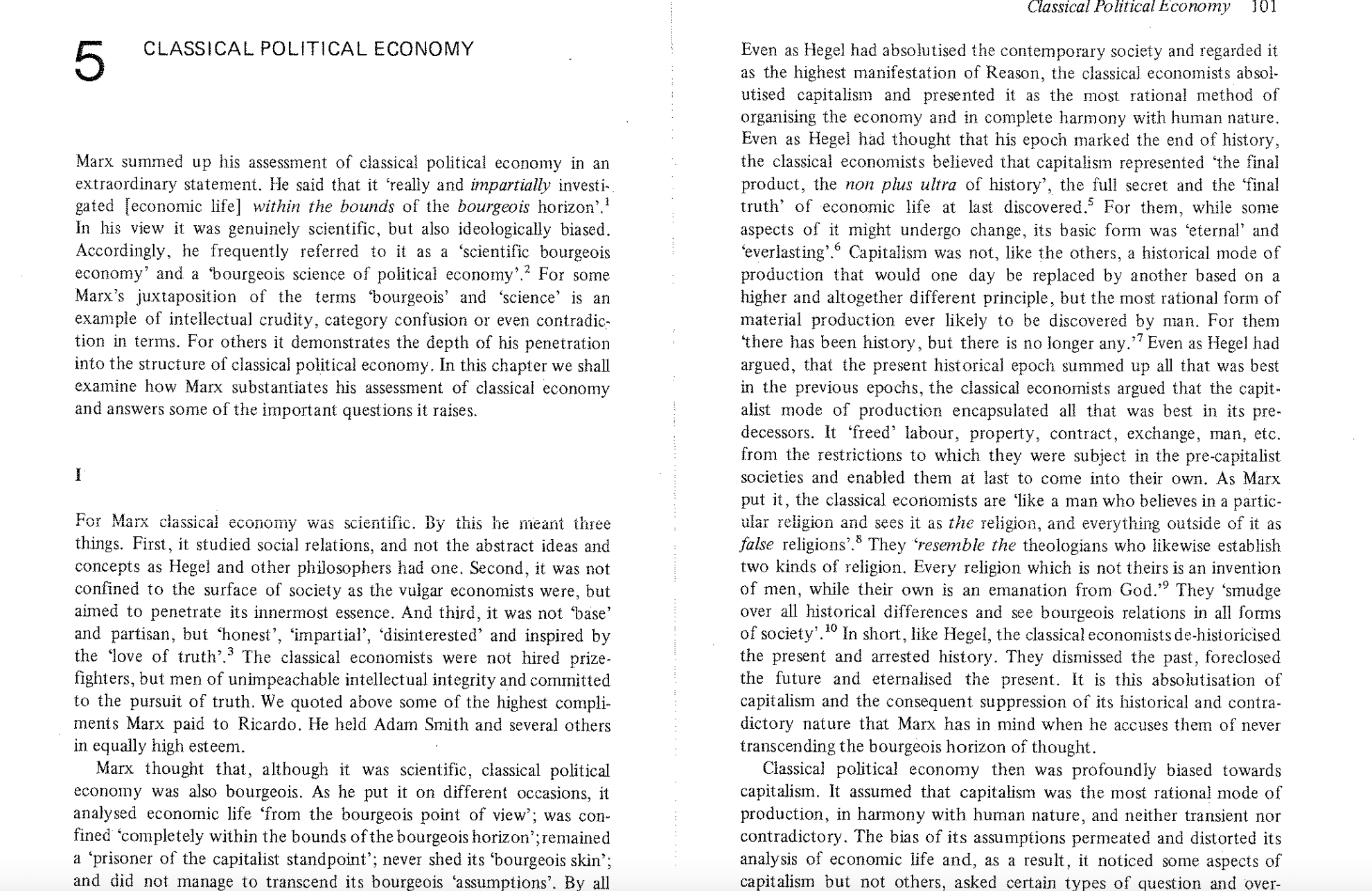
kindly read and summarize this text for me in a way that I understand what it is about that forms my idea of the text
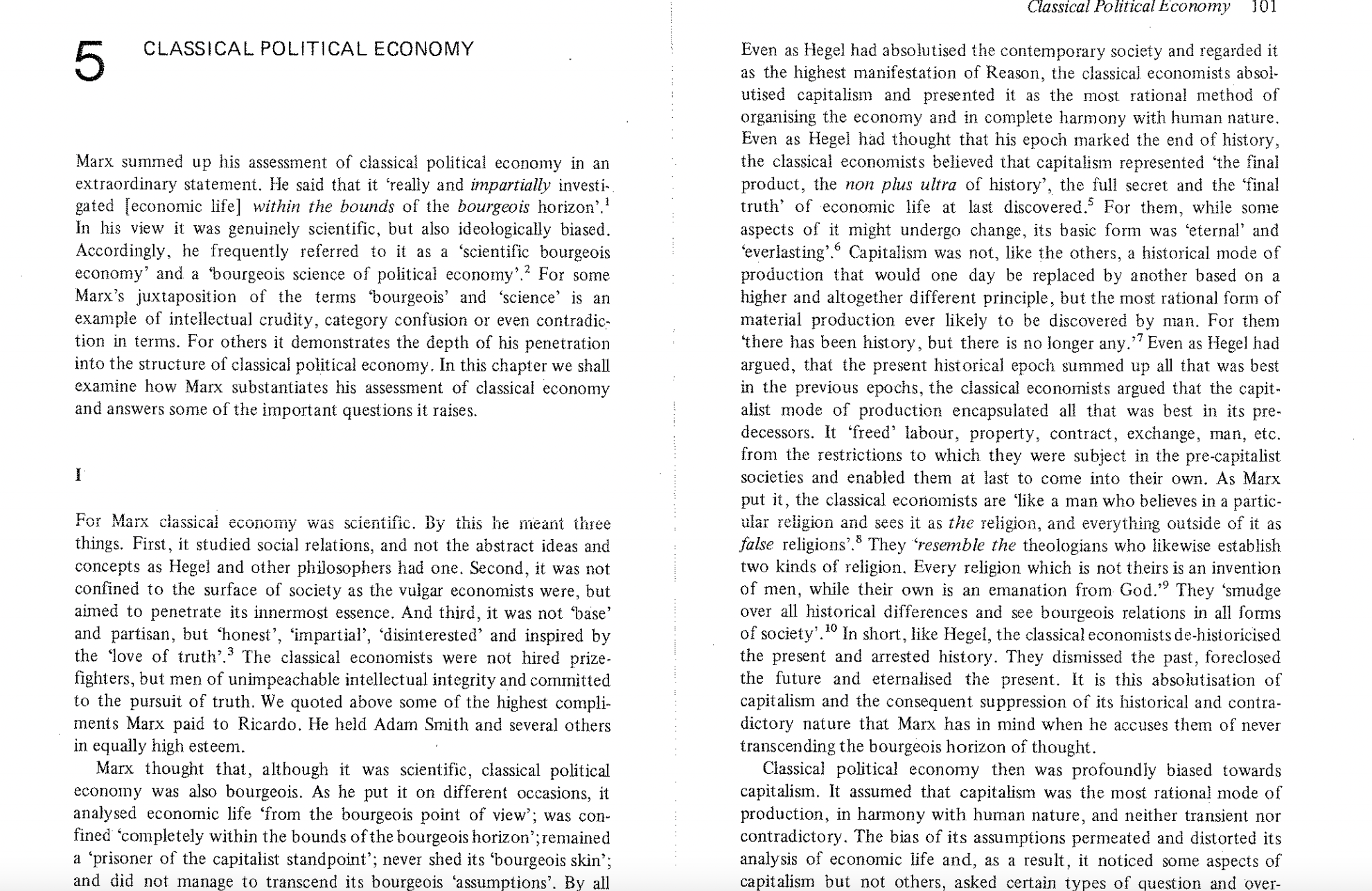
5 CLASSICAL POLITICAL ECONOMY Marx summed up his assessment of classical political economy in an extraordinary statement. He said that it \"really and impartially investi- gated {economic life] within the bounds of the bourgeois horizon'.1 in his View it was genuinely scientific, but also ideologically biased. Accordingly, he frequently referred to it as a 'scientific bourgeois economy' and. a 'bourgeois science of political economy'.2 For some Marx's juxtaposition of the terms 'bourgeois' and 'science' is an example of intellectual crudity, category confusion 01' even contradic~ tion in terms. For others it demonstrates the depth of his penetration into the structure of classical political economy. In this chapter we shall examine how Marx substantiates his assessment of classical economy and answers some of the important questions it raises. 12A, Mm... \"in" \"2.4 -aa._-M_. .W u, -izm, 13.. i aux \"mm mammal ccurruruy Wdh ht. rurru. Dy this he meant three things. First, it studied social relations, and not the abstract ideas and concepts as Hegel and other philosophers had one. Second, it was not confined to the surface of society as the vulgar economists were, but aimed to penetrate its innermost essence. And third, it was not 'base' and partisan, but 'honest', 'impartial', 'disimerested' and inspired by the 'love of truth'.3 The classical economists were not hired prize- ghters, but men of unimpeachable inteilect ual integrity and committed to the pursuit of truth. We quoted above some of the highest compli- ments Marx paid to Ricardo. He held Adam Smith and several others in equally high esteem. ' Marx thought that, although it was scientific, classical political economy was also bourgeois. As he put it on different occasions, it analysed economic life 'from the bourgeois point of view'; was con- ned 'completeiy within the bounds of the bourgeois horizon'uenrained a 'prlsoner of the capitalist standpoint'; never shed its 'bourgeois skin'; and did not manage to transcend its bourgeois 'assumptions'. By all Classical Political Economy 101 Even as Hegel had absolu tised the contemporary society and regarded it as the highest manifestation of Reason, the classical economists absol- utised capitalism and presented it as the most rational method of organising the economy and in complete harmony with human nature. Even as Hegel had thought that his epoch marked the end of history, the classical economists believed that capitalism represented 'the nal product, the non plus ultra of history', the full secret and the 'frnal truth' of economic life at last discovered,5 For them, while some aspects of it might undergo change, its basic form was 'eternal' and 'everlas'ting'.6 Capitalism was not, like the others, a historical mode of production that would one day be replaced by another based on a higher and altogether different principle, but the most rational form of material production ever likely to be discovered by man. For them 'there has been history, but there is no longer any.\" Even as Hegel had argued, that the present historical epoch summed up all that was best in the previous epochs, the classical economists argued that the capit- alist mode of production encapsulated all that was best in its pre- decessors. It 'freed' labour, property, contract, exchange, man, etc. from the restrictions to which they were subject in the piecapitalist societies and enabled them at last to come into their own. As Marx put it, the classical economists are 'like a man who believes in a partic- ular religion and sees it as the religion, and everything outside of it as false religions'.\" They 'resemble the theologians who likewise establish two kinds of religion. Every religion which is not theirs is an invention of men, while their own is an emanation from God.'9 They 'smudge over all historical differences and see bourgeois relations in all forms of society'.10 In short, like Hegel, the classical economists do-historiclsed the present and arrested history. They dismissed the past, foreclosed the future and eternalised the present. It is this absolutisation of capitalism and the consequent suppression of its historical and contra- dictory nature that Marx has in mind when he accuses them of never transcending the bourgeois horizon of thought. Classical political economy then was profoundly biased towards capitalism. It assumed that capitalism was the most rational mode of production, in harmony with human nature, and neither transient nor contradictory. The bias of its assumptions permeated and distorted its analysis of economic life and, as a result, it noticed some aspects of capitalism but not others, asked certain types of question and over
Step by Step Solution
There are 3 Steps involved in it

Get step-by-step solutions from verified subject matter experts