Question: Kindly solve this case study as soon as possible. CASES Traidos Bank and Roche's Drug Trials in China * Explore the concepto mythinkinglab.com On September
Kindly solve this case study as soon as possible.
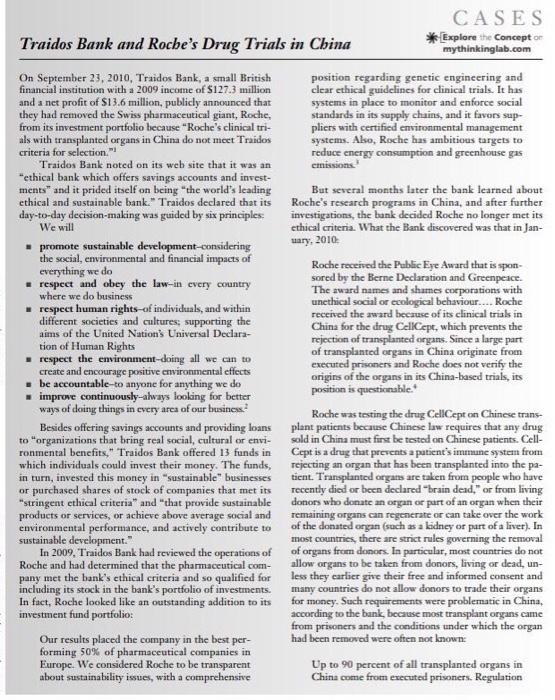
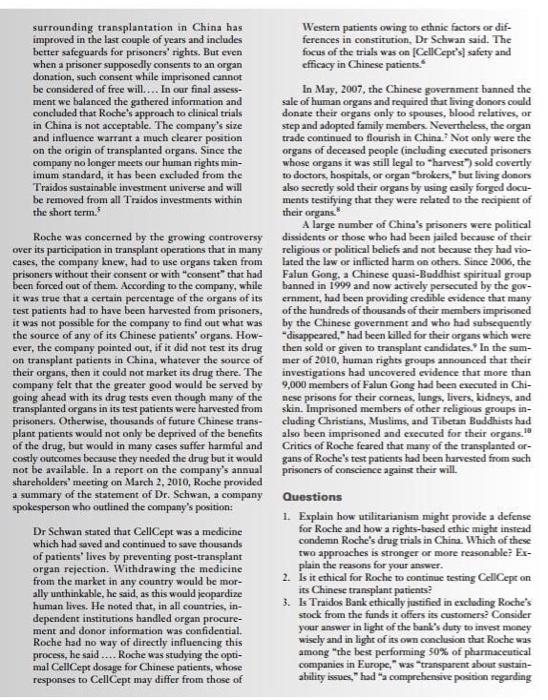
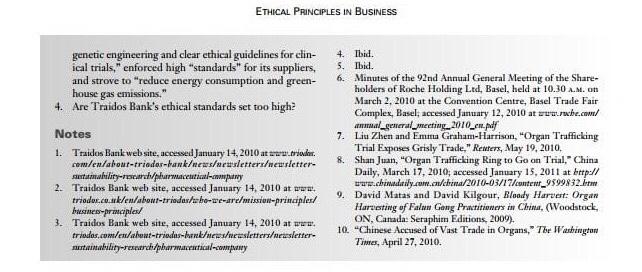
CASES Traidos Bank and Roche's Drug Trials in China * Explore the concepto mythinkinglab.com On September 23, 2010, Traidos Bank, a small British position regarding genetic engineering and financial institution with a 2009 income of $127.3 million clear ethical guidelines for clinical trials. It has and a net profit of $13.6 million, publicly announced that systems in place to monitor and enforce social they had removed the Swiss pharmaceutical giant, Roche, standards in its supply chains, and it favors sup- from its investment portfolio because "Roche's clinical tri- pliers with certified environmental management als with transplanted organs in China do not meet Traidos systems. Ako, Roche has ambitious targets to criteria for selection reduce energy consumption and greenhouse gas Traidos Bank noted on its web site that it was an emissions "ethical bank which offers savings accounts and invest- ments" and it prided itself on being the world's leading But several months later the bank learned about ethical and sustainable bank." Traidos declared that its Roche's research programs in China, and after further day-to-day decision-making was guided by six principles investigations, the bank decided Roche no longer met its We will ethical criteria. What the Bank discovered was that in Jan- - promote sustainable development considering mary, 2010 the social, environmental and financial impacts of everything we do Roche received the Public Eye Award that is spon- respect and obey the law-in every country sored by the Berne Dedaration and Greenpeace. where we do business The award names and shames corporations with respect human rights of individuals, and within unethical social or ecological behaviour.... Roche different societies and cultures, supporting the received the award because of its clinical trials in aims of the United Nations Universal Declara- China for the drug CellCept, which prevents the tion of Human Rights rejection of transplanted organs. Since a large part respect the environment-doing all we can to of transplanted organs in China originate from create and encourage positive environmental effects executed prisoners and Roche does not verify the be accountable-to anyone for anything we do origins of the organs in its China-based trials, its improve continuously always looking for better position is questionable ways of doing things in every area of our business Roche was testing the drug CellCept on Chinese trans- Besides offering savings accounts and providing loans plant patients because Chinese law requires that any drug to "organizations that bring real social, cultural or envi- sold in China must first be tested on Chinese patients. Cell- ronmental benefits," "Traidos Bank offered 13 funds in Cept is a drug that prevents a patient's immune system from which individuals could invest their money. The funds, rejecting an organ that has been transplanted into the pa- in turn, invested this money in "sustainable" businesses tient. Transplanted organs are taken from people who have or purchased shares of stock of companies that met its recently died or beca declared "brain dead," or from living "stringent ethical criteria" and "that provide sustainable donors who donate an organ or part of an organ when their products or services, or achieve above average social and remaining organs can regenerate or can take over the work environmental performance, and actively contribute to of the donated organ (such as a kidney or part of a liver). In sustainable development." most countries, there are strict rules governing the removal In 2009, Traidos Bank had reviewed the operations of of organs from donors. In particular, most countries do not Roche and had determined that the pharmaceutical com- allow organs to be taken from donors, living or dead, un- pany met the bank's ethical criteria and so qualified for less they earlier give their free and informed consent and including its stock in the bank's portfolio of investments. many countries do not allow donors to trade their organs In fact, Roche looked like an outstanding addition to its for money. Such requirements were problematic in China, investment fund portfolio: according to the bank because most transplant organs came from prisoners and the conditions under which the organ Our results placed the company in the best per- had been removed were often not known forming 50% of pharmaceutical companies in Europe. We considered Roche to be transparent Up to 90 percent of all transplanted organs in about sustainability issues, with a comprehensive China come from executed prisoners. Regulation surrounding transplantation in China has improved in the last couple of years and includes better safeguards for prisoners' rights. But even when a prisoner supposedly consents to an organ donation, such consent while imprisoned cannot be considered of free will.... In our final assesse ment we balanced the gathered information and concluded that Roche's approach to clinical trials in China is not acceptable. The company's size and influence warrant a much clearer position on the origin of transplanted organs. Since the company no longer meets our human rights min- imum standard, it has been excluded from the Traidos sustainable investment universe and will be removed from all Traidos investments within the short term. Roche was concerned by the growing controversy over its participation in transplant operations that in many cases, the company knew, had to use organs taken from prisoners without their consent or with consent that had been forced out of them. According to the company, while it was true that a certain percentage of the organs of its test patients had to have been harvested from prisoners, it was not possible for the company to find out what was the source of any of its Chinese patients' organs. How- ever, the company pointed out, if it did not test its drug on transplant patients in China, whatever the source of their organs, then it could not market its drug there. The company felt that the greater good would be served by going ahead with its drug tests even though many of the transplanted organs in its test patients were harvested from prisoners. Otherwise, thousands of future Chinese trans- plant patients would not only be deprived of the benefits of the drug, but would in many cases suffer harmful and costly outcomes because they needed the drug but it would not be available. In a report on the company's annual shareholders' meeting on March 2, 2010, Roche provided a summary of the statement of Dr. Schwan, a company spokesperson who outlined the company's position: Dr Schwan stated that CellCept was a medicine which had saved and continued to save thousands of patients' lives by preventing post-transplant organ rejection. Withdrawing the medicine from the market in any country would be mor- ally unthinkable, he said, as this would jeopardize human lives. He noted that, in all countries, in- dependent institutions handled organ procure- ment and donor information was confidential Roche had no way of directly influencing this process, he said.... Roche was studying the opti- mal CellCept dosage for Chinese patients, whose responses to CellCept may differ from those of Western patients owing to ethnic factors or dif- ferences in constitution. Dr Schwan said. The focus of the trials was on (CellCepe's] safety and efficacy in Chinese patients. In May, 2007, the Chinese government banned the sale of human organs and required that living donors could donate their organs only to spouses, blood relatives, or step and adopted family members. Nevertheless, the organ trade continued to flourish in China. Not only were the organs of deceased people (including executed prisoners whose organs it was still legal to harvest sold covertly to doctors, hospitals, or organ "brokers, but living donors also secredy sold their organs by using casily forged docu- ments testifying that they were related to the recipient of their organs A large number of China's prisoners were political dissidents or those who had been jailed because of their religious or political beliefs and not because they had sio- lated the law or inflicted harm on others. Since 2006, the Falun Gong, a Chinese quasi-Buddhist spiritual group banned in 1999 and now actively persecuted by the gov- ernment, had been providing credible evidence that many of the hundreds of thousands of their members imprisoned by the Chinese government and who had subsequently *disappeared." had been killed for their organs which were then sold or given to transplant candidates. In the sum- mer of 2010, human rights groups announced that their investigations had uncovered evidence that more than 9,000 members of Falun Gong had been executed in Chi- nese prisons for their corneas, lungs, livers, kidneys, and skin. Imprisoned members of other religious groups in- cluding Christians, Muslims, and Tibetan Buddhists had also been imprisoned and executed for their organs Critics of Roche feared that many of the transplanted or gans of Roche's test patients had been harvested from such prisoners of conscience against their will Questions 1. Explain how utilitarianism might provide a defense for Roche and how a rights-based ethic might instead condemn Roche's drug trals in China. Which of these two approaches is stronger or more reasonable? Ex- plain the reasons for your answer. 2. Is it ethical for Roche to continue testing CellCepton its Chinese transplant patients? 3. Is Traidos Bank ethically justified in excluding Roche's stock from the funds it offers its customers? Consider your answer in light of the bank's duty to invest money wisely and in light of its own conclusion that Roche was among the best performing 50% of pharmaceutical companies in Europe," was transparent about sustain- ability issues" had a comprehensive position regarding 16 ETHICAL PRINCIPLES IN BUSINESS genetic engineering and clear ethical guidelines for clin- ical trials," enforced high standards" for its suppliers, and strove to "reduce energy consumption and green- house gas emissions." 4. Are Traidos Bank's ethical standards set too high Notes 1. Traidos Bank website, accessed January 14, 2010 at www.rde. com/en/about-triador-hankewsewslettersewsletter- saunamobility-researplurmaceutical company 2. Traidos Bank web site, accessed January 14, 2010 at www. triodor.co.uk/en/abowt-triodas/who-we-are/mission-principles/ business principles/ 3. Traidos Bank web site, accessed January 14, 2010 at www. trados.com/ex/about-triodus-hankewsewslettersewsletter nuntainability researchpharmaceutical-com 4. Ibid. 5. Ibid. 6. Minutes of the 92nd Annual General Meeting of the Share- holders of Roche Holding Ltd, Basel, held at 10.30 ... on March 2, 2010 at the Convention Centre, Basel Trade Fair Complex, Basel, accessed January 12, 2010 at wwwbe.com/ ammal_general_meeting_2010_en.pdf 7. Liu Zhen and Emnu Graham-Harrison, "Organ Trafficking Trial Exposes Grisly Trade." Renters, May 19, 2010, 8. Shan Juan, "Organ Trafficking Ring to Go on Trial, China Daily, March 17, 2010; accessed January 15, 2011 at http:// ww.chandedly.com.cat/cena/2010-03/17/contenr_9599832.im 9. David Matas and David Kilgour, Bloody Harvest: Organ Hardesting of Falun Gong Practitioners in China. (Woodstock, ON, Canada: Seraphim Editions. 2009). 10. "Chinese Accused of Vast Trade in Organs." The Washington Times, April 27, 2010









 Study Help