







Question: K=k2k1=[A][C][X] Example 2.2 and Problem 2.23 deal with this type of intermediate. The trial-and-error procedure involved in searching for a mechanism is illustrated in the
![K=k2k1=[A][C][X] Example 2.2 and Problem 2.23 deal with this type of](https://dsd5zvtm8ll6.cloudfront.net/si.experts.images/questions/2024/09/66f83db549484_75666f83db4c776c.jpg)
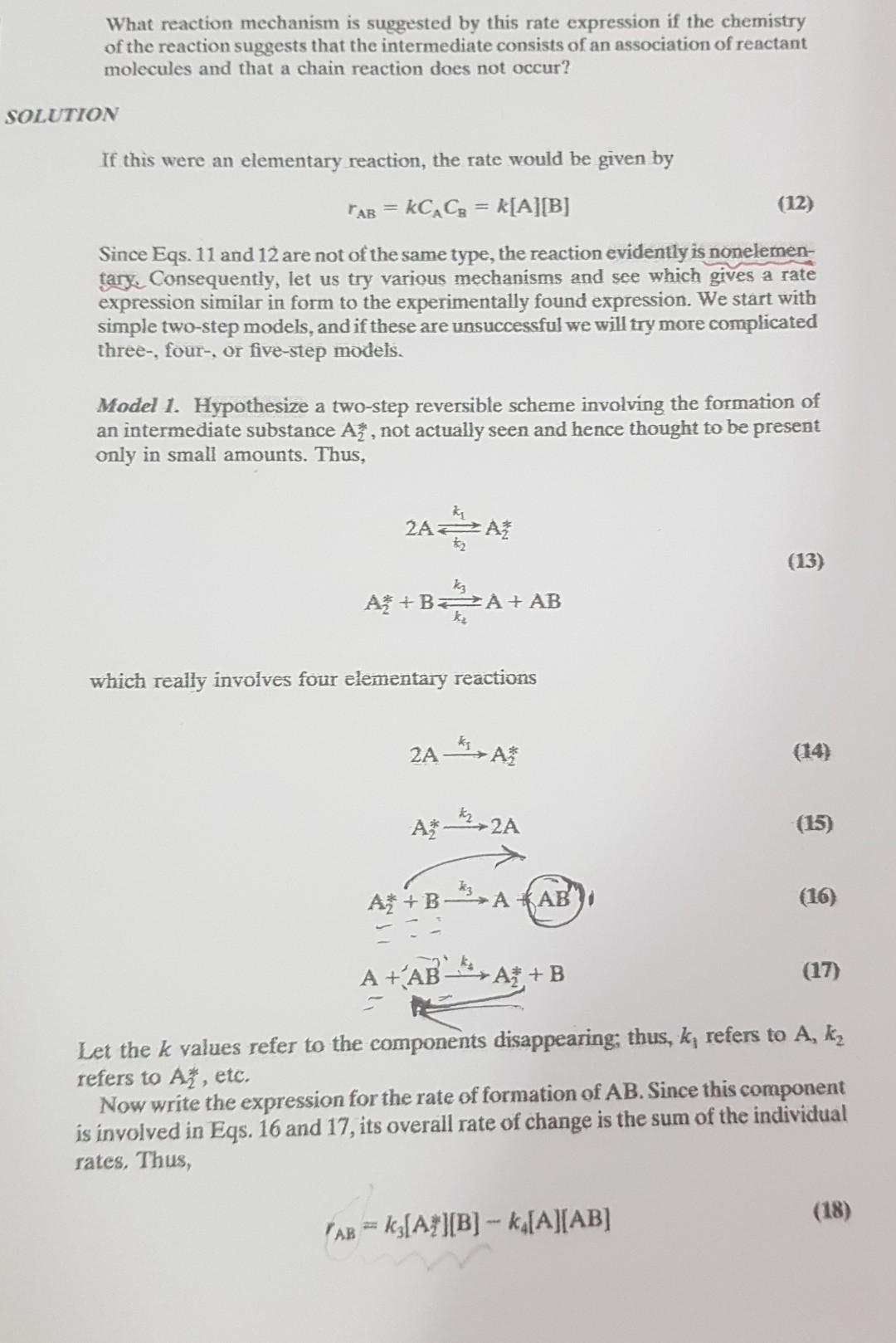
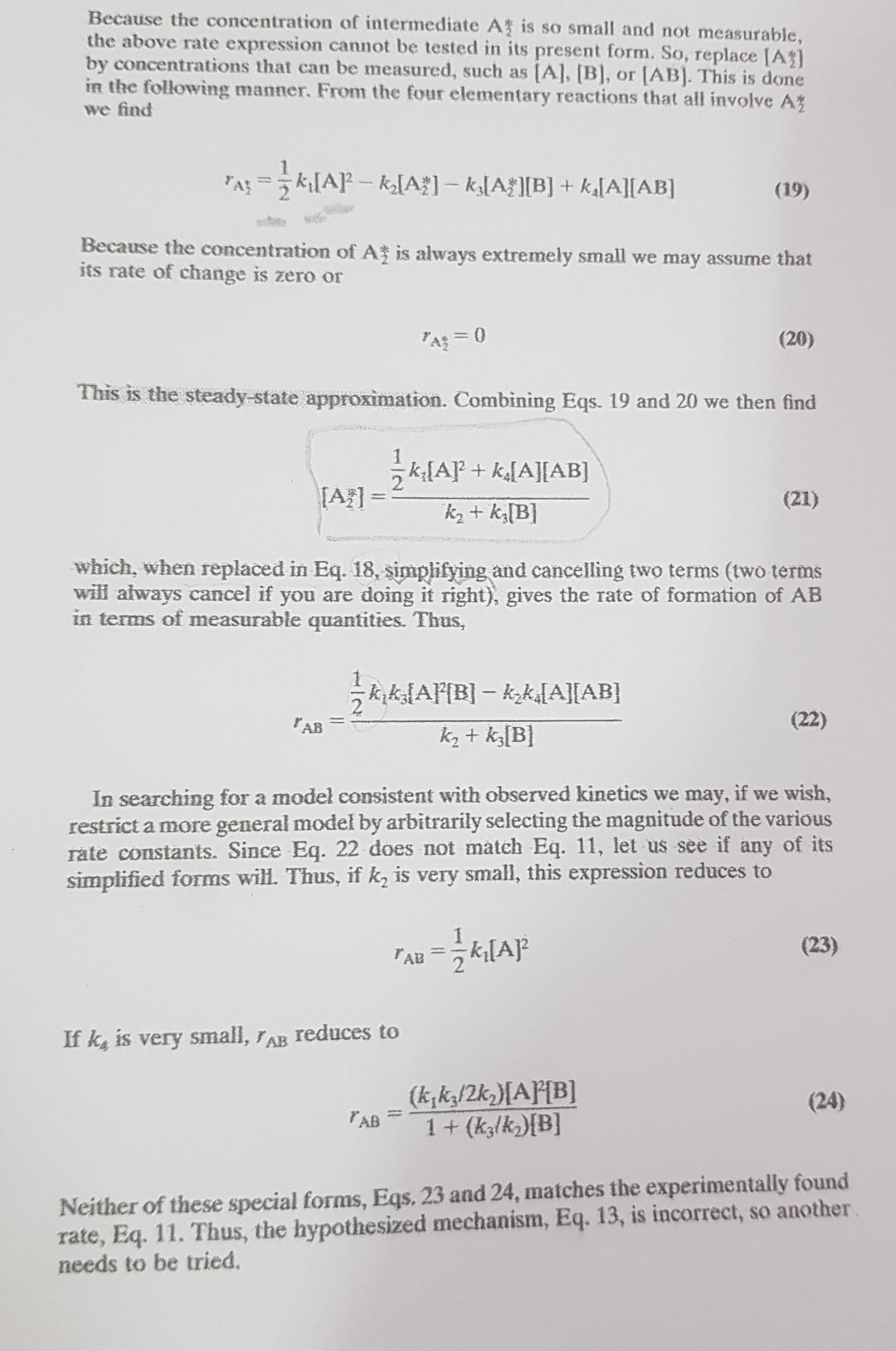
K=k2k1=[A][C][X] Example 2.2 and Problem 2.23 deal with this type of intermediate. The trial-and-error procedure involved in searching for a mechanism is illustrated in the following two examples. 2.1 SEARCH FOR TAE REACTION MECHANISM The irreversible reaction A+B=AB has been studied kinetically, and the rate of formation of product bas been found to be well correlated by the following rate equation: rAB=kCB2..independentofCA. What reaction mechanism is suggested by this rate expression if the chemistry of the reaction suggests that the intermediate consists of an association of reactant molecules and that a chain reaction does not occur? If this were an elementary reaction, the rate would be given by rAB=kCACB=k[A][B] Since Eqs. 11 and 12 are not of the same type, the reaction evidently is nonelementary Consequently, let us try various mechanisms and see which gives a rate expression similar in form to the experimentally found expression. We start with simple two-step models, and if these are unsuccessful we will try more complicated three-, four-, or five-step models. Model 1. Hypothesize a two-step reversible scheme involving the formation of an intermediate substance A2, not actually seen and hence thought to be present only in small amounts. Thus, 2Ak2k1A2A2+B=k4k3A+AB which really involves four elementary reactions 2Ak1A2 Let the k values refer to the components disappearing; thus, k1 refers to A,k2 refers to A2, etc. Now write the expression for the rate of formation of AB. Since this component is involved in Eqs. 16 and 17, its overall rate of change is the sum of the individual rates, Thus, rAB=k3[A2][B]k4[A][AB] Because the concentration of intermediate A2is so small and not measurable, the above rate expression cannot be tested in its present form. So, replace [A, ] by concentrations that can be measured, such as [A],[B], or [AB]. This is done in the following manner. From the four elementary reactions that all involve A * we find rA2=21k1[A]2k2[A2]k3[A2][B]+k4[A][AB] Because the concentration of A2 is always extremely small we may assume that its rate of change is zero or rA2=0 This is the steady-state approximation. Combining Eqs. 19 and 20 we then find [Ax2]=k2+k3[B]21k1[A]2+k4[A][AB] which, when replaced in Eq. 18, simplifying and cancelling two terms (two terms will always cancel if you are doing it right), gives the rate of formation of AB in terms of measurable quantities. Thus, rAB=k2+k3[B]21k1k3[A]2[B]k2k4[A][AB] In searching for a model consistent with observed kinetics we may, if we wish, restrict a more general model by arbitrarily selecting the magnitude of the various rate constants. Since Eq. 22 does not match Eq. 11, let us see if any of its simplified forms will. Thus, if k2 is very small, this expression reduces to rAB=21k1[A]2 If k4 is very small, rAB reduces to rAB=1+(k3/k2)[B](k1k3/2k2)[A]2[B] Neither of these special forms, Eqs, 23 and 24, matches the experimentally found rate, Eq. 11. Thus, the hypothesized mechanism, Eq. 13, is incorrect, so another needs to be tried. K=k2k1=[A][C][X] Example 2.2 and Problem 2.23 deal with this type of intermediate. The trial-and-error procedure involved in searching for a mechanism is illustrated in the following two examples. 2.1 SEARCH FOR TAE REACTION MECHANISM The irreversible reaction A+B=AB has been studied kinetically, and the rate of formation of product bas been found to be well correlated by the following rate equation: rAB=kCB2..independentofCA. What reaction mechanism is suggested by this rate expression if the chemistry of the reaction suggests that the intermediate consists of an association of reactant molecules and that a chain reaction does not occur? If this were an elementary reaction, the rate would be given by rAB=kCACB=k[A][B] Since Eqs. 11 and 12 are not of the same type, the reaction evidently is nonelementary Consequently, let us try various mechanisms and see which gives a rate expression similar in form to the experimentally found expression. We start with simple two-step models, and if these are unsuccessful we will try more complicated three-, four-, or five-step models. Model 1. Hypothesize a two-step reversible scheme involving the formation of an intermediate substance A2, not actually seen and hence thought to be present only in small amounts. Thus, 2Ak2k1A2A2+B=k4k3A+AB which really involves four elementary reactions 2Ak1A2 Let the k values refer to the components disappearing; thus, k1 refers to A,k2 refers to A2, etc. Now write the expression for the rate of formation of AB. Since this component is involved in Eqs. 16 and 17, its overall rate of change is the sum of the individual rates, Thus, rAB=k3[A2][B]k4[A][AB] Because the concentration of intermediate A2is so small and not measurable, the above rate expression cannot be tested in its present form. So, replace [A, ] by concentrations that can be measured, such as [A],[B], or [AB]. This is done in the following manner. From the four elementary reactions that all involve A * we find rA2=21k1[A]2k2[A2]k3[A2][B]+k4[A][AB] Because the concentration of A2 is always extremely small we may assume that its rate of change is zero or rA2=0 This is the steady-state approximation. Combining Eqs. 19 and 20 we then find [Ax2]=k2+k3[B]21k1[A]2+k4[A][AB] which, when replaced in Eq. 18, simplifying and cancelling two terms (two terms will always cancel if you are doing it right), gives the rate of formation of AB in terms of measurable quantities. Thus, rAB=k2+k3[B]21k1k3[A]2[B]k2k4[A][AB] In searching for a model consistent with observed kinetics we may, if we wish, restrict a more general model by arbitrarily selecting the magnitude of the various rate constants. Since Eq. 22 does not match Eq. 11, let us see if any of its simplified forms will. Thus, if k2 is very small, this expression reduces to rAB=21k1[A]2 If k4 is very small, rAB reduces to rAB=1+(k3/k2)[B](k1k3/2k2)[A]2[B] Neither of these special forms, Eqs, 23 and 24, matches the experimentally found rate, Eq. 11. Thus, the hypothesized mechanism, Eq. 13, is incorrect, so another needs to be tried
Step by Step Solution
There are 3 Steps involved in it

Get step-by-step solutions from verified subject matter experts
 Study Help