







Question: Knowledge Check 01 Identify the simplifying assumptions usually made in net present value analysis. (You may select more than one answer. Single click the box
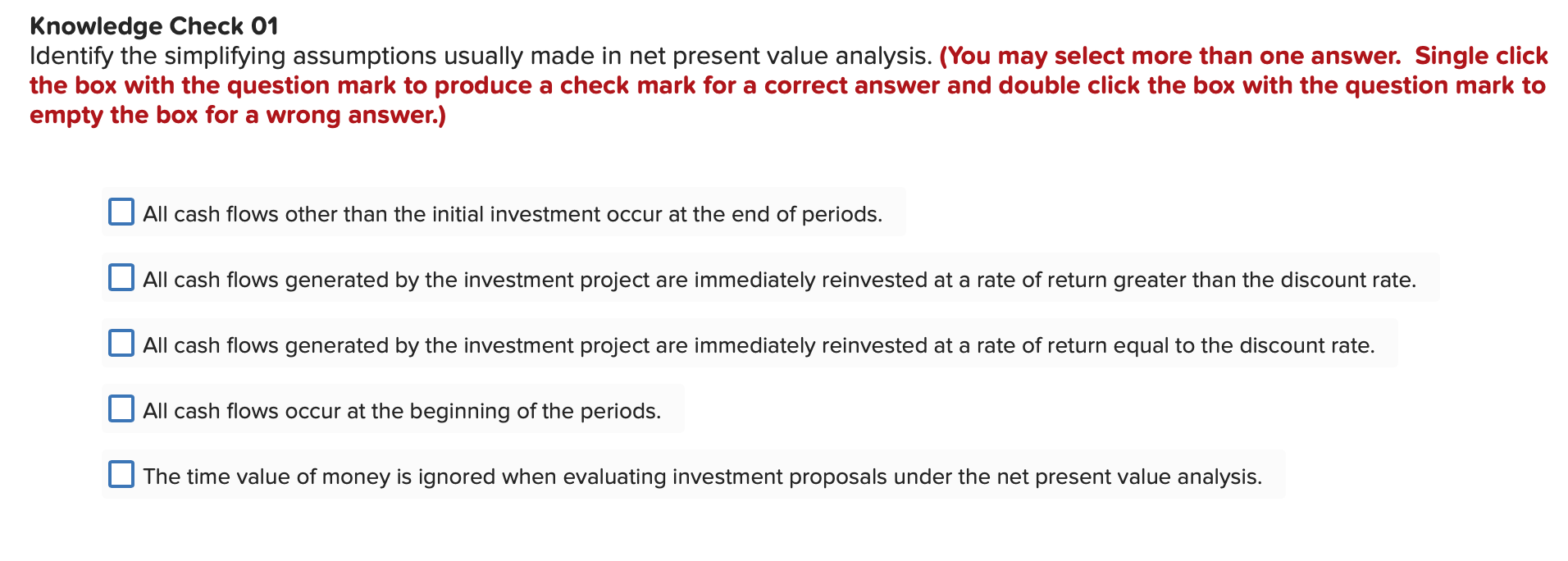
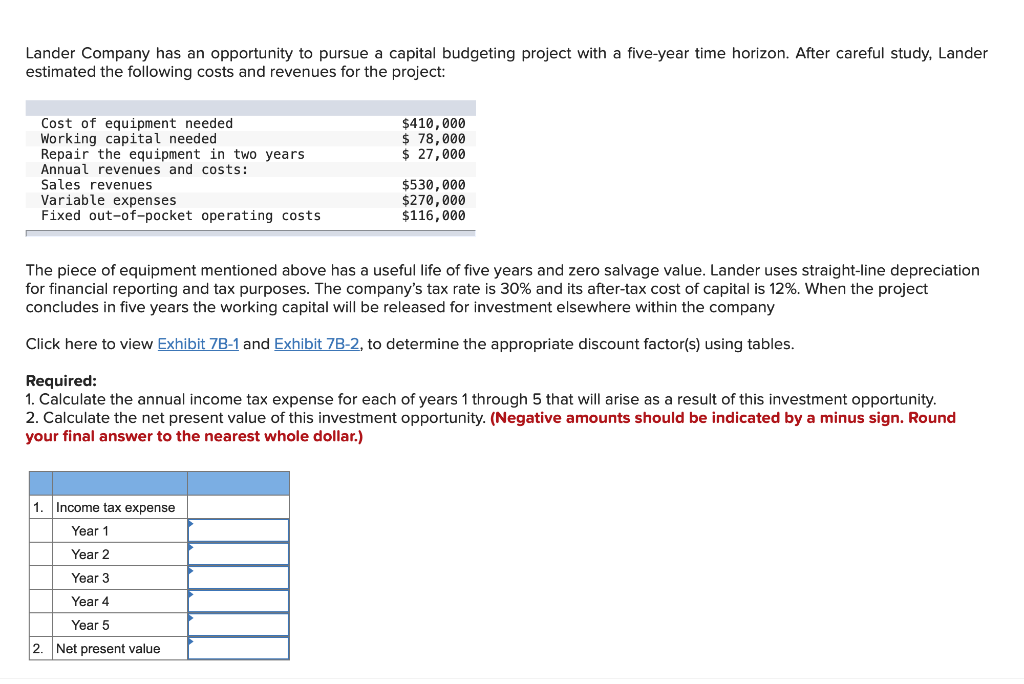
Knowledge Check 01 Identify the simplifying assumptions usually made in net present value analysis. (You may select more than one answer. Single click the box with the question mark to produce a check mark for a correct answer and double click the box with the question mark to empty the box for a wrong answer.) All cash flows other than the initial investment occur at the end of periods. All cash flows generated by the investment project are immediately reinvested at a rate of return greater than the discount rate. All cash flows generated by the investment project are immediately reinvested at a rate of return equal to the discount rate. All cash flows occur at the beginning of the periods. The time value of money is ignored when evaluating investment proposals under the net present value analysis. Lander Company has an opportunity to pursue a capital budgeting project with a five-year time horizon. After careful study, Lander estimated the following costs and revenues for the project: $410,000 $ 78,000 $ 27,000 Cost of equipment needed Working capital needed Repair the equipment in two years Annual revenues and costs: Sales revenues Variable expenses Fixed out-of-pocket operating costs $530,000 $270,000 $116,000 The piece of equipment mentioned above has a useful life of five years and zero salvage value. Lander uses straight-line depreciation for financial reporting and tax purposes. The company's tax rate is 30% and its after-tax cost of capital is 12%. When the project concludes in five years the working capital will be released for investment elsewhere within the company Click here to view Exhibit 7B-1 and Exhibit 7B-2, to determine the appropriate discount factor(s) using tables. Required: 1. Calculate the annual income tax expense for each of years 1 through 5 that will arise as a result of this investment opportunity. 2. Calculate the net present value of this investment opportunity. (Negative amounts should be indicated by a minus sign. Round your final answer to the nearest whole dollar.) 1. Income tax expense Year 1 Year 2 Year 3 Year 4 Year 5 2. Net present value
Step by Step Solution
There are 3 Steps involved in it

Get step-by-step solutions from verified subject matter experts
 Study Help