







Question: kuramoto matlab code: function kuramoto(N) if nargin N=100; end % timesteps ts=100; show=1; % visualization % 1 = circle, 2 = square viz=2; % only
kuramoto matlab code:
function kuramoto(N)
if nargin
N=100;
end
% timesteps
ts=100;
show=1;
% visualization
% 1 = circle, 2 = square
viz=2;
% only change the two parameters below
K=0.2; % can try multiple K values by setting K as a vector
sigma=.3;
% timestep
dt=1; % seconds
%initialize
w=randn(N,1)*sigma + 1;
th0=randn(N,1)*.2;
rc=zeros(1,ts);
figure(1); gcf;
clf;
set(gcf, 'units', 'normalized');
set(gcf, 'position', [0.1479 0.6947 0.4974 0.2079]);
for Ki=K
[t, th]=ode45(@kuramoto_ode, 0:dt:ts, th0, [], w, Ki);
th=th';
th1=-pi:.1:pi;
for k=2:numel(t)
rc(Ki==K,k)=1/N*norm([sum(cos(th(:,k))), sum(sin(th(:,k)))]);
if show
subplot(1,2,1); gca; cla;
% the multiplier just verifies that everything is okay
if viz==2
vals=mod(th(:,k), pi);
A=ones(sqrt(N)).*reshape(vals,sqrt(N),sqrt(N))*255/pi;
imshow(uint8(A));
elseif viz==1
plot(cos(th(:,k)), sin(th(:,k)), 'ko');
hold on;
plot(cos(th1), sin(th1), 'b');
end
subplot(1,2,2); gca; cla;
% psi=mean(th(:,k));
plot(1:k, rc(1:k), 'k'); hold on;
xlabel('time');
ylabel('coherence');
drawnow;
box off;
end
end
end
plot(rc', 'linewidth', 2); hold on;
for jj=1:size(rc,1)
text(k+5, rc(jj,end), sprintf('%.2f', K(jj)), 'fontsize', 16);
end
set(gca, 'fontsize', 16);
xlabel('time (s)');
set(gca, 'xticklabel', get(gca, 'xtick')*dt);
ylabel('coherence');
function xdot=kuramoto_ode(t,x, w, K)
N=numel(w);
for i=1:N
xdot(i,1)=w(i) + K/N*sum(sin(x-x(i)));
end
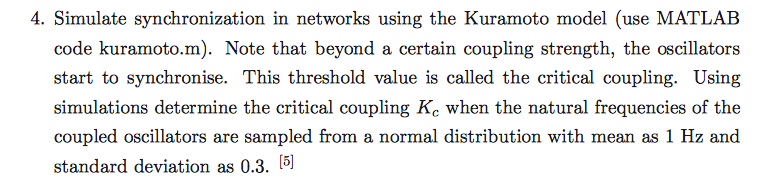
. Simulate synchronization in networks using the Kuramoto model (use MATLAB code kuramoto.m). Note that beyond a certain coupling strength, the oscillators start to synchronise. This threshold value is called the critical coupling. Using simulations determine the critical coupling Ke when the natural frequencies of the coupled oscillators are sampled from a normal distribution with mean as 1 Hz and standard deviation as 0.3. 5] . Simulate synchronization in networks using the Kuramoto model (use MATLAB code kuramoto.m). Note that beyond a certain coupling strength, the oscillators start to synchronise. This threshold value is called the critical coupling. Using simulations determine the critical coupling Ke when the natural frequencies of the coupled oscillators are sampled from a normal distribution with mean as 1 Hz and standard deviation as 0.3. 5]
Step by Step Solution
There are 3 Steps involved in it

Get step-by-step solutions from verified subject matter experts
 Study Help