







Question: l I In!!! Part 1: Graphical Method Suppose you had a force table. Obviously, you do not have one in front of you, but for
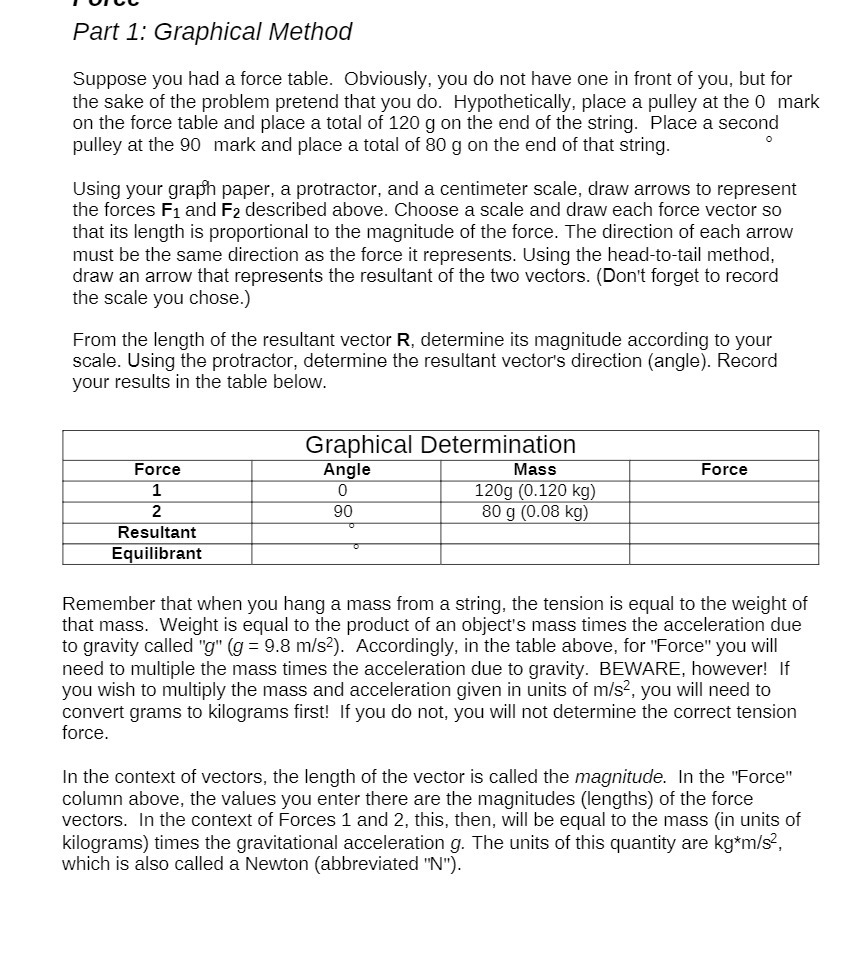
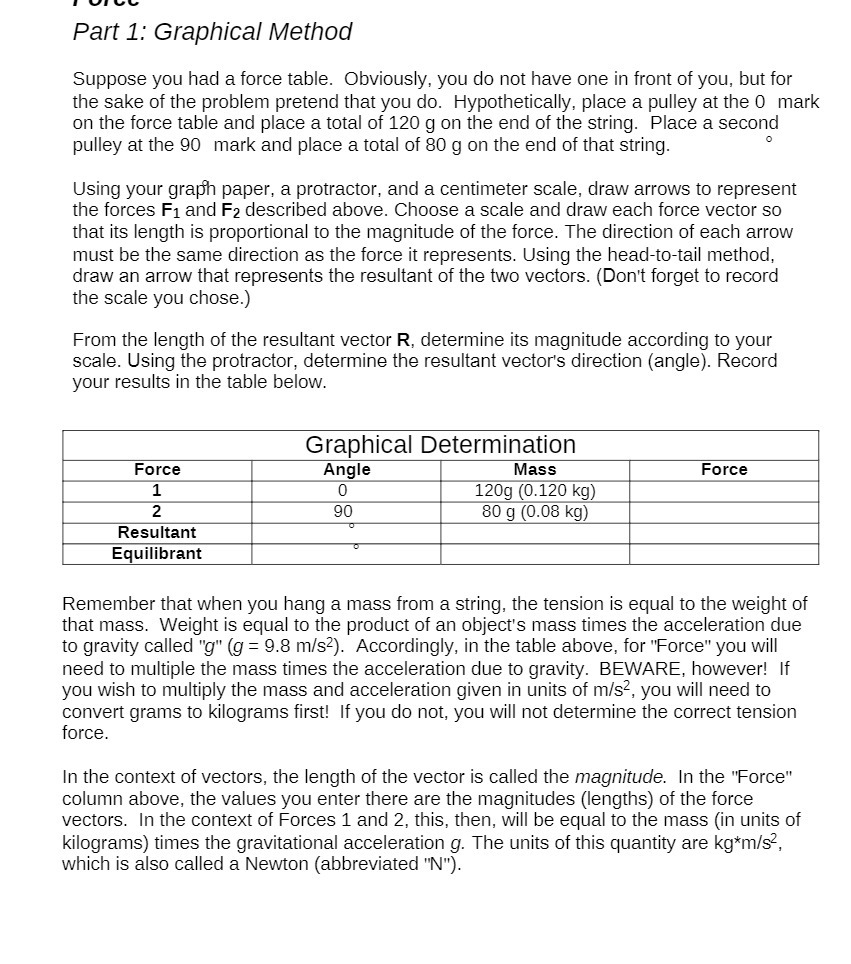
l "I In!!! Part 1: Graphical Method Suppose you had a force table. Obviously, you do not have one in front of you, but for the sake of the problem pretend that you do. Hypothetically, place a pulley at the 0 mark on the force table and place a total of 120 g on the end of the string. Place a second pulley at the 90 mark and place a total of 80 g on the end of that string. Using your graph paper, a protractor, and a centimeter scale, draw arrows to represent the forces F1 and F2 described above. Choose a scale and draw each force vector so that its length is proportional to the magnitude of the force. The direction of each arrow must be the same direction as the force it represents. Using the headtotail method, draw an arrow that represents the resultant of the two vectors. {Don't forget to record the scale you chose.) From the length of the resultant vector R, determine its magnitude according to your scale. Using the protractor, determine the resultant vector's direction (angle). Record your results in the table below. Graphical Determination 1209 (0.120 kg) mm:- m - _a so g was kg) m Remember that when you hang a mass from a string, the tension is equal to the weight of that mass. Weight is equal to the product of an object's mass times the acceleration due to gravity called "g" (g : 9.8 mlsE). Accordingly, in the table above, for 'Force" you will need to multiple the mass times the acceleration due to gravity. BEWARE, however! If you wish to multiply the mass and acceleration given in units of misz, you will need to convert grams to kilograms first! If you do not, you will not determine the correct tension force. In the context of vectors, the length of the vector is called the magnitude. in the "Force" column above, the values you enter there are the magnitudes (lengths) of the force vectors. In the context of Forces 1 and 2, this, then, will be equal to the mass (in units of kilograms) times the gravitational acceleration g. The units of this quantity are kg*mis2, which is also called a Newton (abbreviated "N")
Step by Step Solution
There are 3 Steps involved in it

Get step-by-step solutions from verified subject matter experts
 Study Help