







Question: -.. l. Integrate it using the table of integration: f (2'5 cos(x)ctt. Can you integrate it using some other method? 2. Integrate using ONLY trigonometric
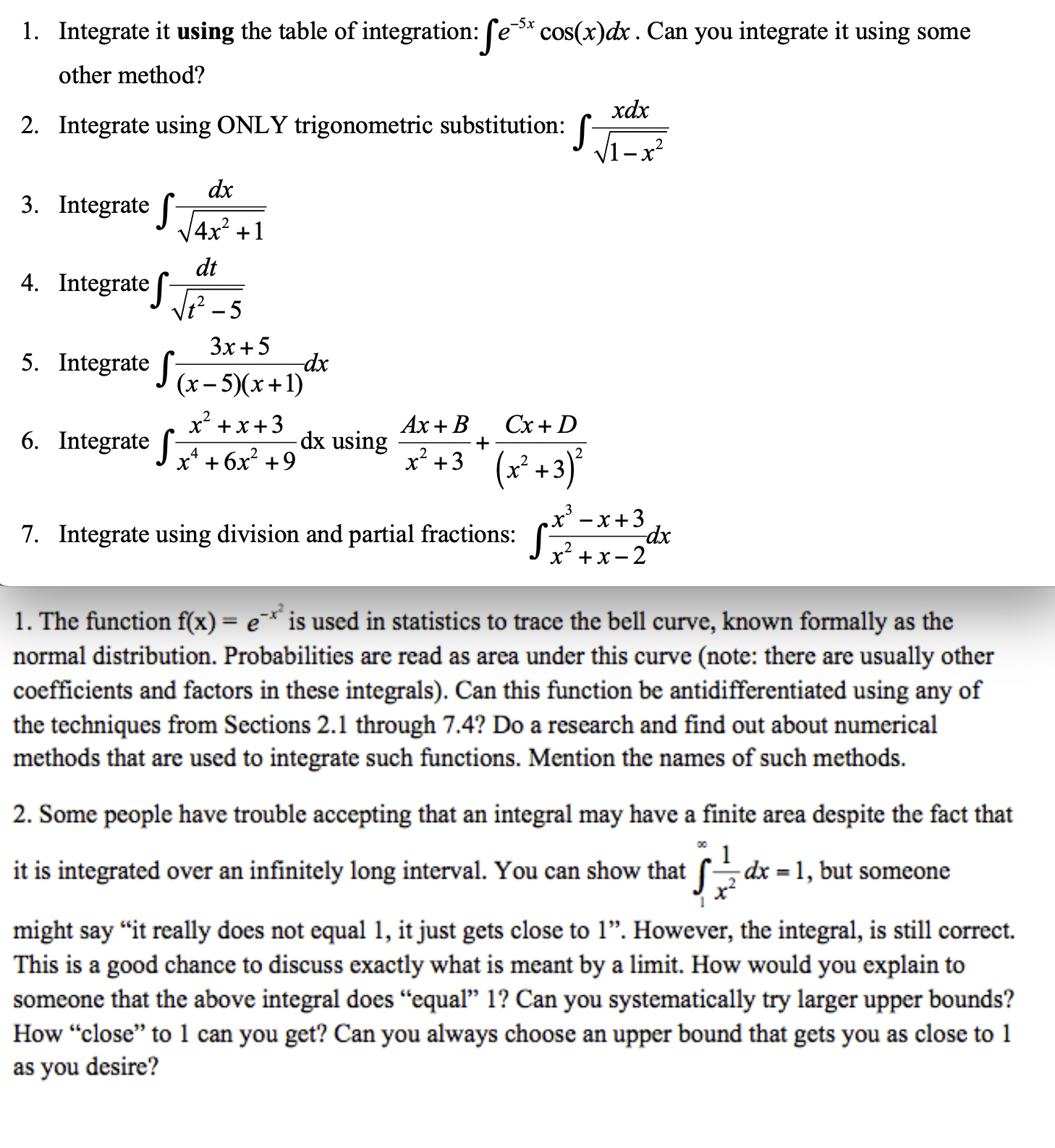
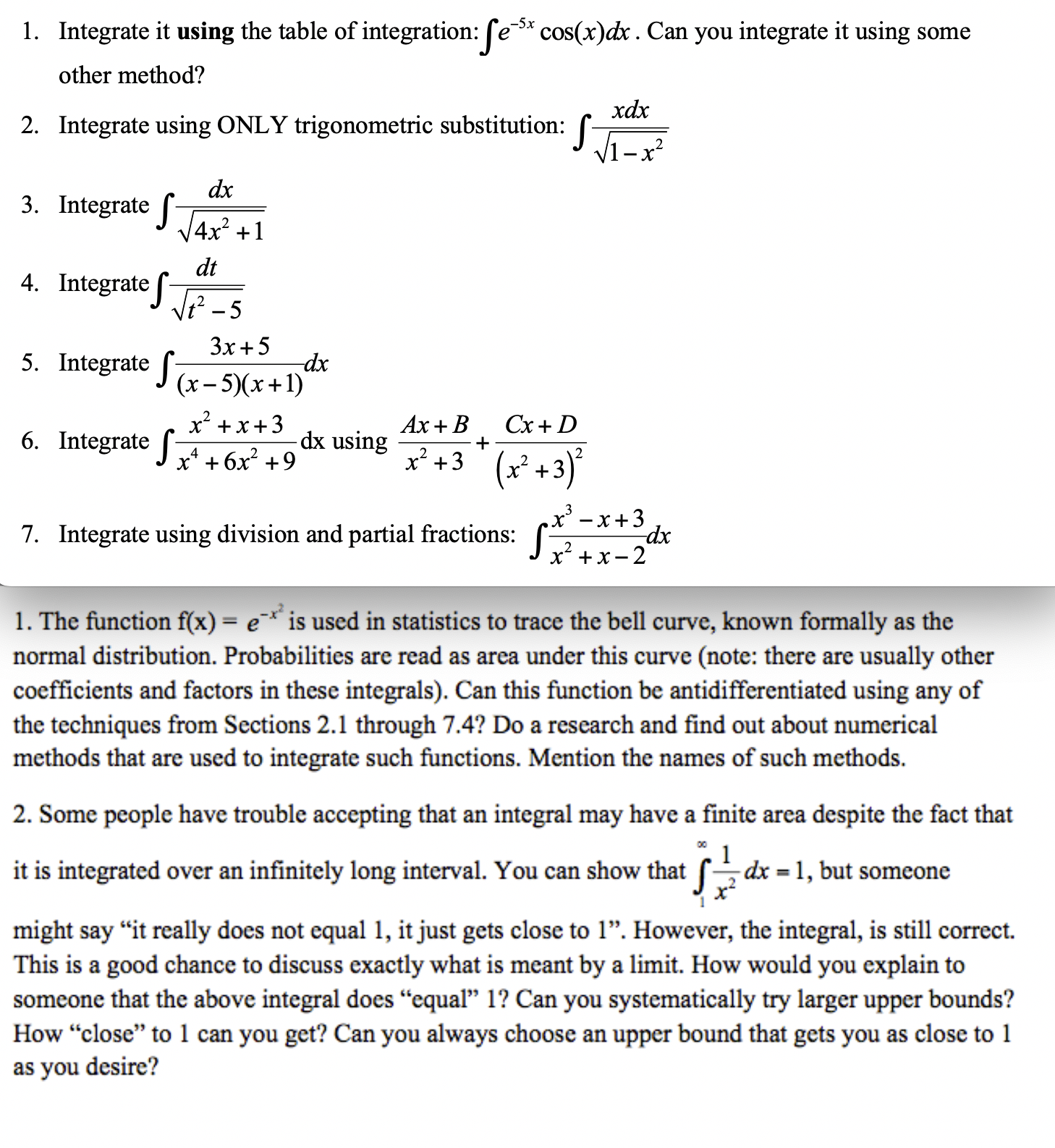
-.. l. Integrate it using the table of integration: f (2'5" cos(x)ctt. Can you integrate it using some other method? 2. Integrate using ONLY trigonometric substitution: 1' xdx 2 Vlx 3 Integrate 1' dx 4x2 +1 4 Integrate I dt :2 5 5. Integrate fdx (x 5)(x + 1) 2 6. Integrate dex using A: +3 +Oc_+D2 x +6x +9 x +3 (x2+3) . . . . . . x3 x + 3 7. Integrate usmg d1v131on and partlal fraetlons: fd2 2 'x x + x 1. The mction f(x) = e": is used in statistics to trace the bell curve, known formally as the normal distribution. Probabilities are read as area under this curve (note: there are usually other coefcients and factors in these integrals). Can this function be antidiffercntiated using any of the techniques from Sections 2.1 through 7.4? Do a research and nd out about numerical methods that are used to integrate such functions. Mention the names of such methods. 2. Some people have trouble accepting that an integral may have a nite area despite the fact that it [5 integrated over an infinitely long interval. You can Show that f , dx - 1, but someone I 1 might say \"it really does not equal 1, it just gets close to 1\". However, the integral, is still correct. This is a good chance to discuss exactly what is meant by a limit. How would you explain to someone that the above integral does \"equal\" 1? Can you systematically try larger upper bounds? How \"close\" to 1 can you get? Can you always choose an upper bound that gets you as close to l as you desire
Step by Step Solution
There are 3 Steps involved in it

Get step-by-step solutions from verified subject matter experts
 Study Help