







Question: Lab 10 -- Programming C++ with User defined functions and For loop In this lab, we will practice: Decompose the program into modules and implement
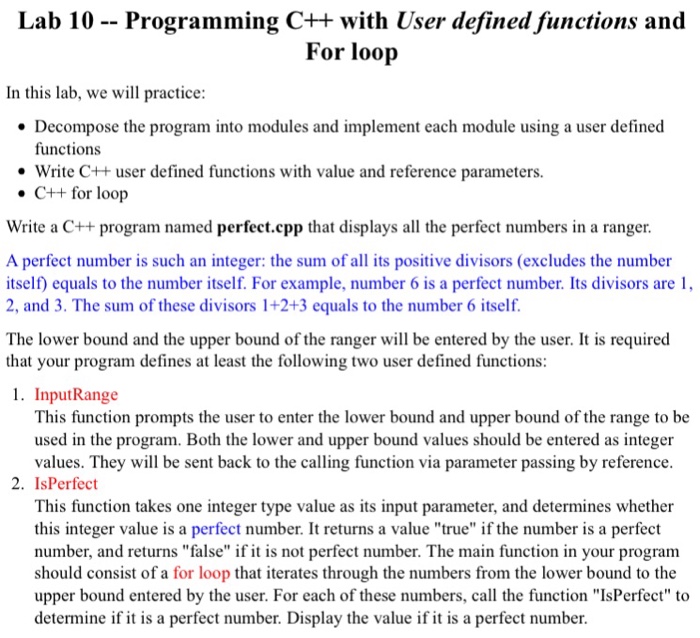
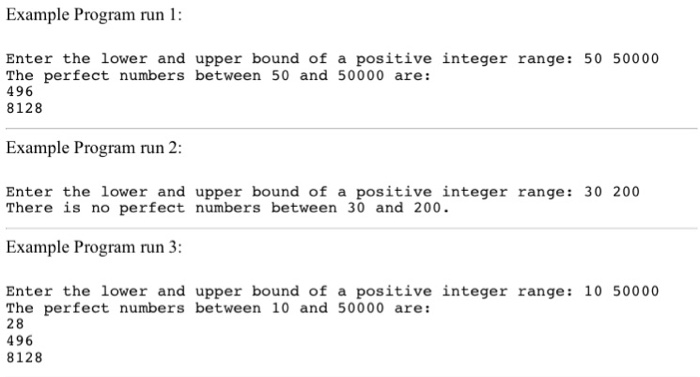
Lab 10 -- Programming C++ with User defined functions and For loop In this lab, we will practice: Decompose the program into modules and implement each module using a user defined functions Write C++ user defined functions with value and reference parameters. . C++for loop Write a C+program named perfect.cpp that displays all the perfect numbers in a ranger A perfect number is such an integer: the sum of all its positive divisors (excludes the number itself) equals to the number itself. For example, number 6 is a perfect number. Its divisors are 1, 2, and 3. The sum of these divisors 1+2+3 equals to the number 6 itself The lower bound and the upper bound of the ranger will be entered by the user. It is required that your program defines at least the following two user defined functions 1. InputRange This function prompts the user to enter the lower bound and upper bound of the range to be used in the program. Both the lower and upper bound values should be entered as integer values. They will be sent back to the calling function via parameter passing by reference 2. IsPerfect This function takes one integer type value as its input parameter, and determines whether this integer value is a perfect number. It returns a value "true" if the number is a perfect number, and returns "false" if it is not perfect number. The main function in your program should consist of a for loop that iterates through the numbers from the lower bound to the upper bound entered by the user. For each of these numbers, call the function "IsPerfect" to determine if it is a perfect number. Display the value if it is a perfect number
Step by Step Solution
There are 3 Steps involved in it

Get step-by-step solutions from verified subject matter experts
 Study Help