





Question: Lab 11: PhET simulation: Wave on a String Objective: To investigate the relationships among period, wavelength, and frequency. Students will use simulations to calculate the
Lab 11: PhET simulation: "Wave on a String"Lab 11: PhET simulation: "Wave on a String"Lab 11: PhET simulation: "Wave on a String"
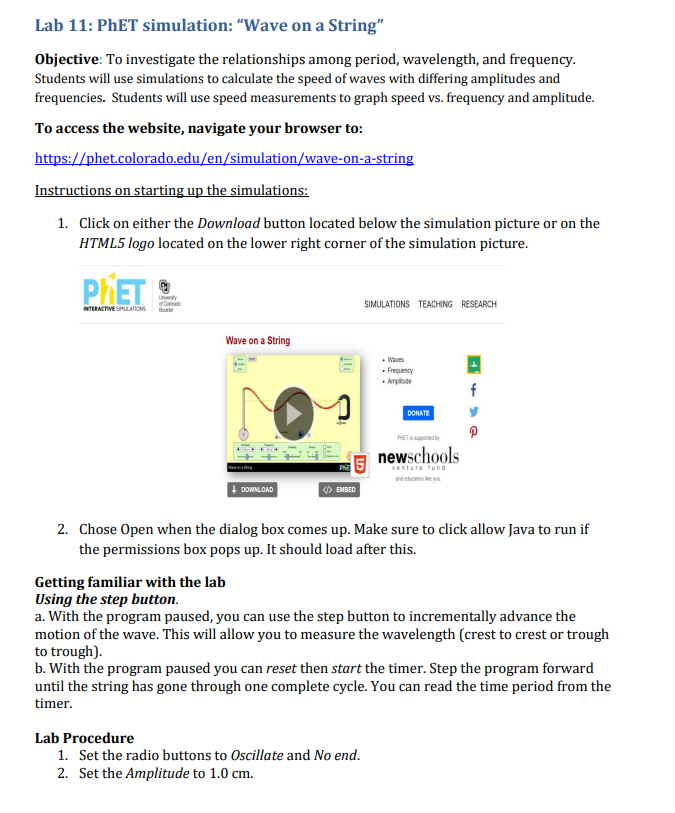
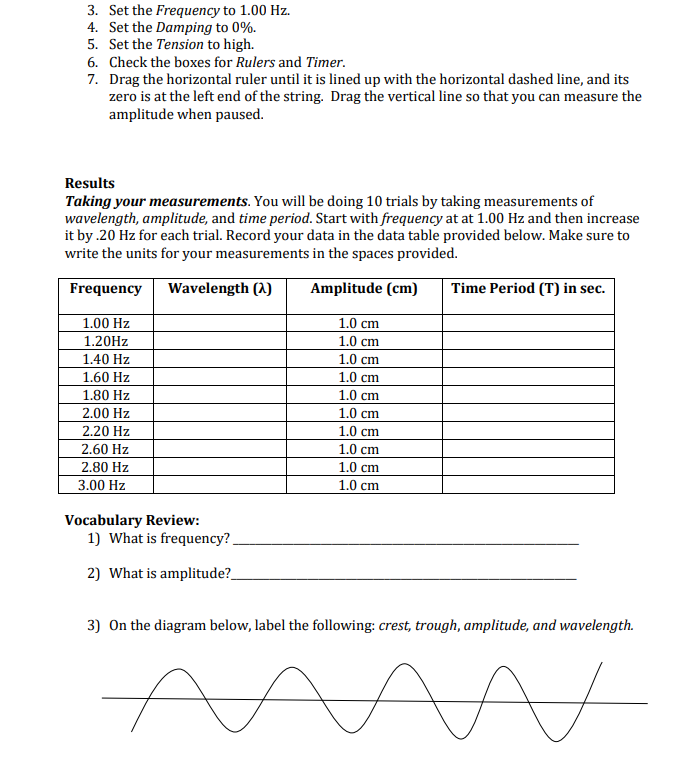
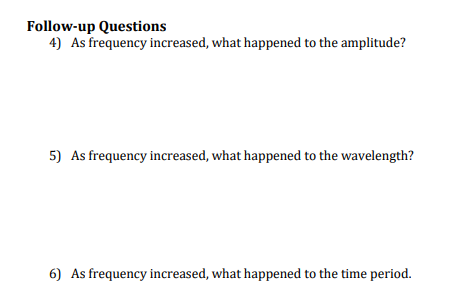
Lab 11: PhET simulation: "Wave on a String" Objective: To investigate the relationships among period, wavelength, and frequency. Students will use simulations to calculate the speed of waves with differing amplitudes and frequencies. Students will use speed measurements to graph speed vs. frequency and amplitude. To access the website, navigate your browser to: https://phet.colorado.edu/en/simulation/wave-on-a-string Instructions on starting up the simulations: 1. Click on either the Download button located below the simulation picture or on the HTML5 logo located on the lower right corner of the simulation picture. PHET SIMULATIONS TEACHING RESEARCH Wave on a String Frequency Amplitude DONATE PRET 's supported by + + 5 newschools venture fund # DOWNLOAD EMBED 2. Chose Open when the dialog box comes up. Make sure to click allow Java to run if the permissions box pops up. It should load after this. Getting familiar with the lab Using the step button. a. With the program paused, you can use the step button to incrementally advance the motion of the wave. This will allow you to measure the wavelength (crest to crest or trough to trough). b. With the program paused you can reset then start the timer. Step the program forward until the string has gone through one complete cycle. You can read the time period from the timer. Lab Procedure 1. Set the radio buttons to Oscillate and No end. 2. Set the Amplitude to 1.0 cm.3. Set the Frequency to 1.00 Hz. 4. Set the Damping to 0%. 5. Set the Tension to high. 6. Check the boxes for Rulers and Timer. 7. Drag the horizontal ruler until it is lined up with the horizontal dashed line, and its zero is at the left end of the string. Drag the vertical line so that you can measure the amplitude when paused. Results Taking your measurements. You will be doing 10 trials by taking measurements of wavelength, amplitude, and time period. Start with frequency at at 1.00 Hz and then increase it by .20 Hz for each trial. Record your data in the data table provided below. Make sure to write the units for your measurements in the spaces provided. Frequency Wavelength (2) Amplitude (cm) Time Period (T) in sec. 1.00 Hz 1.0 cm 1.20Hz 1.0 cm 1.40 Hz 1.0 cm 1.60 Hz 1.0 cm 1.80 Hz 1.0 cm 2.00 Hz 1.0 cm 2.20 Hz 1.0 cm 2.60 Hz 1.0 cm 2.80 Hz 1.0 cm 3.00 Hz 1.0 cm Vocabulary Review: 1) What is frequency? 2) What is amplitude? 3) On the diagram below, label the following: crest, trough, amplitude, and wavelength.Follow-up Questions 4) As frequency increased, what happened to the amplitude? 5) As frequency increased, what happened to the wavelength? 6) As frequency increased, what happened to the time period
Step by Step Solution

There are 3 Steps involved in it

1 Expert Approved Answer
Step: 1 Unlock blur-text-image

Question Has Been Solved by an Expert!

Get step-by-step solutions from verified subject matter experts

Step: 2 Unlock
Step: 3 Unlock

Students Have Also Explored These Related Mathematics Questions!