







Question: Waves Interference Lab 1 Wave Introduction This lab uses the Waves Interference simulation from PhET Interactive Simulations at University of Colorado Boulder, under the CC-BY
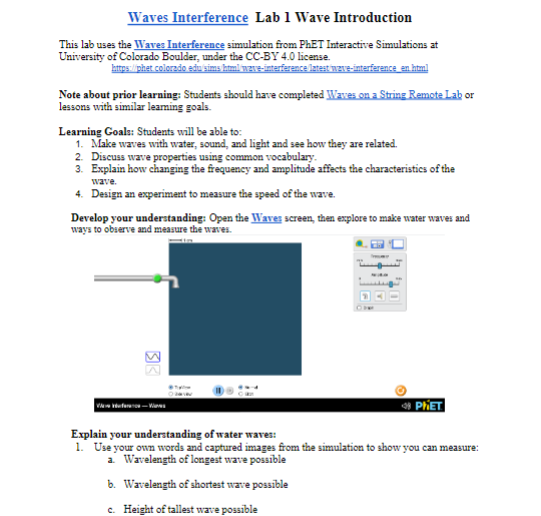
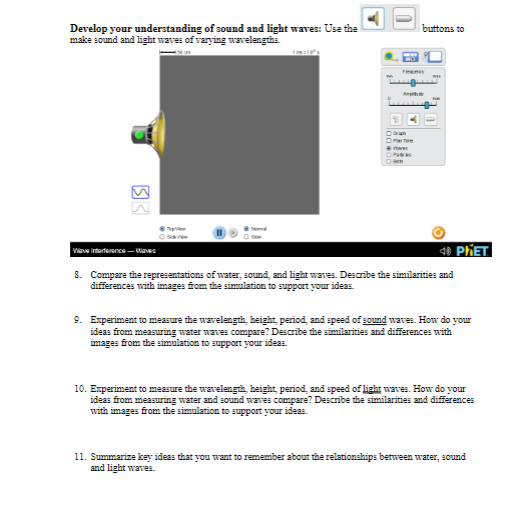
Waves Interference Lab 1 Wave Introduction This lab uses the Waves Interference simulation from PhET Interactive Simulations at University of Colorado Boulder, under the CC-BY 4.0 license. http:x/iphet colorado edu/sims html wave-interference latest wave-interference_en.html Note about prior learning: Students should have completed Waves on a String Remote Lab or lessons with similar leaming goals. Learning Goals: Students will be able to: 1. Make waves with water, sound, and light and see how they are related. 2. Discuss wave properties using common vocabulary . Explain how changing the frequency and amplitude affects the characteristics of the wave. 4. Design an experiment to measure the speed of the wave. Develop your understanding: Open the Waves screen, then explore to make water waves and ways to observe and measure the waves. PHET Explain your understanding of water waves! 1. Use your own words and captured images from the simulation to show you can measure: a. Wavelength of longest wave possible b. Wavelength of shortest wave possible c. Height of tallest wave possible2. Describe your experiments to make waves of different wavelengths and heights including which views and tools were needed and why. Support your explanation with images from the simulation. page 1 3. Use your own words and captured images from the simulation to show you can or cannot measure: a Period of longest wave possible b. Period of shortest wave possible c. Period of tallest wave possible 4. Describe your experiments to measure period including which views and tools were needed and why. Support your explanation with images from the simulation 5. Use your own words and captured images from the simulation to show you can or cannot measure: a. Speed of longest wave possible b. Speed of shortest wave possible5. Use your own words and captured images from the simulation to show you can or cannot measure: a. Speed of longest wave possible b. Speed of shortest wave possible c. Speed of tallest wave possible 6. Describe your experiments to measure speed including which views and tools were needed and why. Support your explanation with images from the simulation. 7. Summarize your understanding of wave characteristics and behaviors by comparing the longest, shortest, and tallest waves. Use these vocabulary words: Frequency, Amplitude, Wave Speed, and WavelengthDevelop your understanding of sound and light waves: Use the buttons to make sound and light waves of varying wavelengths. O Wind In one once - Waves 40 PHET Compare the representations of water, sound, and light waves. Describe the similarities and differences with images from the simulation to support your ideas. 9. Experiment to measure the wavelength, height, period, and speed of sound waves. How do your ideas from measuring water waves compare? Describe the similarities and differences with images from the simulation to support your ideas. 10. Experiment to measure the wavelength, height, period, and speed of light waves. How do your ideas from measuring water and sound waves compare? Describe the similarities and differences with images from the simulation to support your ideas. 11. Summarize key ideas that you want to remember about the relationships between water, sound and light waves
Step by Step Solution
There are 3 Steps involved in it

Get step-by-step solutions from verified subject matter experts
 Study Help