





Question: Lab 7 - How do Exponentials Sound? Exponential functions are commonly used in many scientific phenomena, such as population growth, or radioactive decay. But exponentials
Lab 7 - How do Exponentials Sound? Exponential
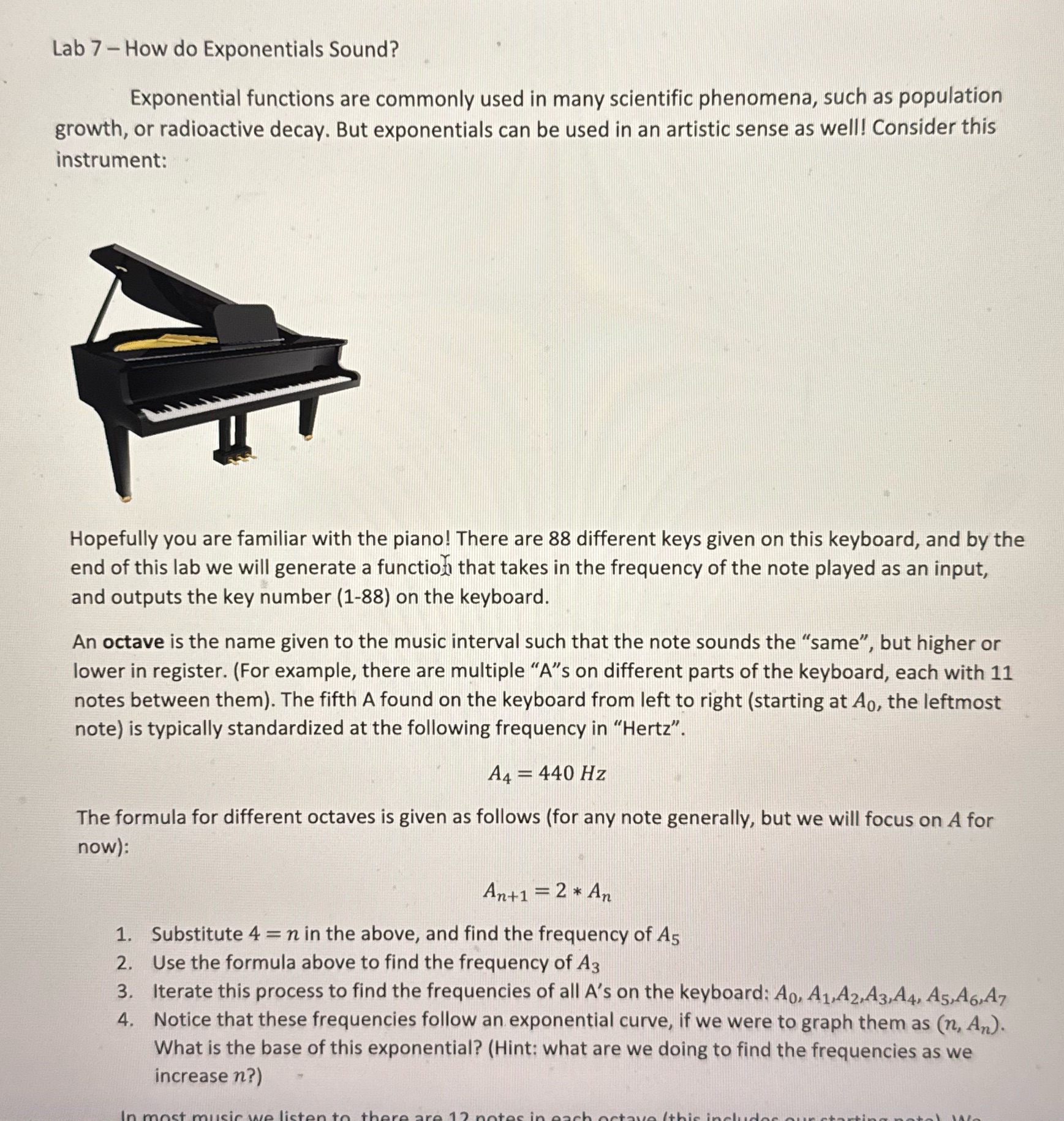
Lab 7 - How do Exponentials Sound? Exponential functions are commonly used in many scientific phenomena, such as population growth, or radioactive decay. But exponentials can be used in an artistic sense as well! Consider this instrument: Hopefully you are familiar with the piano! There are 88 different keys given on this keyboard, and by the end of this lab we will generate a function that takes in the frequency of the note played as an input, and outputs the key number (1-88) on the keyboard. An octave is the name given to the music interval such that the note sounds the "same", but higher or lower in register. (For example, there are multiple "A"'s on different parts of the keyboard, each with 11 notes between them). The fifth A found on the keyboard from left to right (starting at Ao, the leftmost note) is typically standardized at the following frequency in "Hertz". A4 = 440 Hz The formula for different octaves is given as follows (for any note generally, but we will focus on A for now): An+1 = 2 * An 1. Substitute 4 = n in the above, and find the frequency of As 2. Use the formula above to find the frequency of A3 3. Iterate this process to find the frequencies of all A's on the keyboard; Ao, A1,A2,A3, A4, As,A6,An 4. Notice that these frequencies follow an exponential curve, if we were to graph them as (n, An). What is the base of this exponential? (Hint: what are we doing to find the frequencies as we increase n?)

Step by Step Solution

There are 3 Steps involved in it

1 Expert Approved Answer
Step: 1 Unlock blur-text-image

Question Has Been Solved by an Expert!

Get step-by-step solutions from verified subject matter experts

Step: 2 Unlock
Step: 3 Unlock

Students Have Also Explored These Related Mathematics Questions!