







Question: lab help with finding data APHY106 Lab 4 Projectile Motion EQUIPMENT DESCRIPTION: SPRING-LOADED GUN In this lab a spring-based 'gun' is used . to re
lab help with finding data
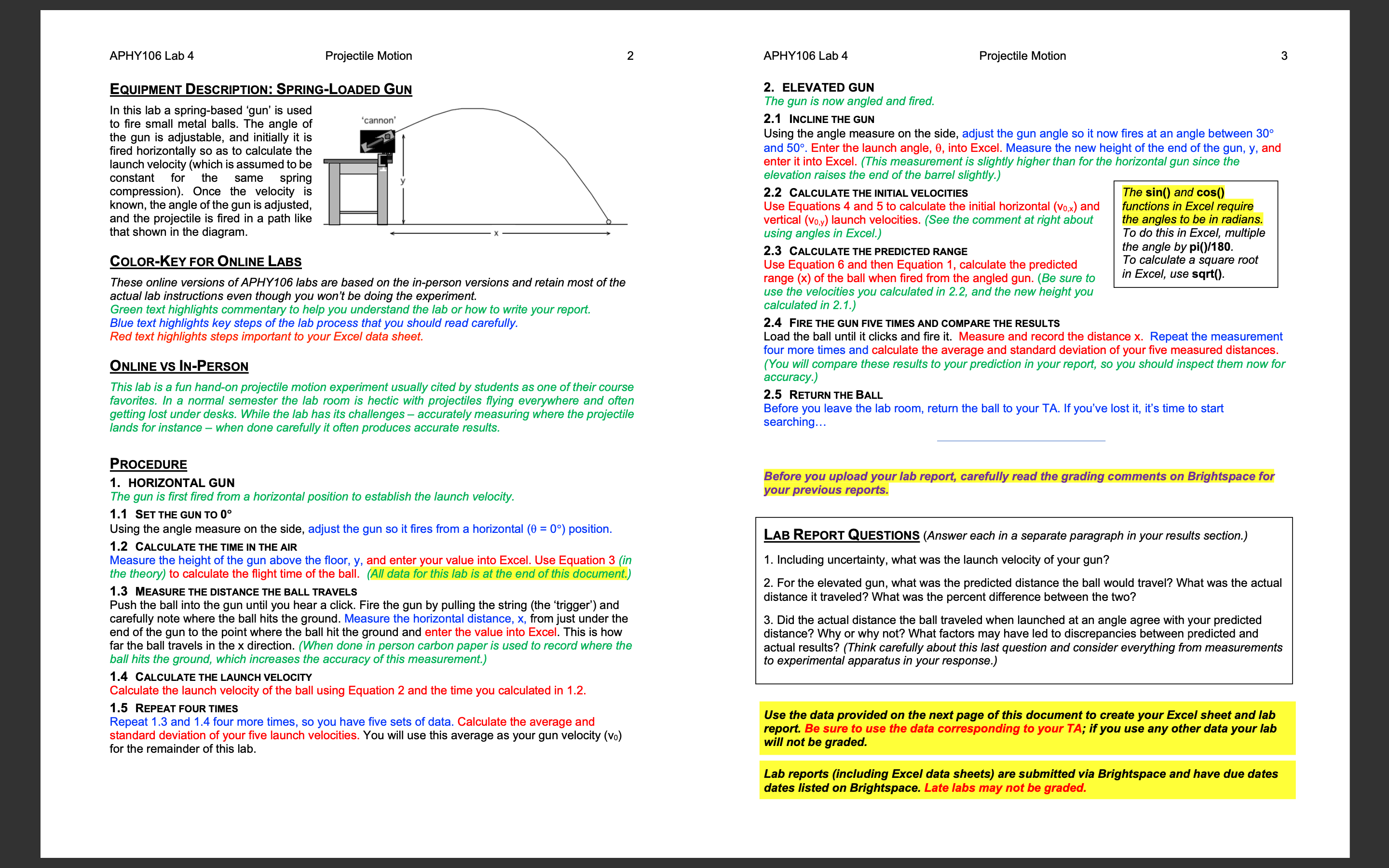
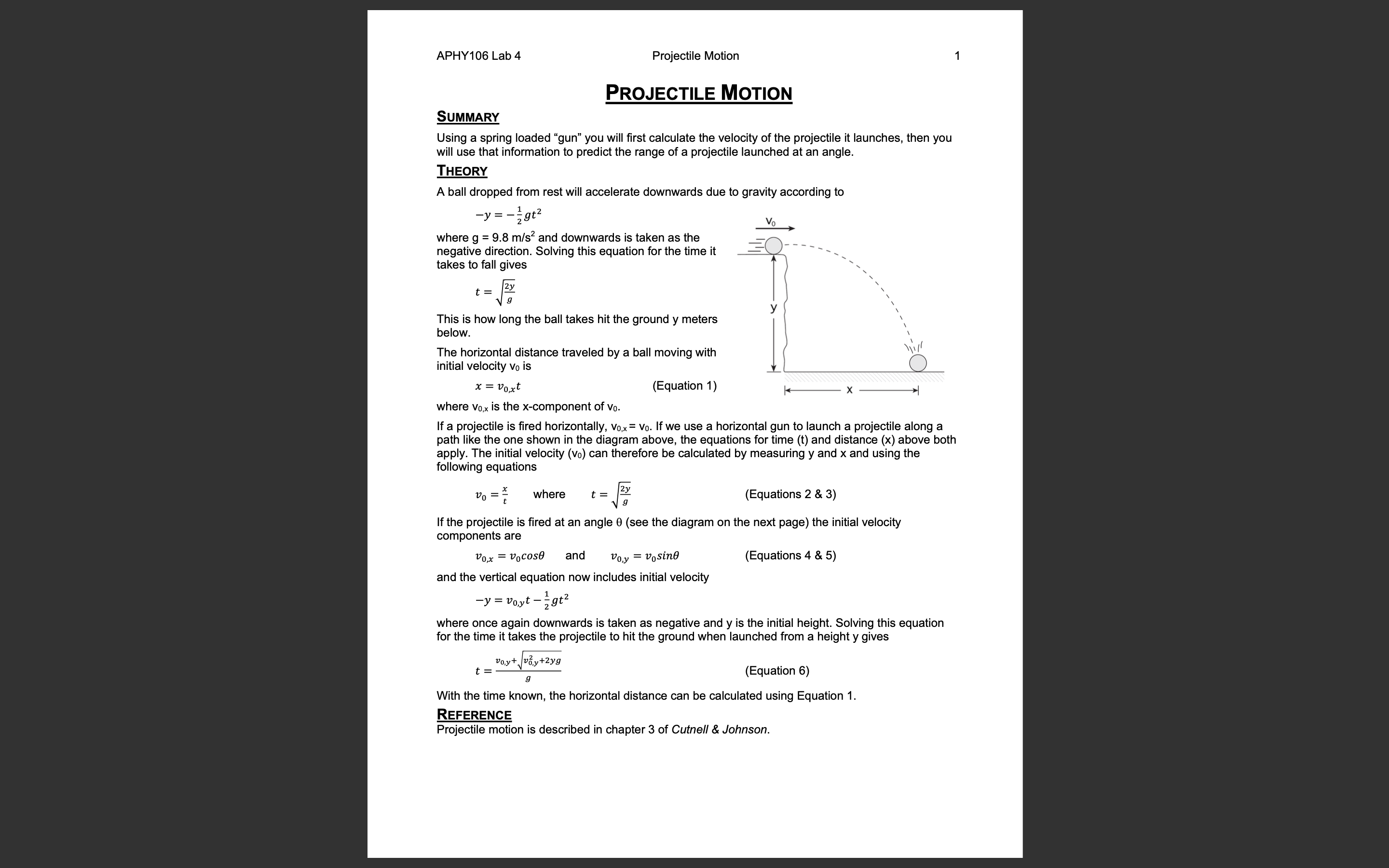
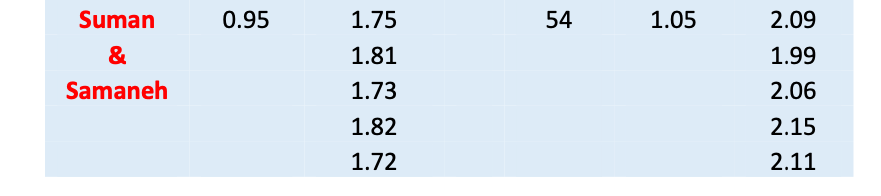
APHY106 Lab 4 Projectile Motion EQUIPMENT DESCRIPTION: SPRING-LOADED GUN In this lab a spring-based 'gun' is used . to re small metal balls. The angle of \"\""m'" the gun is adjustable, and initially it is red horizontally so as to calculate the launch velocity (which is assumed to be constant for the same spring y compression). Once the velocity is known. the angle of the gun is adjusted. and the projectile is red in a path like that shown in the diagram. ' x . COLOR-KEY FOR ONLINE LABS These online versions of APHY1 06 labs are based on the in-persan versions and retain most of the actual lab instructions even though you won't be doing the experiment, Green text highlights commentary to help you understand the lab or how to write your report. Blue text highlights key steps of the lab process that you should read carefully. Red text highlights steps important to your Excel data sheet. ONLINE vs lN-PERs0N This lab Is a fun hand-on projectile motion experiment usually cited by students as one oftheir course favorites in a normal semester the lab room is hectic With projectiles flying everywhere and often getting lost under desks. While the lab has its challenges 7 accurately measuring where the projectile lands for Instance 7 when done carefully it often produces accurate results PROCEDURE 1. HORIZONTAL GUN The gun Is rst red from a horizontal position to establish the launch velocity. 1.1 SET THE SUN To 0 Using the angle measure on the side, adjust the gun so It res from a horizontal (e = 0\") position. 1.2 CALcULATE THE TIME IN THE AIR Measure the height of the gun above the floor, y, and enter your value into Excel. Use Equation 3 {in the theory) to calculate the ight time of the ball. (All data for this lab is at the end ofthis document.) 1.3 MEASURE THE DISTANCE THE BALL TRAVELS Push the ball into the gun until you hear a click. Fire the gun by pulling the string (the 'trigger') and caretully note where the ball hits the ground. Measure the horizontal distance, x. from just under the end of the gun to the point where the ball hit the ground and enter the value into Excel. This is how far the ball travels in the x direction, {When done In person carbon paper IS used to record where the ball hits the ground. which increases the accuracy of this measurement) 1.4 CALCULATE THE LAUNCH VELOCITY Calculate the launch velocity of the ball using Equation 2 and the time you calculated in 1.2. 1.5 REPEAT FoUR TIMES Repeat 1.3 and 1.4 four more times, so you have five sets of data. Calculate the average and standard deviation of your five launch velocities. You will use this average as your gun velocity (vo) for the remainder of this lab. APHY106 Lab 4 Projectile Motion 2. ELEVATED GUN The gun Is now angled and fired, 2.1 INCLINE THE SUN Using the angle measure on the side, adjust the gun angle so it now res at an angle between 30 and 50. Enter the launch angle, 9, into Excel. Measure the new height of the end of the gun, y, and enter it into Excel. (This measurement Is slightly higher than for the horizontal gun since the elevation raises the end of the barrel slightly.) 2.2 CALCULATE THE INITIAL VELDcITIEs The sin() and cos() Use Equations 4 and 5 to calculate the initial horizontal (vux) and functions in Excel require vertical (my) launch velocities. (See the comment at right about the angles to be in radians. using angles in Excel ) To do this in Excel, multiple 2.3 CALCULATE THE PREDICTED RANGE \"'9 angle by \"0,130 Use Equation 6 and then Equation 1, calculate the predicted To calculate a square root range (x) of the ball when red from the angled gun. (Be sure to \"7 Excel, use sqrt(). use the velocities you calculated in 2 2, and the new height you calculated in 2 7 ) 2.4 FIRE THE GUN FIVE TIMES AND COMPARE THE RESULTS Load the ball until it clicks and re it. Measure and record the distance x. Repeat the measurement four more times and calculate the average and standard deviation of your ve measured distances. (You will compare these results to yourprediction in your report, so you should inspect them now for accuracy.) 2.5 RETURN THE BALL Before you leave the lab room, return the ball to your TA. It you've lost it, it's time to start searching... Before you upload your lab report, carelully read the grading comments on Brightspaoe for your previous reports. LAB REPORT QUESTIONS (Answer each in a separate paragraph in your results section.) 1. Including uncertainty, what was the launch velocity of your gun? 2. For the elevated gun, what was the predicted distance the ball would travel? What was the actual distance it traveled? What was the percent difference between the two? 3. Did the actual distance the ball traveled when launched at an angle agree with your predicted distance? Why or why not? What factors may have led to discrepancies between predicted and actual results? ( Think carefully about this last question and consider everything from measurements to experimental apparatus in your response.) Use the data provided on the next page of this document to create your Excel sheet and lab report. Be sure to use the data corresponding to your TA; if you use any other data your lab will not be graded. Lab reports (including Excel data sheets) are submitted vla Brightspace and have due dates dates listed on Brightspace. Late labs may not be graded. APHY106 Lab 4 Projectile Motion PROJECTILE MOTION SUMMARY Using a spring loaded \"gun" you will rst calculate the velocity of the projectile it launches, then you will use that information to predict the range of a projectile launched at an angle, THEORY A ball dropped from rest will accelerate downwards due to gravity according to _y=_;gt2 where g = 9.8 m/sz and downwards is taken as the negative direction. Solving this equation for the time it takes to fall gives J? This is how long the ball takes hit the ground y meters below. The horizontal distance traveled by a ball moving with initial velocity Va is x = 1:\": (Equation 1) where vim is the x-component of vo. If a projectile is red horizontally, Vo,x= Vi). If we use a horizontal gun to launch a projectile along a path like the one shown in the diagram above, the equations for time (t) and distance (x) above both apply. The initial velocity (Va) can therefore be calculated by measuring y and x and using the following equations we =f where t: 2?\" (Equations 2 & 3) If the projectile is fired at an angle 9 (see the diagram on the next page) the initial velocity components are v\" : vocosa and 1:0,, : vosina (Equations 4 & 5) and the vertical equation now includes initial velocity 1 *y : Voyt , gstz where once again downwards is taken as negative and y is the initial height Solving this equation for the time it takes the projectile to hit the ground when launched from a height y gives v0,\" viwzm 9 With the time known, the horizontal distance can be calculated using Equation 1. REFERENCE Projectile motion is described in chapter 3 of Cutnell & Johnson. t : (Equation 6) Suman 0.95 1.75 54 1.05 2.09 & 1.81 1.99 Samaneh 1.73 2.06 1.82 2.15 1.72 2.11
Step by Step Solution
There are 3 Steps involved in it

Get step-by-step solutions from verified subject matter experts
 Study Help