







Question: Lab Intro To Microprocessor The maximum value of a byte is 255 (OxFF). Which means the maximum number of times we can make iterations is
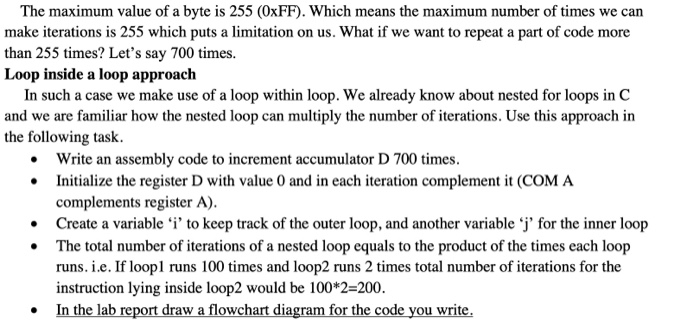
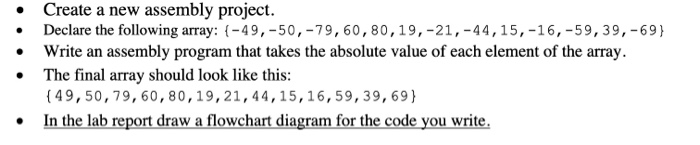
The maximum value of a byte is 255 (OxFF). Which means the maximum number of times we can make iterations is 255 which puts a limitation on us. What if we want to repeat a part of code more than 255 times? Let's say 700 times. Loop inside a loop approach In such a case we make use of a loop within loop. We already know about nested for loops in C and we are familiar how the nested loop can multiply the number of iterations. Use this approach in the following task. Write an assembly code to increment accumulator D 700 times. Initialize the register D with value 0 and in each iteration complement it (COM A complements register A). Create a variable 'i' to keep track of the outer loop, and another variable 'j' for the inner loop The total number of iterations of a nested loop equals to the product of the times each loop runs.i.e. If loopl runs 100 times and loop2 runs 2 times total number of iterations for the instruction lying inside loop2 would be 100*2=200. In the lab report draw a flowchart diagram for the code you write. Create a new assembly project. Declare the following array: {-49,-50,-79, 60, 80,19,-21,-44,15,-16, -59,39,-69} Write an assembly program that takes the absolute value of each element of the array. The final array should look like this: {49, 50, 79, 60, 80, 19, 21, 44,15,16,59,39,69) In the lab report draw a flowchart diagram for the code you write. The maximum value of a byte is 255 (OxFF). Which means the maximum number of times we can make iterations is 255 which puts a limitation on us. What if we want to repeat a part of code more than 255 times? Let's say 700 times. Loop inside a loop approach In such a case we make use of a loop within loop. We already know about nested for loops in C and we are familiar how the nested loop can multiply the number of iterations. Use this approach in the following task. Write an assembly code to increment accumulator D 700 times. Initialize the register D with value 0 and in each iteration complement it (COM A complements register A). Create a variable 'i' to keep track of the outer loop, and another variable 'j' for the inner loop The total number of iterations of a nested loop equals to the product of the times each loop runs.i.e. If loopl runs 100 times and loop2 runs 2 times total number of iterations for the instruction lying inside loop2 would be 100*2=200. In the lab report draw a flowchart diagram for the code you write. Create a new assembly project. Declare the following array: {-49,-50,-79, 60, 80,19,-21,-44,15,-16, -59,39,-69} Write an assembly program that takes the absolute value of each element of the array. The final array should look like this: {49, 50, 79, 60, 80, 19, 21, 44,15,16,59,39,69) In the lab report draw a flowchart diagram for the code you write
Step by Step Solution
There are 3 Steps involved in it

Get step-by-step solutions from verified subject matter experts
 Study Help