



Question: Lab report: put what you have finished in running testbench into the lab report, totally at least three pages, need to explain your understanding of
Lab report: put what you have finished in running testbench into the lab report, totally at least three pages, need to
explain your understanding of the code, how you run the code and need to put the screenshot in it.
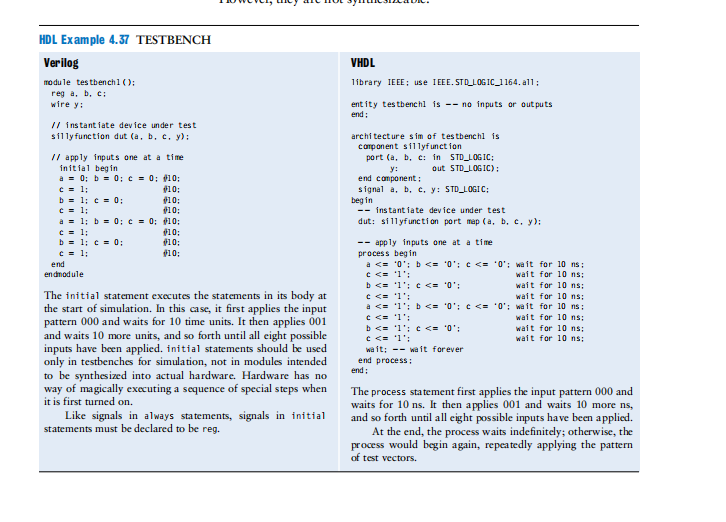
Verilog
module testbench1 ();
reg a, b, c;
wire y;
// instantiate device under test
sillyfunction dut (a, b, c, y);
// apply inputs one at a time
initial begin
a = 0; b= 0; c = 0; #10;
c =1; #10;
b =1; c= 0; #10;
c =1; #10;
a =1; b= 0; c= 0; #10;
c =1; #10;
b =1; c =0; #10;
c =1; #10;
end
endmodule
The initial statement executes the statements in its body at
the start of simulation. In this case, it first applies the input
pattern 000 and waits for 10 time units. It then applies 001
and waits 10 more units, and so forth until all eight possible
inputs have been applied. initial statements should be used
only in testbenches for simulation, not in modules intended
to be synthesized into actual hardware. Hardware has no
way of magically executing a sequence of special steps when
it is first turned on.
Like signals in always statement, signals in initial statement must be declared to be reg.
VHDL
library IEEE; use IEEE.STD_LOGIC_1164.all;
entity testbench1 is no inputs or outputs
end;
architecture sim of testbench1 is
component sillyfunction
port (a, b, c: in STD_LOGIC;
y: out STD_LOGIC);
end component;
signal a, b, c, y: STD_LOGIC;
begin
instantiate device under test
dut: sillyfunction port map (a, b, c, y);
apply inputs one at a time
process begin
a
c
b
c
A
C
B
wait; wait forever
end process;
end;
The process statement first applies the input pattern 000 and
waits for 10 ns. It then applies 001 and waits 10 more ns,
and so forth until all eight possible inputs have been applied.
At the end, the process waits indefinitely; otherwise, the
process would begin again , repeatedly applying the pattern of test vectors.
VHDL HDL Example 4.37 TESTBENCH Verilog module testbench 1(); reg a, b, c: wire y: library IEEE; use IEEE. STD_LOGIC_1164. all; entity testbenchl is -- no inputs or outputs end: 17 instantiate device under test silly function dut (a, b, c, y): // apply inputs one at a time initial begin a = 0; b = 0; c = 0; 110: C = 1; 010: b = 1; C = 0; 110: C = 1: 110: a = 1; b = 0; c = 0; 010: C = 1: 010: b = 1; c = 0; 110: C = 1; 110: end endmodule architecture sim of testbenchl is component sillyfunction port (a, b, c in STD_LOGIC; y: out STD_LOGIC): end component: signal a, b, c, y: STD_LOGIC: begin -- instantiate device under test dut: sillyfunction port map (a, b, c, y): The initial statement executes the statements in its body at the start of simulation. In this case, it first applies the input pattern 000 and waits for 10 time units. It then applies 001 and waits 10 more units, and so forth until all eight possible inputs have been applied. initial statements should be used only in testbenches for simulation, not in modules intended to be synthesized into actual hardware. Hardware has no way of magically executing a sequence of special steps when it is first turned on. Like signals in always statements, signals in initial statements must be declared to be reg. -- apply inputs one at a time process begin a
Step by Step Solution
There are 3 Steps involved in it

Get step-by-step solutions from verified subject matter experts