







Question: Label Each Question and Chapter: Chapter 7 Does motivation come from within a person or is it a result of a situation. Explain. Goal setting.
Label Each Question and Chapter:
Chapter 7
- Does motivation come from within a person or is it a result of a situation. Explain.
- Goal setting. Where do you want to be in five years? Do you have specific five-years goals? Discuss three goals you want to achieve in five years and make sure the goals are specific, challenging, and measurable (read the Goal-Setting Theory section pg. 212-214 before posting to this section).
Something to think about: The topic of motivation is a great one! Many of you will become managers in some capacity. It is so important to know how to motivate your employees.
However, read this chapter and make postings, not only think about what it takes to motivate others, but I also to think about what really motivates you. Do you know how you are motivated? I believe that knowing how you are motivated is a great tool in the search for satisfying employment!
Chapter 7: Case Incident
Case Incident 2 - pg. 231
This case discusses bullying bosses, however, the introduction discusses adding your boss as a Facebook friend. I'm just curious, how many of you have your boss as a FB friend?
How many of you refuse to add coworkers or your boss as a FB friend?
I make it a policy not to add my students as my FB friend unless they are also someone that I have a relationship with outside of the classroom. Do you think this is a good idea or not? Tell me what you think about mixing FB with business...
Chapter 8
Ch 8 - Flextime & Telecommuting
What are your opinions about flextime and/or telecommuting?
Chapter 9
- Identify five roles you play. What behaviors do they require? Are any of these roles in conflict? If so, in what way? How do you resolve these conflicts?
- What effect, if any, do you expect that workforce diversity has on a group's performance and satisfaction?
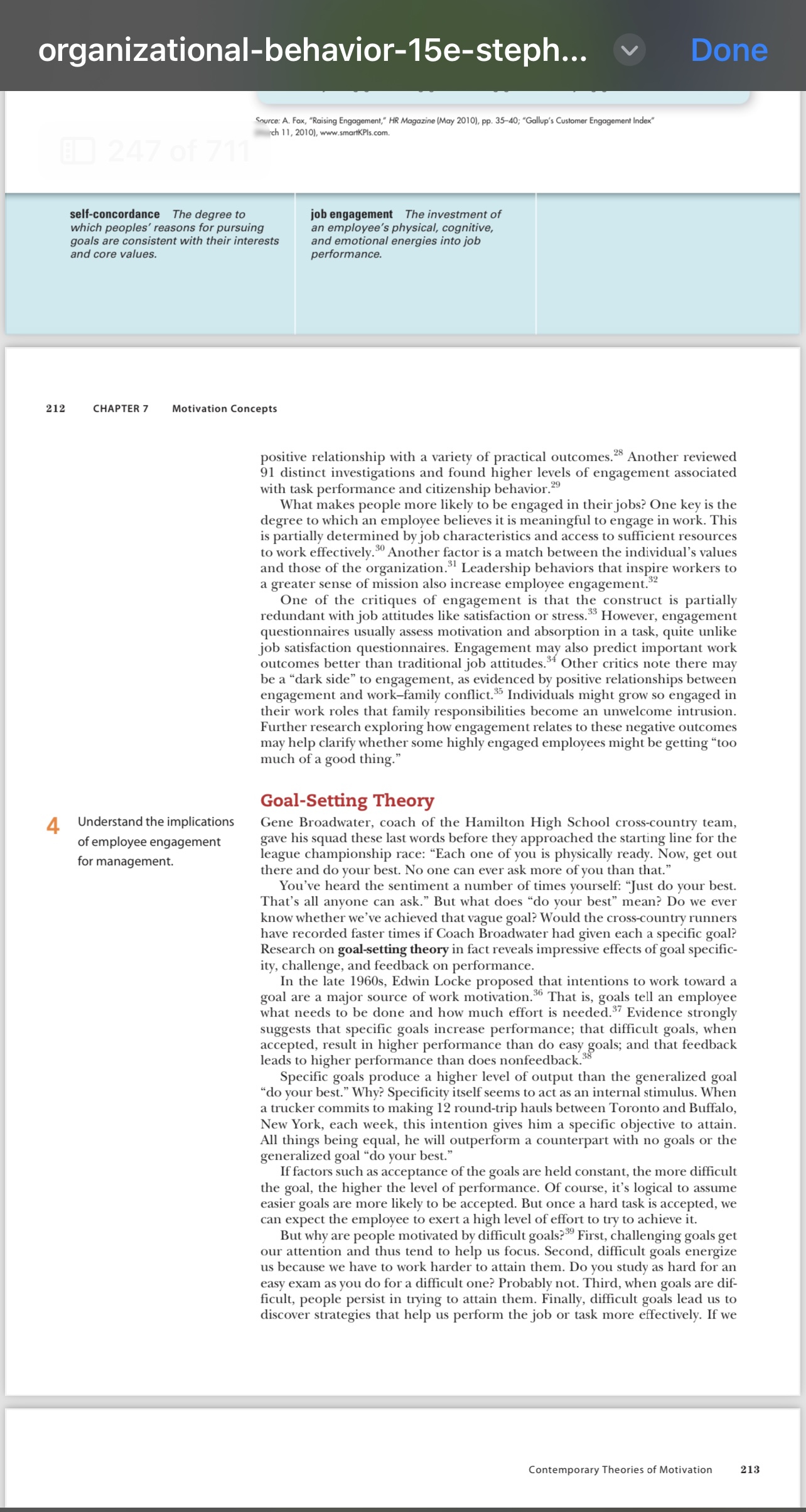
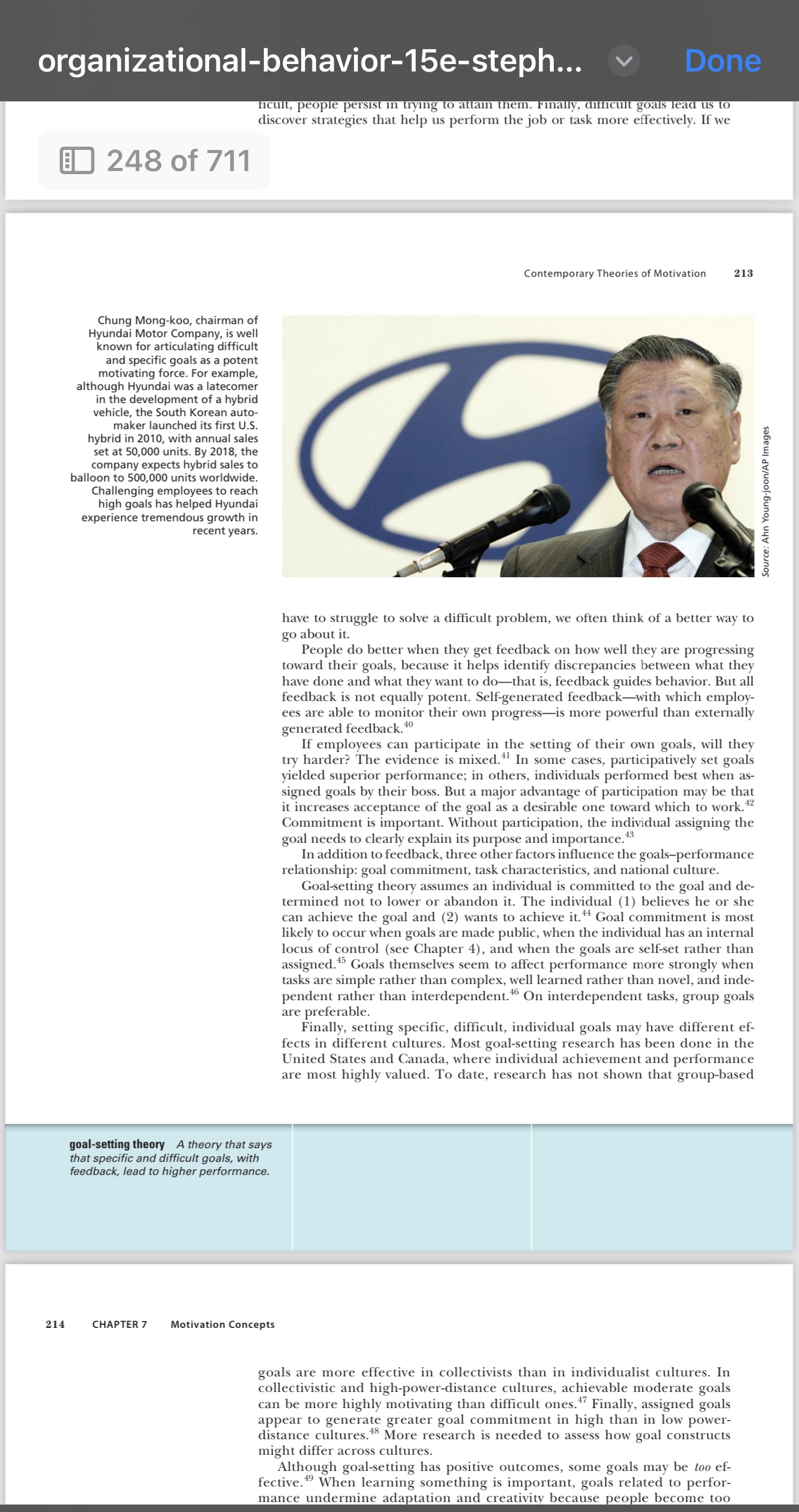
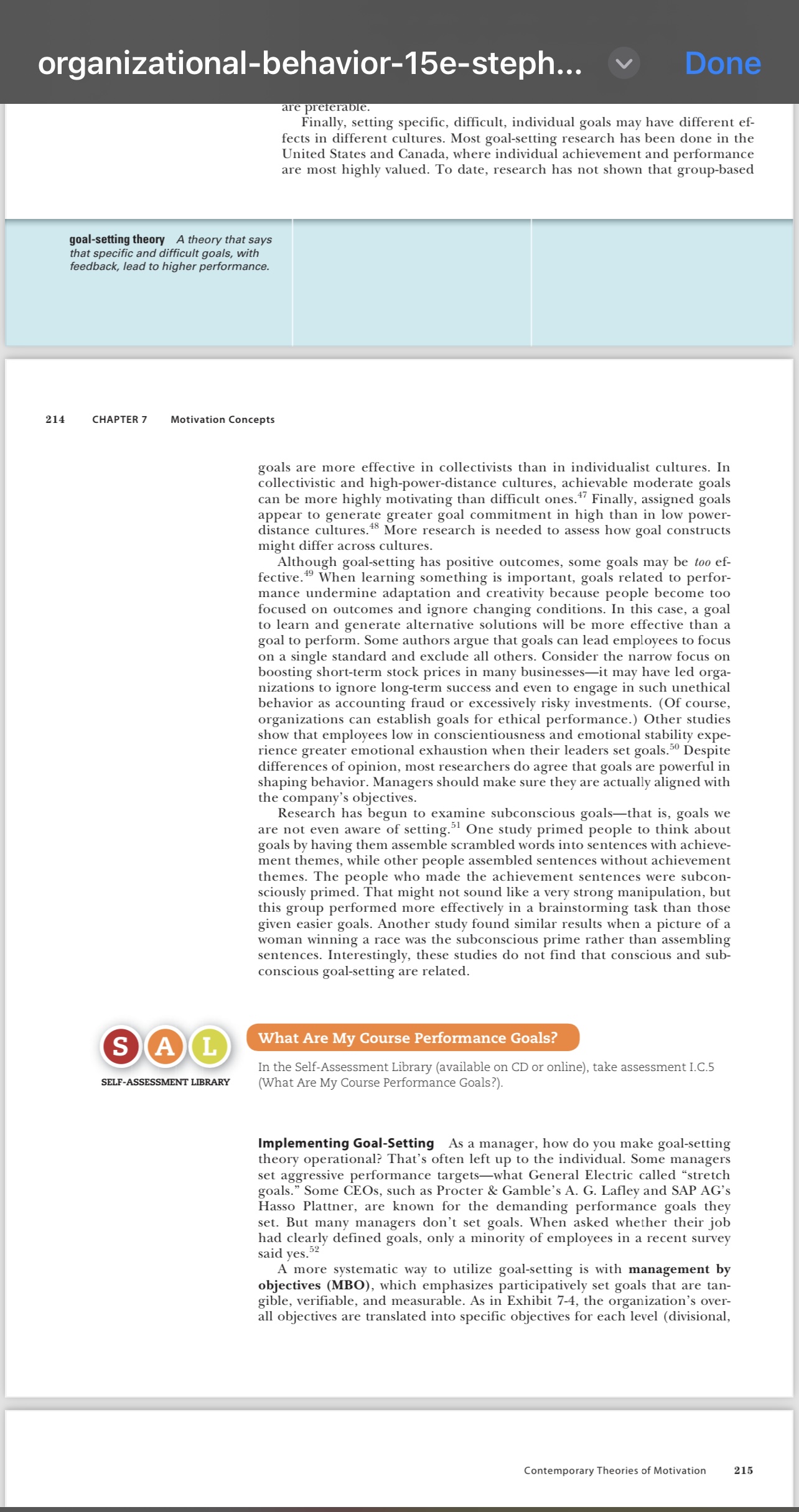
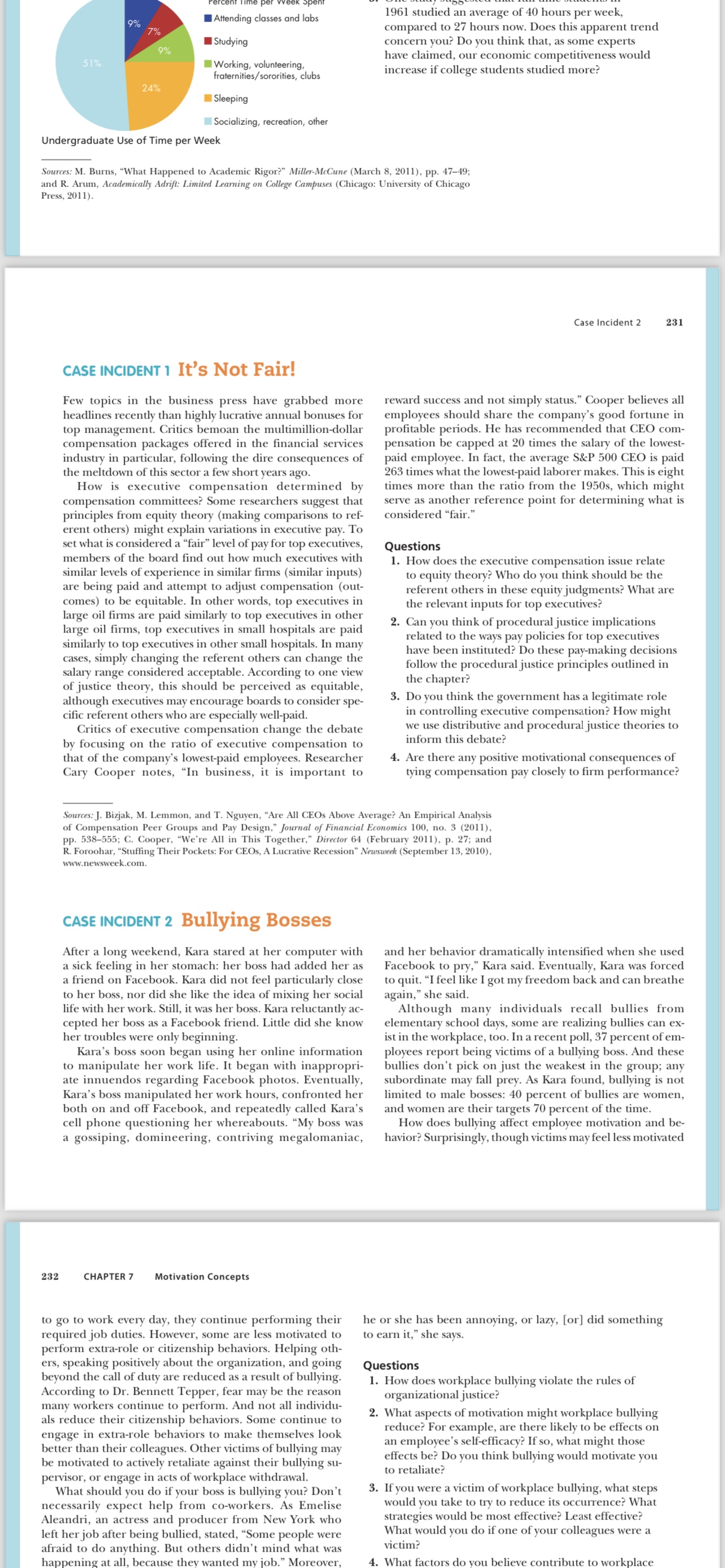
organizational-behavior-15e-steph... Saurce: A. Fox, \"Raising Engogement,\" HR Mogazine (May 2010), pp. 35-40; \"Gallup's Cusiomer Engagement Index\" rch 11, 2010), www.smartKPls.com self-concordance The degree to job engagement The investment of which peoples' reasons for pursuing an employee's physical, cognitive, goals are consistent with their interests and emotional energies into job and core values. performance. 212 CHAPTER 7 Motivation Concepts positive relationship with a variety of practical outcomes.\" Another reviewed 91 distinct investigations and found higher levels of engagement associated with task performance and citizenship behavior.\" What makes people more likely to be engaged in their jobs? One key is the degree to which an employee believes it is meaningful to engage in work. This is partially determined by job characteristics and access to sufficient resources to work c'ffecti\\'ely.m Another factor is a match between the individual's values and those of the organization.\" Leadership behaviors that inspire workers to a greater sense of mission also increase employee engagement. One of the critiques of engagement is that the construct is partially redundant with job attitudes like satisfaction or stress.\"* However, engagement questionnaires usually assess motivation and absorption in a task, quite unlike Jjob satisfaction questionnaires. Engagement may also predict important work outcomes better than traditional job attitudes.\" Other critics note there may be a \"dark side\" to engagement, as evidenced by positive relationships between engagement and workfamily conflict.\"\" Individuals might grow so engaged in their work roles that family responsibilities become an unwelcome intrusion. Further research exploring how engagement relates to these negative outcomes may help clarify whether some highly engaged employees might be getting \"too much of a good thing.\" Goal-Setting Theory Understand the implications Gene Broadwater, coach of the Hamilton High School cross-country team, of employee engagement gave his squad these last words before they approached the starting line for the league championship race: \"Each one of you is physically ready. Now, get out there and do your best. No one can ever ask more of you than that.\" You've heard the sentiment a number of times yourself: \"Just do your best. That's all anyone can ask.\" But what does \"do your best\" mean? Do we ever know whether we've achieved that vague goal? Would the cross-countr mners have recorded faster times if Coach Broadwater had given each a specific goal? Research on goal-setting theory in fact reveals impressive effects of goal specific- ity, challenge, and feedback on performance. In the late 1960s, Edwin Locke proposed that intentions to work toward a goal are a major source of work motivation.\" That is, goals tell an employee what needs to be done and how much effort is needed.*\" Evidence strongly suggests that specific goals increase performance; that difficult goals, when accepted, result in higher performance than do ea o;\\ls; and that feedback leads to higher performance than does nonfeedback. Specific goals produce a higher level of output than the generalized goal \"do your best.\" Why? Specificity itself seems to act as an internal stimulus. When a trucker commits to making 12 round-trip hauls between Toronto and Buffalo, New York, each week, this intention gives him a specific objective to attain. All things being equal, he will outperform a counterpart with no goals or the generalized goal \"do your best.\" If factors such as acceptance of the goals are held constant, the more difficult the goal, the higher the level of performance. Of course, it's logical to assume easier goals are more likely to be accepted. But once a hard task is accepted, we can expect the employee to exert a high level of effort to try to achieve it. But why are people motivated by difficult guals?:'" First, challenging goals get our attention and thus tend to help us focus. Second, difficult goals energize us because we have to work harder to attain them. Do you study as hard for an easy exam as you do for a difficult one? Probably not. Third, when goals are dif- ficult, people persist in trying to attain them. Finally, difficult goals lead us to discover strategies that help us perform the job or task more effectively. If we for management. Contemporary Theories of Motivation 213 organizational-behavior-15e-steph. 1cult, people persist 1n rying to attain them. Fmally, difficult goals lead us to discover strategies that help us perform the job or task more effectively. If we (0] 248 of 711 Contemporary Theories of Motivation 213 Chung Mong-koo, chairman of Hyundai Motor Company, is well known for articulating difficult and specific goals as a potent motivating force. For example, although Hyundai was a latecomer in the development of a hybrid vehicle, the South Korean auto- maker launched its first U.S. hybrid in 2010, with annual sales set at 50,000 units. By 2018, the company expects hybrid sales to balloon to 500,000 units worldwide. Challenging employees to reach high goals has helped Hyundai experience tremendous growth in recent years. Source: Ahn Young-joon/AP Images have to struggle to solve a difficult problem, we often think of a better way to go about it. People do better when they get feedback on how well they are progressing toward their goals, because it helps identify discrepancies between what they have done and what they want to dothat is, feedback guides behavior. But all feedback is not equally potent. Self-generated feedbackwith which employ- ees are able to monitor their own progressis more powerful than externally generated feedback."\" If employees can participate in the setting of their own goals, will they try harder? The evidence is mixed.*' In some cases, participatively set goals vielded superior performance; in others, individuals performed best when as- signed goals by their boss. But a major advantage of participation may be that it increases acceptance of the goal as a desirable one toward which to work. Commitment is important. Without participation, the individual assigning the goal needs to clearly explain its purpose and importance.* In addition to feedback, three other factors influence the goalsperformance relationship: goal commitment, task characteristics, and national culture. Goal-setting theory assumes an individual is committed to the goal and de- termined not to lower or abandon it. The individual (1) believes he or she can achieve the goal and (2) wants to achieve it." Goal commitment is most likely to occur when goals are made public, when the individual has an internal locus of control (see Chapter 4), and when the goals are selfset rather than assigned.\" Goals themselves seem to affect performance more strongly when tasks are simple rather than complex, well learned rather than novel, and inde- pendent rather than imerdependem.\"" On interdependent tasks, group goals are preferable. Finally, setting specific, difficult, individual goals may have different ef- fects in different cultures. Most goal-setting research has been done in the United States and Canada, where individual achievement and performance are most highly valued. To date, research has not shown that group-based goal-setting theory A theory that says that specific and difficult goals, with feedback, lead to higher performance. 214 CHAPTER 7 Motivation Concepts goals are more effective in collectivists than in individualist cultures. In collectivistic and high-power-distance cultures, achievable moderate goals can be more highly motivating than difficult ones. '' Finally, assigned goals appear to generate greater goal commitment in high than in low power- distance cultures.\" More research is needed to assess how goal constructs might differ across cultures. Although goal-setting has positive outcomes, some goals may be too ef- fective.* When learning something is important, goals related to perfor- mance undermine adalaliou and creativity because Eeogle become too organizational-behavior-15e-steph... are prelerable. Finally, setting specific, difficult, individual goals may have different ef- fects in different cultures. Most goal-setting research has been done in the United States and Canada, where individual achievement and performance are most highly valued. To date, research has not shown that group-based goal-setting theory A theory that says that specific and difficult goals, with feedback, lead to higher performance. 214 CHAPTER 7 Motivation Concepts goals are more effective in collectivists than in individualist cultures. In collectivistic and high-power-distance cultures, achievable moderate goals can be more highly motivating than difficult ones.*\" Finally, assigned goals appear to generate greater goal commitment in high than in low power- distance cultures.\" More research is needed to assess how goal constructs might differ across cultures. Although goalsetting has positive outcomes, some goals may be too ef- fective.* When learning something is important, goals related to perfor- mance undermine adaptation and creativity because people become too focused on outcomes and ignore changing conditions. In this case, a goal to learn and generate alternative solutions will be more effective than a goal to perform. Some authors argue that goals can lead employees to focus on a single standard and exclude all others. Consider the narrow focus on boosting short-term stock prices in many businessesit may have led orga- nizations to ignore long-term success and even to engage in such unethical behavior as accounting fraud or excessively risky investments. (Of course, organizations can establish goals for ethical performance.) Other studies show that employees low in conscientiousness and emotional stability expe- rience greater emotional exhaustion when their leaders set goals.\" Despite differences of opinion, most researchers do agree that goals are powerful in shaping behavior. Managers should make sure they are actually aligned with the company's objectives. Research has begun to examine subconscious goalsthat is, goals we are not even aware of setting.\"' One study primed people to think about goals by having them assemble scrambled words into sentences with achieve- ment themes, while other people assembled sentences without achievement themes. The people who made the achievement sentences were subcon- sciously primed. That might not sound like a very strong manipulation, but this group performed more effectively in a brainstorming task than those given easier goals. Another study found similar results when a picture of a woman winning a race was the subconscious prime rather than assembling sentences. Interestingly, these studies do not find that conscious and sub- conscious goal-setting are related. 9 0 What Are My Course Performance Goals? In the Self-Assessment Library (available on CD or online), take assessment 1.C.5 SELF-ASSESSMENT LIBRARY (What Are My Course Performance Goals?). Implementing Goal-Setting As a manager, how do you make goal-setting theory operational? That's often left up to the individual. Some managers set aggressive performance targetswhat General Electric called \"stretch goals.\" Some CEOs, such as Procter & Gamble's A. G. Lafley and SAP AG's Hasso Plattner, are known for the demanding performance goals they set. But many managers don't set goals. When asked whether their job had clearly defined goals, only a minority of employees in a recent survey said yes. A more systematic way to utilize goal-setting is with management by objectives (MBO), which emphasizes participatively set goals that are tan- gible, verifiable, and measurable. As in Exhibit 7-4, the organization's over- all objectives are translated into specific objectives for each level (divisional, Contemporary Theories of Motivation 215 rercent lime per vveek dpent M Attending classes and labs M Studying B Working, volunteering, fraternities/sororities, clubs W Sleeping Socidlizing, recreation, other Undergraduate Use of Time per Week Sources: M. B and R. Arum, Press, 2011). 1961 sludicdt::l average of 40 hours per week, compared to 27 hours now. Does this apparent trend concern you? Do you think that, as some experts have claimed, our economic competitiveness would increase if college students studied more? s. \"What Happened to Academic Rigor?\" Mille-McCune (March 8, 2011), pp. 47-49; ademically Adrift: Limited Leaming on College Campuses (Chicago: University of Chicago CAsE INCIDENT 1 It's Not Fair! Few topics in the business press have grabbed more headlines recently than highly lucrative annual bonuses for top management. Critics bemoan the multimillion-dollar compensation packages offered in the financial services industry in particular, following the dire consequences of the meltdown of this sector a few short years ago. How is executive compensation determined by compensation committees? Some researchers suggest that principles from equity theory (making comparisons to ref- erent others) might explain variations in executive pay. To set what is considered a \"fair\" level of pay for top executives, members of the board find out how much executives with similar levels of experience in similar firms (similar inputs) are being paid and attempt to adjust compensation (out- comes) to be equitable. In other words, top executives in large oil firms are paid similarly to top executives in other large oil firms, top executives in small hospitals are paid similarly to top executives in other small hospitals. In many cases, simply changing the referent others can change the salary range considered acceptable. According to one view of justice theory, this should be perceived as equitable, although executives may encourage boards to consider spe- cific referent others who are especially well-paid. Critics of executive compensation change the debate by focusing on the ratio of executive compensation to that of the company's lowest-paid employees. Researcher Cary Cooper notes, \"In business, it is important to Stuffing Their Pockets: For CEOs, A Lu www.newsweek.com. CASE INCIDENT 2 Bullying Bosses After a long weekend, Kara stared at her computer with a sick feeling in her stomach: her boss had added her as a friend on Facebook. Kara not feel particularly close to her boss, nor did she like the idea of mixing her social life with her work. Still, it was her boss. Kara reluctantly ac- cepted her boss as a Facebook friend. Little did she know her troubles were only beginning. Kara's boss soon began using her online information to manipulate her work life. It began with inappropri- ate innuendos regarding Facebook photos. Eventually, Kara's boss manipulated her work hours, confronted her both on and off Facebook, and repeatedly called Kara's cell phone questioning her whereabouts. \"My boss was a gossiping, domineering, contriving megalomaniac, Case Incident 2 231 reward success and not simply status.\" Cooper believes all employees should share the company's good fortune in profitable periods. He has recommended that CEO com- pensation be capped at 20 times the salary of the lowest- paid employee. In fact, the average S&P 500 CEO is paid 263 times what the lowest-paid laborer makes. This is eight times more than the ratio from the 1950s, which might serve as another reference point for determining what is considered \"fair.\" Questions 1. How does the executive compensation issue relate to equity theory? Who do you think should be the referent others in these equity judgments? What are the relevant inputs for top executives? 2. Can you think of procedural justice implications related to the ways pay policies for top executives have been instituted? Do these pay-making decisions follow the procedural justice principles outlined in the chapter? e Do you think the government has a legitimate role in controlling executive compensation? How might we use distributive and procedural justice theories to inform this debate? 4. Are there any positive motivational consequences of tying compensation pay closely to firm performance? and her behavior dramatically intensified when she used Facebook to pry,\" Kara said. Eventually, Kara was forced to quit. \"I'feel like I got my freedom back and can breathe again,\" she said. Although many individuals recall bullies from elementary school days, some are realizing bullies can ex- istin the workplace, too. In a recent poll, 37 percent of em- ployees report being victims of a bullying boss. And these bullies don't pick on just the weakest in the group; any subordinate may fall prey. As Kara found, bullying is not limited to male bosses: 40 percent of bullies are women, and women are their targets 70 percent of the time. How does bullying affect employee motivation and be- havior? Surprisingly, though victims may feel less motivated 232 CHAPTER 7 Motivation Concepts 10 go to work every day, they continue performing their required job duties. However, some are less motivated to perform extra-role or citizenship behaviors. Helping oth- ers, speaking positively about the organization, and going beyond the call of duty are reduced as a result of bullying. According to Dr. Bennett Tepper, fear may be the reason many workers continue to perform. And not all individu- als reduce their citizenship behaviors. Some continue to engage in extra-role behaviors to make themselves look better than their colleagues. Other victims of bullying may be motivated to actively retaliate against their bullying su- pervisor, or engage in acts of workplace withdrawal. What should you do if your boss is bullying you? Don't necessarily expect help from co-workers. As Emelise Aleandri, an actress and producer from New York who left her job after being bullied, stated, \"Some people were afraid to do anything. But others didn't mind what was happening at all, because they wanted my job.\" Moreover, he or she has been annoying, or lazy, [or] did something to earn it,\" she says. Questions 1. How does workplace bullying violate the rules of organizational justice? 2. What aspects of motivation might workplace bullying reduce? For example, are there likely to be effects on an employee's self-efficacy? If so, what might those effects be? Do you think bullying would motivate you to retaliate? 3. If you were a victim of workplace bullying, what steps would you take to try to reduce its occurrence? What strategies would be most effective? Least effective? What would you do if one of your colleagues were a victim? 4. What factors do you believe contribute to workplace
Step by Step Solution
There are 3 Steps involved in it

Get step-by-step solutions from verified subject matter experts
 Study Help