







Question: - Label port based on the BID information provided below. Use RP, DP and AP port designations. Figure 2-2 802.1D Port Roles - Scenario 1
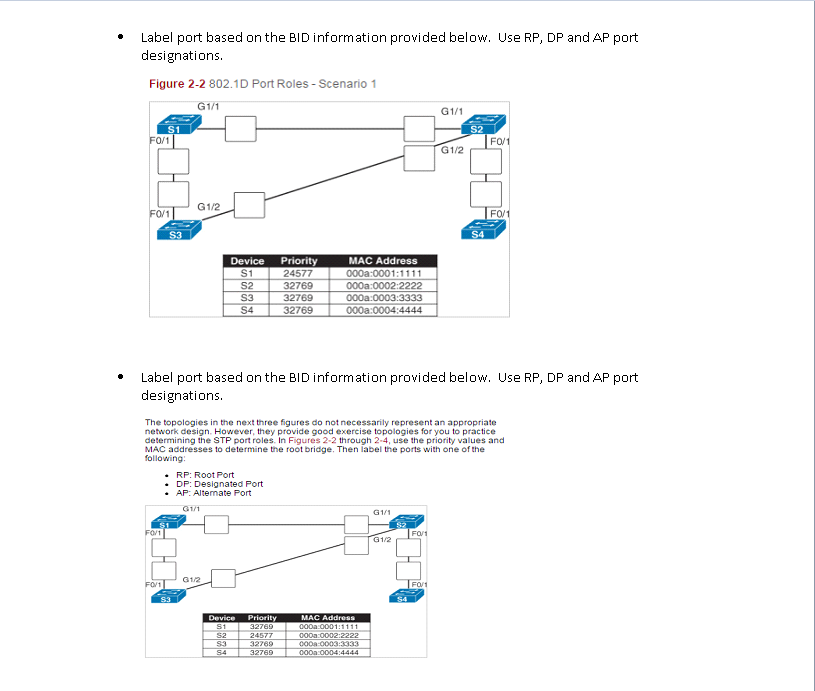
- Label port based on the BID information provided below. Use RP, DP and AP port designations. Figure 2-2 802.1D Port Roles - Scenario 1 - Label port based on the BID information provided below. Use RP, DP and AP port designations. The topologies in the next three figures do not necessarily represent an appropriate network design. However, they provide good exercise topologies for you to practice determining the STP port roles. In Figures 2-2 through 2-4, use the priority values and MAC addresses to determine the root bridge. Then label the ports with one of the following: - RP: Root Port - DP: Designated Port - AP: Altemate Port - Label port based on the BID information provided below. Use RP, DP and AP port designations. Figure 2-2 802.1D Port Roles - Scenario 1 - Label port based on the BID information provided below. Use RP, DP and AP port designations. The topologies in the next three figures do not necessarily represent an appropriate network design. However, they provide good exercise topologies for you to practice determining the STP port roles. In Figures 2-2 through 2-4, use the priority values and MAC addresses to determine the root bridge. Then label the ports with one of the following: - RP: Root Port - DP: Designated Port - AP: Altemate Port
Step by Step Solution
There are 3 Steps involved in it

Get step-by-step solutions from verified subject matter experts
 Study Help