







Question: Laboratory 2: Plate Tectonics - Activity Answer Sheet Activity 2.2 - Plate Motion and the San Andreas Fault A. Displacement along the San Andreas -
Laboratory 2: Plate Tectonics - Activity Answer Sheet\ Activity 2.2 - Plate Motion and the San Andreas Fault\ A. Displacement along the San Andreas - refer to Figure A2.2.1 and associated text\ Aproximate distance from Neenach Volcanics to Pinnacles Volcanics along the San Andreas Fault m.\ Based on your answer to the previous question and making the first-order assumption that faulting began soon after volcanism ceased (around 19.0 Myr), estimate the average rate at which Neenach and Pinnacles have moved apart since
19Myr. Show your work below. Estimated average rate of displacement since
19Myr:
k(m)/(M)yr.\ GPS sites near Neenach and Pinnacles indicate that the two are moving apart at
21.2m(m)/(y)r(21.2k(m)/(M)yr). If we assume that Neenach and Pinnacles have moved apart at a constant rate of
21.2k(m)/(M)yr-a first-order assumption that might not be accurate-estimate when the faulting that split them apart might have begun. (Hint: Use the distance you measured from Neenach to Pinnacles.). Show your work below. Estimated age of faulting: nyr\ B. Motion of the Crust in a Plate Boundary Zone - refer to Figure A2.2.2 and associated text\ Use the velocity vectors on either side of the San Andreas Fault to estimate how much faster the Pacific Plate is mo relative to the deforming western edge of the North American Plate in southern California. You may give your ans a range of velocities. Answer:
n(m)/(y)r.\ Add half-arrows along the depiction of the trace of the San Andreas Fault to the right to show the sense of motion across the fault based on your best interpretation of the difference in GPS vectors across the fault.
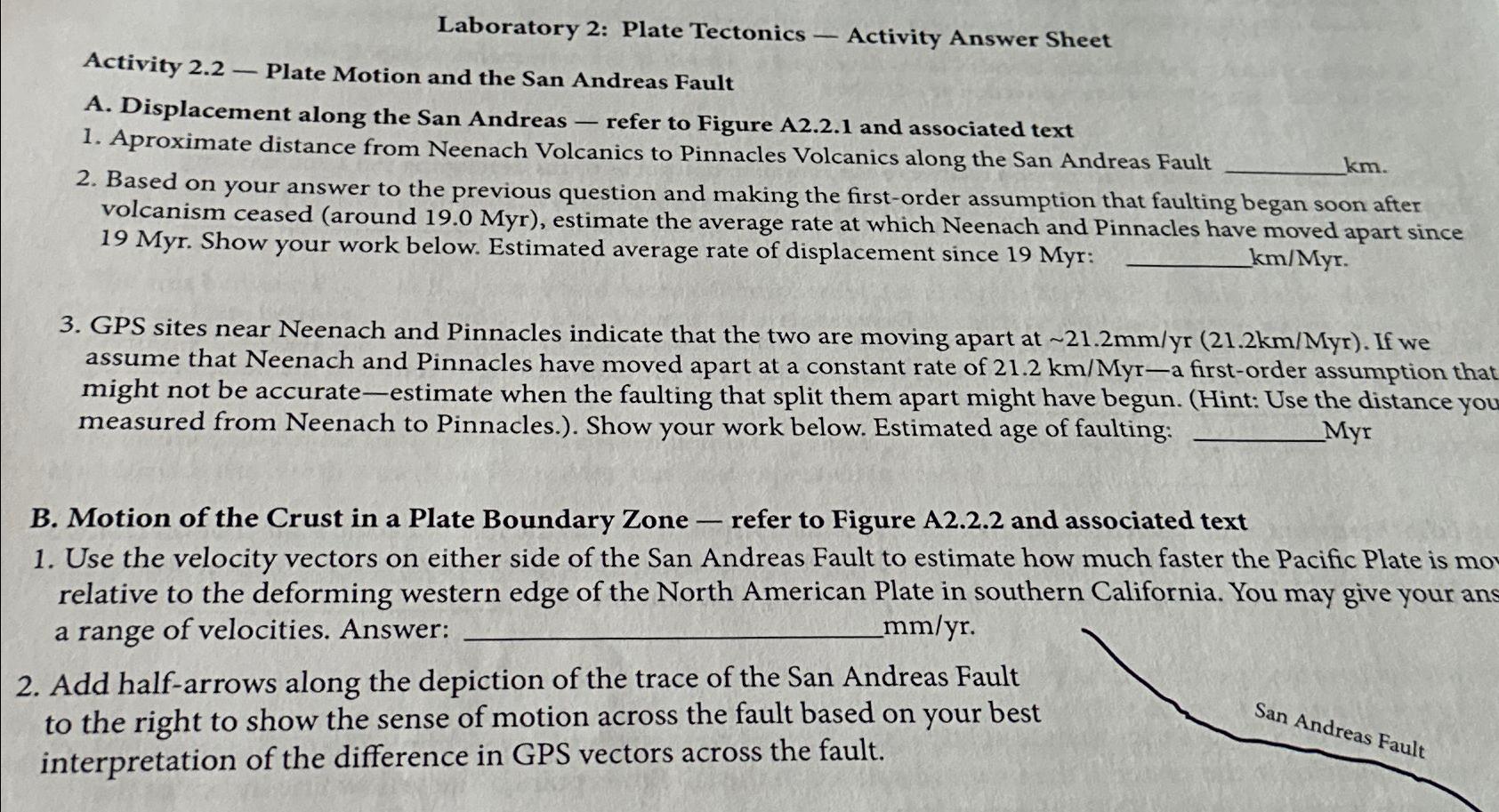
Activity 2.2 - Plate Motion and the San Andreas Fault A. Displacement along the San Andreas - refer to Figure A2.2.1 and associated text 1. Aproximate distance from Neenach Volcanics to Pinnacles Volcanics along the San Andreas Fault km. 2. Based on your answer to the previous question and making the first-order assumption that faulting began soon after volcanism ceased (around 19.0 Myr), estimate the average rate at which Neenach and Pinnacles have moved apart since 19 Myr. Show your work below. Estimated average rate of displacement since 19 Myr: km/Myr. 3. GPS sites near Neenach and Pinnacles indicate that the two are moving apart at 21.2mm/yr(21.2km/Myr). If we assume that Neenach and Pinnacles have moved apart at a constant rate of 21.2km/Myra first-order assumption that might not be accurate - estimate when the faulting that split them apart might have begun. (Hint: Use the distance you measured from Neenach to Pinnacles.). Show your work below. Estimated age of faulting: Myr B. Motion of the Crust in a Plate Boundary Zone - refer to Figure A2.2.2 and associated text 1. Use the velocity vectors on either side of the San Andreas Fault to estimate how much faster the Pacific Plate is mo relative to the deforming western edge of the North American Plate in southern California. You may give your ans a range of velocities. Answer: mm/yr. 2. Add half-arrows along the depiction of the trace of the San Andreas Fault to the right to show the sense of motion across the fault based on your best interpretation of the difference in GPS vectors across the fault
Step by Step Solution
There are 3 Steps involved in it

Get step-by-step solutions from verified subject matter experts
 Study Help