







Question: Language: C Project to start from (BisectionRootFinding.c): /*---------------------------------------------------- File: bisectionSearchSoln.c Description: Applies bisection root finding method. ------------------------------------------------------*/ #include #include #include gng1106plplot.h #define N 100 //
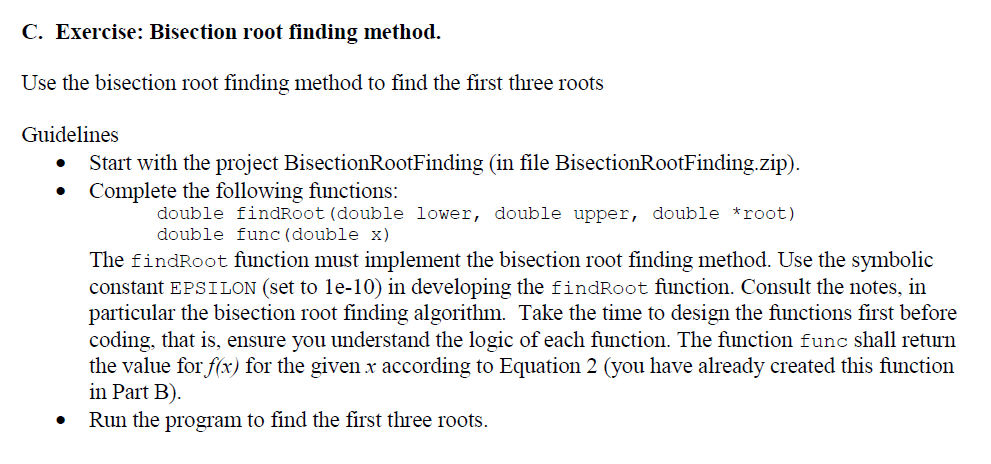
Language: C
Project to start from ("BisectionRootFinding.c"):
/*---------------------------------------------------- File: bisectionSearchSoln.c Description: Applies bisection root finding method. ------------------------------------------------------*/ #include
int findRoot(double lower, double upper, double *root) { // Complete this function } /*---------------------------------------------------------- Function: func Parameters: x - x value function f(x) Returns: value y of function f(x) Description: Plots the value of the function:
f(x) = 50 - x^2 |cos(sqrt(x)| , x must be positive, if x negative return 0. -----------------------------------------------------------*/ double func(double x) {
} /*---------------------------------------------------------- Function: findInterval Parameters: begin, end: pointers to double variables for storing selected begin and end values of x for the desired interval Description: Repeatedly plot the graph of the function for the intervals given by the user until the user has made a selection of the interval for root finding. ---------------------------------------------------------------*/ void findInterval(double *begin, double *end) { //Variables declarations char answer; // sentinal do { printf("Please give start and end values for plotting: "); fflush(stdin); scanf("%lf %lf",begin,end); plotFunc(*begin, *end, 0, NULL); printf("Are you happy with this interval: "); fflush(stdin); scanf("%c",&answer); } while(answer != 'y'); }
/*---------------------------------------------------------- Function: plotFunc Parameters: begin, end: beginning and end of interval (x values) to plot flag - set to TRUE when root was found and needs to be plotted root - value of root when flag is TRUE. Description: Plot the function on the interval between begin and end. Plots an x at the roots if nRoots > 0. ---------------------------------------------------------------*/ void plotFunc(double begin, double end, int nRoots, double roots[]) { double x[N]; double y[N]; double inc; // increment for incrementing x double yRoots[nRoots]; int ix; // Calculate function points inc = (end - begin)/N; x[0] = begin; y[0] = func(x[0]); // Compute first point for(ix = 1; ix
/*------------------------------------------------- Function: plot() Parameters: n: number of points in the arrays xPtr: pointer to x values (horizontal axis). yPtr: pointer to y values (vertical axis). Return value: none. Description: Initialises the plot. The following values in the referenced structure are used to setup the plot: x[0], x[n-1] - assume that x values are sequential miny, maxy - vertical axis range (add 10% to min/max value) Sets up white background and black forground colors. Then plots the curve accessed using xPtr and yPtr. -------------------------------------------------*/ void plot(int n, double *xPtr, double *yPtr, int nRoots, double *xRoots, double *yRoots) { double miny, maxy; double range; // range of vertical axix // Setup plot configuration plsdev("wingcc"); // Sets device to wingcc - CodeBlocks compiler // Initialise the plot plinit(); // Configure the axis and labels plwidth(3); // select the width of the pen // Find range for axis miny = getMin(yPtr, n); maxy = getMax(yPtr, n); range = maxy - miny; // the width of the range maxy = maxy + 0.1*range; miny = miny - 0.1*range; plenv0(xPtr[0], xPtr[n-1], miny, maxy, 0, 1); plcol0(GREEN); // Select color for labels pllab("x", "f(x)", "Function"); // Plot the velocity. plcol0(BLUE); // Color for plotting curve plline(n, xPtr, yPtr); // Plot the points if(nRoots > 0) { plcol0(RED); plpoin(nRoots,xRoots, yRoots, 'x'); } plend(); } /*---------------------------------------------------------- Function: getMin Parameters: array - reference to an array with double values n - number of elements in the array Returns min: the minimum value found in the array Description: Traverses the array to find its minimum value. ----------------------------------------------------------------*/ double getMin(double *array, int n) { int ix; double min = array[0]; for(ix = 1; ix array[ix]) min = array[ix]; return(min); }
/*---------------------------------------------------------- Function: getMax Parameters: array - reference to an array with double values n - number of elements in the array Returns max: the maximum value found in the array Description: Traverses the array to find its maximum value. ----------------------------------------------------------------*/ double getMax(double *array, int n) { int ix; double max = array[0]; for(ix = 1; ix
Step by Step Solution
There are 3 Steps involved in it

Get step-by-step solutions from verified subject matter experts
 Study Help