







Question: Language : C zip zip is a compression utility. The actual Unix zip utility supports a number of different compression algorithms, but we'll be using
Language : C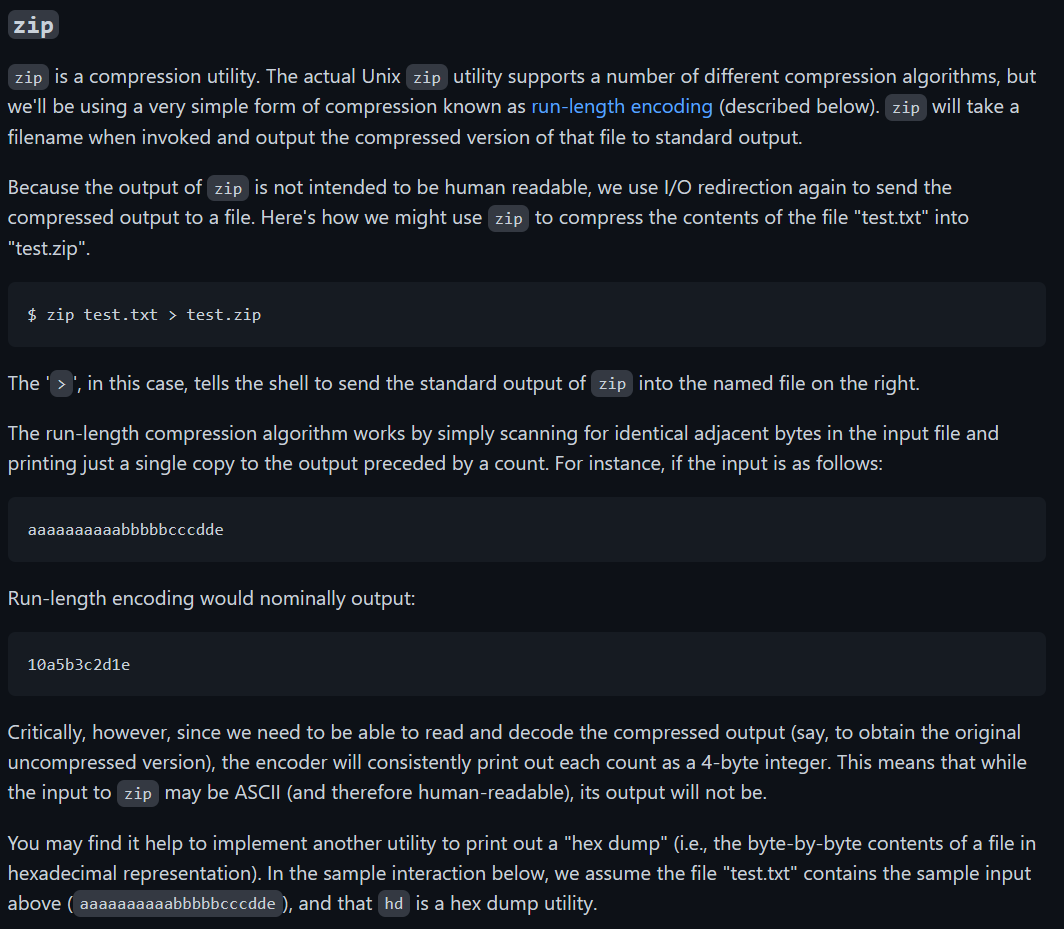
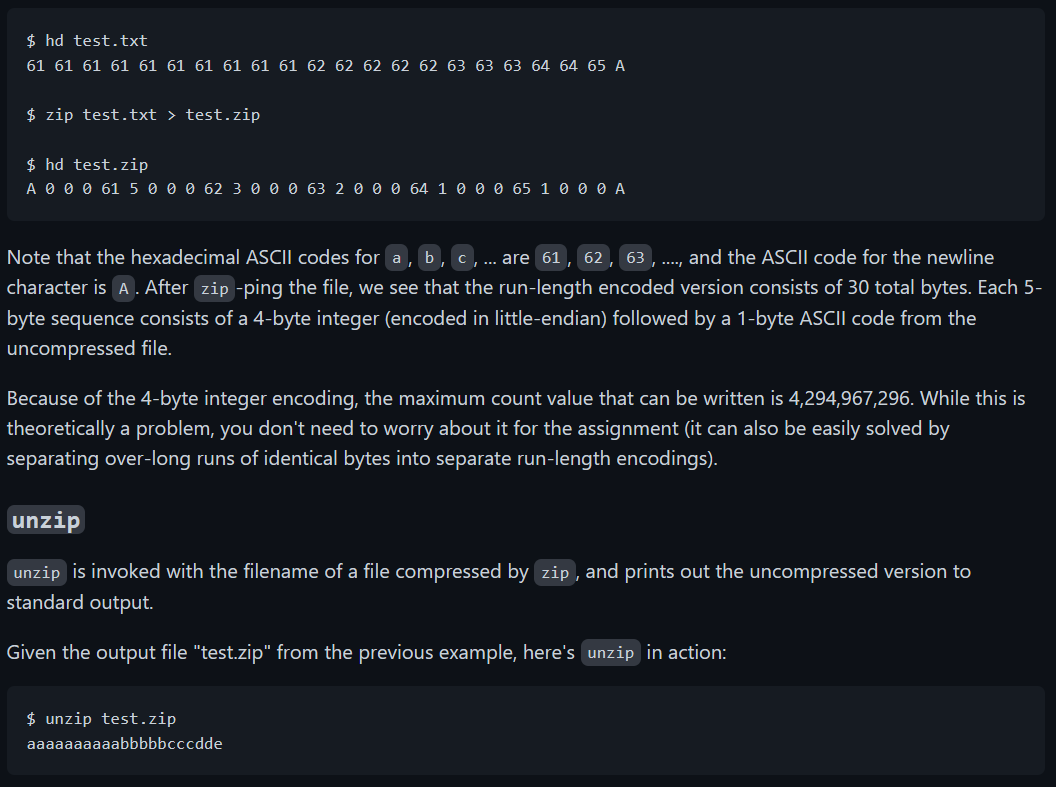
zip zip is a compression utility. The actual Unix zip utility supports a number of different compression algorithms, but we'll be using a very simple form of compression known as run-length encoding (described below). zip will take a filename when invoked and output the compressed version of that file to standard output. Because the output of zip is not intended to be human readable, we use I/O redirection again to send the compressed output to a file. Here's how we might use zip to compress the contents of the file "test.txt" into "test.zip". $ zip test.txt > test.zip The ' > ', in this case, tells the shell to send the standard output of zip into the named file on the right. The run-length compression algorithm works by simply scanning for identical adjacent bytes in the input file and printing just a single copy to the output preceded by a count. For instance, if the input is as follows: Run-length encoding would nominally output: Critically, however, since we need to be able to read and decode the compressed output (say, to obtain the original uncompressed version), the encoder will consistently print out each count as a 4-byte integer. This means that while the input to zip may be ASCII (and therefore human-readable), its output will not be. You may find it help to implement another utility to print out a "hex dump" (i.e., the byte-by-byte contents of a file in hexadecimal representation). In the sample interaction below, we assume the file "test.txt" contains the sample input above and that hd is a hex dump utility. Note that the hexadecimal ASCII codes for a,b,c, are 61,62,63,., and the ASCII code for the newline character is A. After zip-ping the file, we see that the run-length encoded version consists of 30 total bytes. Each 5 byte sequence consists of a 4-byte integer (encoded in little-endian) followed by a 1-byte ASCII code from the uncompressed file. Because of the 4-byte integer encoding, the maximum count value that can be written is 4,294,967,296. While this is theoretically a problem, you don't need to worry about it for the assignment (it can also be easily solved by separating over-long runs of identical bytes into separate run-length encodings). is invoked with the filename of a file compressed by zip, and prints out the uncompressed version to standard output. Given the output file "test.zip" from the previous example, here's in action: $ unzip test.zip
Step by Step Solution
There are 3 Steps involved in it

Get step-by-step solutions from verified subject matter experts
 Study Help