







Question: Language is C# and its in a windows application form You will add exception handling to your application created in part 3 Lab 4 the
Language is C# and its in a windows application form
You will add exception handling to your application created in part 3 Lab 4 the calculator. Exception handling helps you manage the state of the application after a try catch fails. Add a try-catch statement in the btnCalculate_Click event handler that will catch any exceptions that occur when the statements in that event handler are executed. If an exception occurs, display a dialog box with the error message, the type of error, and a stack trace. Test the application by entering a nonnumeric value for one of the operands. Add three additional catch blocks to the try-catch statement that will catch a FormatException, an OverflowException, and a DivideByZeroException. These catch blocks should display a dialog box with an appropriate error message.
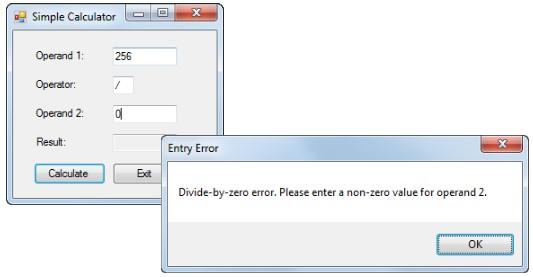
Output should look like:
Existing Code:
namespace frmTryCatch { public partial class Form1 : Form { public Form1() { InitializeComponent(); }
private void btnCalculate_Click_1(object sender, EventArgs e) { double x, y; string p; /* console input data at text boxes */ x = Convert.ToDouble(txtOp1.Text); y = Convert.ToDouble(txtOp2.Text); p = txtOperator.Text; /* call method with three arguments operand 1 (x), operand 2 (y), and operator (p). */ calculate(x, y, p);
}
/* define function */ void calculate(double a, double b, string op) { /* print result at label upto 4 decimal space for different operators */ if (op == "+") { txtResult.Text = Math.Round((a + b), 4).ToString(); } else if (op == "-") { txtResult.Text = Math.Round((a - b), 4).ToString(); } else if (op == "*") { txtResult.Text = Math.Round((a * b), 4).ToString(); } else if (op == "/") { txtResult.Text = Math.Round((a / b), 4).ToString(); } }
//closes the application private void btnExit_Click(object sender, EventArgs e) { this.Close(); }
//resets the form txt fields private void btnReset_Click(object sender, EventArgs e) { txtOp1.Text = ""; txtOp2.Text = ""; txtOperator.Text = ""; txtResult.Text = ""; }
}
}
Simple Calculator 256 Operand 1 Operator: / Operand 2 ol Result: Entry Error Calculate Excit Divide-by-zero error. Please enter a non-zero value for operand 2. OK
Step by Step Solution
There are 3 Steps involved in it

Get step-by-step solutions from verified subject matter experts
 Study Help