







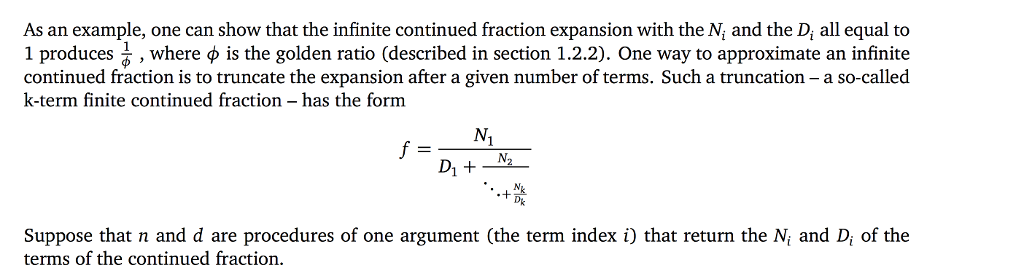
Question: **language is SCHEME** As an example, one can show that the infinite continued fraction expansion with the N; and the D; all equal to 1
**language is SCHEME**
As an example, one can show that the infinite continued fraction expansion with the N; and the D; all equal to 1 produces , where O is the golden ratio described in section 12.2). One way to approximate an infinite continued fraction is to truncate the expansion after a given number of terms. Such a truncation - a so -called k-term finite continued fraction has the form N, D , + Na Suppose that n and d are procedures of one argument (the term index i) that return the N; and D, of the terms of the continued fraction. As an example, one can show that the infinite continued fraction expansion with the N; and the D; all equal to 1 produces , where O is the golden ratio described in section 12.2). One way to approximate an infinite continued fraction is to truncate the expansion after a given number of terms. Such a truncation - a so -called k-term finite continued fraction has the form N, D , + Na Suppose that n and d are procedures of one argument (the term index i) that return the N; and D, of the terms of the continued fraction
Step by Step Solution
There are 3 Steps involved in it

Get step-by-step solutions from verified subject matter experts
 Study Help