







Question: large uses in CHAPTER 5.AGGREGATE SUPPLY AND DEMAND 119 prices Empirical ent of Earlier, we identified the 1973 OPEC oil embargo as a classical example
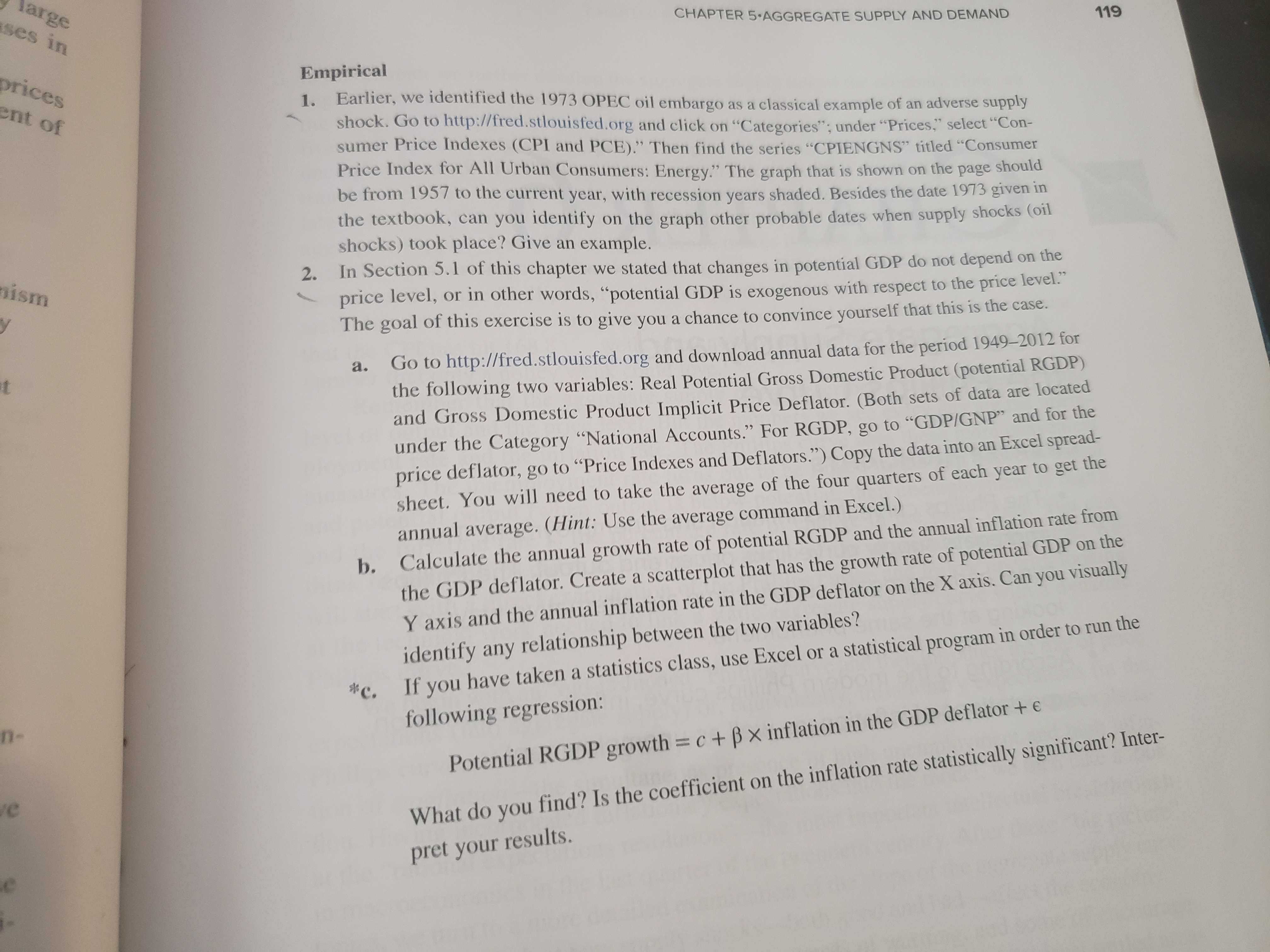
large uses in CHAPTER 5.AGGREGATE SUPPLY AND DEMAND 119 prices Empirical ent of Earlier, we identified the 1973 OPEC oil embargo as a classical example of an adverse supply shock. Go to http://fred.stlouisfed.org and click on "Categories"; under "Prices," select "Con- sumer Price Indexes (CPI and PCE)." Then find the series "CPIENGNS" titled "Consumer Price Index for All Urban Consumers: Energy." The graph that is shown on the page should be from 1957 to the current year, with recession years shaded. Besides the date 1973 given in the textbook, can you identify on the graph other probable dates when supply shocks (oil shocks) took place? Give an example . ism In Section 5.1 of this chapter we stated that changes in potential GDP do not depend on the price level, or in other words, "potential GDP is exogenous with respect to the price level." The goal of this exercise is to give you a chance to convince yourself that this is the case. a. Go to http://fred.stlouisfed.org and download annual data for the period 1949-2012 for the following two variables: Real Potential Gross Domestic Product (potential RGDP) and Gross Domestic Product Implicit Price Deflator. (Both sets of data are located under the Category "National Accounts." For RGDP, go to "GDP/GNP" and for the price deflator, go to "Price Indexes and Deflators.") Copy the data into an Excel spread- sheet. You will need to take the average of the four quarters of each year to get the annual average. (Hint: Use the average command in Excel.) . Calculate the annual growth rate of potential RGDP and the annual inflation rate from the GDP deflator. Create a scatterplot that has the growth rate of potential GDP on the Y axis and the annual inflation rate in the GDP deflator on the X axis. Can you visually identify any relationship between the two variables? . If you have taken a statistics class, use Excel or a statistical program in order to run the following regression: Potential RGDP growth = c + B X inflation in the GDP deflator + e What do you find? Is the coefficient on the inflation rate statistically significant? Inter- pret your results
Step by Step Solution
There are 3 Steps involved in it

Get step-by-step solutions from verified subject matter experts
 Study Help